SmartLivingNEXT lead project successfully completes first project quarter.
4. December 2023
Reading time:
4 minutes
The SmartLivingNEXT lead project provides the basis for the projects of the technology program and is thus working on a future-oriented smart living ecosystem. The interim results for the first quarter of the project are promising. Successes were achieved in the further development of Dataspace, the connection of basic services and the availability of building data.
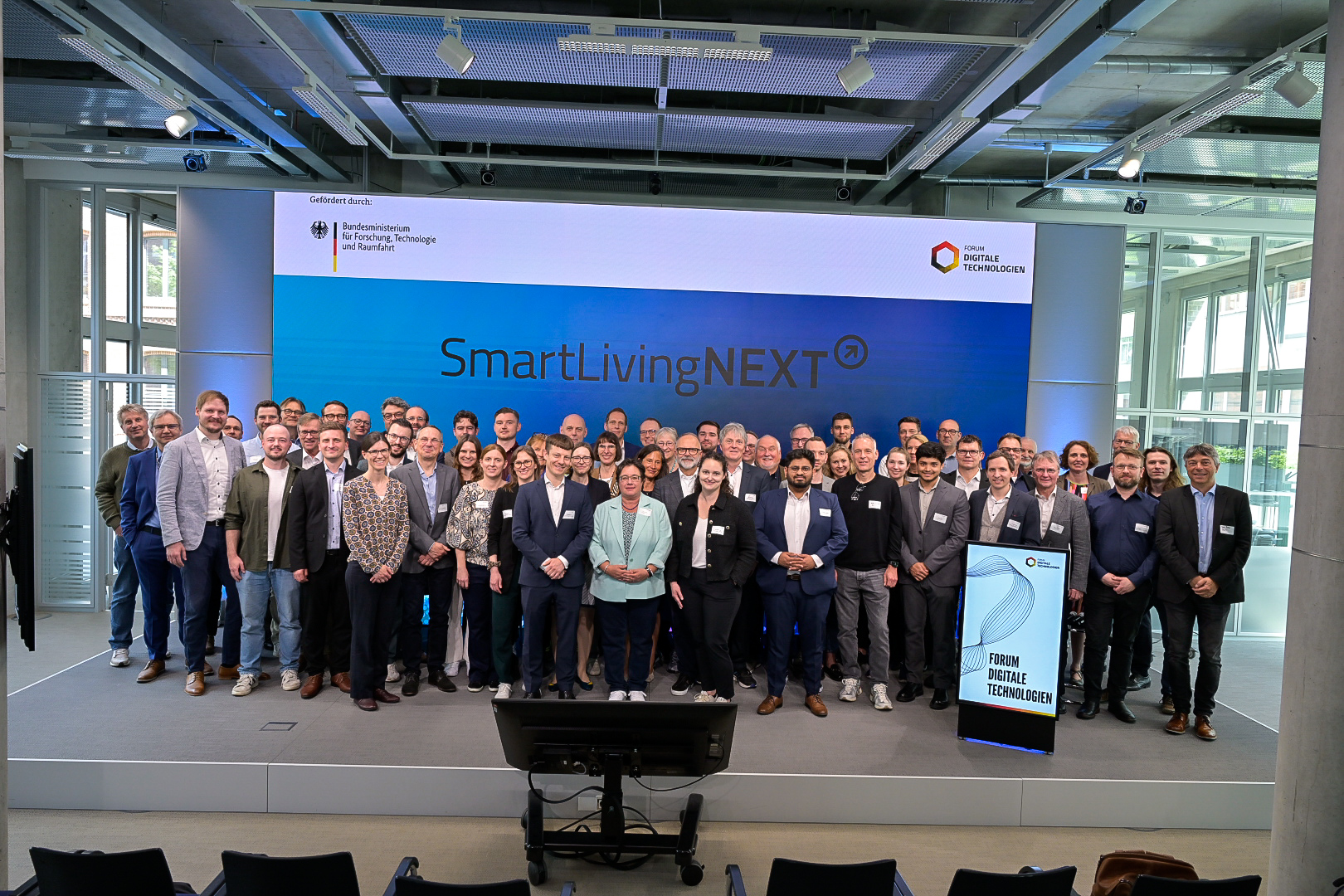
The third and fourth quarters of 2023 marked the start of the three-year research work for the SmartLivingNEXT flagship project. The kick-off meeting was held on September 7, 2023 at Materna in Berlin. The event was attended not only by representatives of all consortium partners, but also by the Federal Ministry of Economics and Climate Protection (BMWK) and the German Aerospace Center (DLR). The task from this meeting for the first quarter of the project was clear: in particular, the technical infrastructure had to be created in order to create a prototype of the data room and connect the first data sources by the end of 2023.
SmartLivingNEXT Dataspace: Prototype developed
At the beginning, the SmartLivingNEXT Dataspace was evaluated with regard to the technical, business and operational components and the options for the future governance structure were analyzed. A core criterion in the design of the ecosystem is the Gaia-X conformity of the dataspace. It is planned that other projects will be able to use this modular dataspace blueprint in whole or in part to set up their own dataspaces and that the SmartLivingNEXT dataspace will have connectors to all relevant building technologies and also plugins for smart home systems.
Dataspace equipped with basic services for training AI
The consortium partner German Research Center for Artificial Intelligence (DFKI) has provided a system architecture that can accommodate the first basic services. These are AI-enriched services for data preparation and data analysis that can be accessed by all other applications on the platform in the same way.
Developers and project managers from the various lead project consortium partners were also involved in building up the knowledge of the SmartLivingNEXT community. In the first quarter of 2024, a glossary and a white paper focusing on the technical and organizational onboarding of the dataspace will be made available on the SmartLivingNEXT website.
First milestone reached: heat forecasts possible
In the SmartLivingNEXT lead project, the practical suitability is demonstrated by two use cases. In the “sustainable energy management” use case, a data portal for cross-building energy efficiency and heat planning is being developed for the public sector. The Dataspace bundles data on the building fabric with real consumption data and thus enables a system with which housing and real estate companies can derive potential savings. The first milestone that has already been reached is the ability to carry out heat forecasts on the physical and technical properties of buildings based on the DIN 4108-6, DIN 4701-10 and DIN 18599 series of standards.
Conclusion of the first quarter in the SmartLivingNEXT lead project: with the prototypical setup of the Dataspace and the connection of the first basic services and building and energy data, the first step towards the planned Dataspace infrastructure has been completed. Further adjustments will be made in the coming quarter. In the future, the Dataspace Blueprint or parts of it can be used to develop your own intelligent services and applications.
Article in audio format (German only):
Editorial office:
Maximilian
Metzner
Category:
Flagship project

Central documents for SmartLivingNEXT
The white paper contains the guideline and reference framework for the future technical development of the SmartLivingNEXT Dataspace and the desired governance structure. It was created with the collaboration of teams from German Research Center for Artificial Intelligence (DFKI), the Research Association for Electrical Engineering at ZVEI e.V., Ludwig-Maximilians-Universität München (LMU) and Materna Information & Communications SE. You can have the white paper sent to you as a PDF. Please contact our project office at projektbuero@smartlivingnext.de.
The document is intended as a structuring investor perspective and orientation framework, not as a final business plan, and analyzes the possible roles of potential investors. It was written in collaboration with Michael Schidlack, Research Association for Electrical Engineering at ZVEI e.V., Dr. Rahild Neuburger, Ludwig-Maximilians-Universität München (LMU) and Lars Thomsen, future matters AG. You can have the document sent to you as a PDF. Please contact our project office at projektbuero@smartlivingnext.de.
Das Dokument erläutert im ersten Teil (Governance & Organisation) SmartLivingNEXT als föderiertes Datenökosystem und beschreibt die Rollen, Verantwortlichkeiten und Entscheidungslogiken. Der zweite Teil (technische Architektur & Datenraum) beschreibt, wie diese Governance technisch umgesetzt wird. Es entstand unter Mitwirkung von Michael Schidlack, Forschungsvereinigung Elektrotechnik beim ZVEI e.V., Dr. Rahild Neuburger, Ludwig-Maximilians-Universität München (LMU) und Fanni Vespermann, Materna Information & Communications SE. Sie können sich das Dokument als PDF zusenden lassen. Please contact our project office at projektbuero@smartlivingnext.de.