“Europe has the know-how, the technologies and well-trained specialists to build digital sovereignty.”
30. April 2025
Reading time:
8 minutes
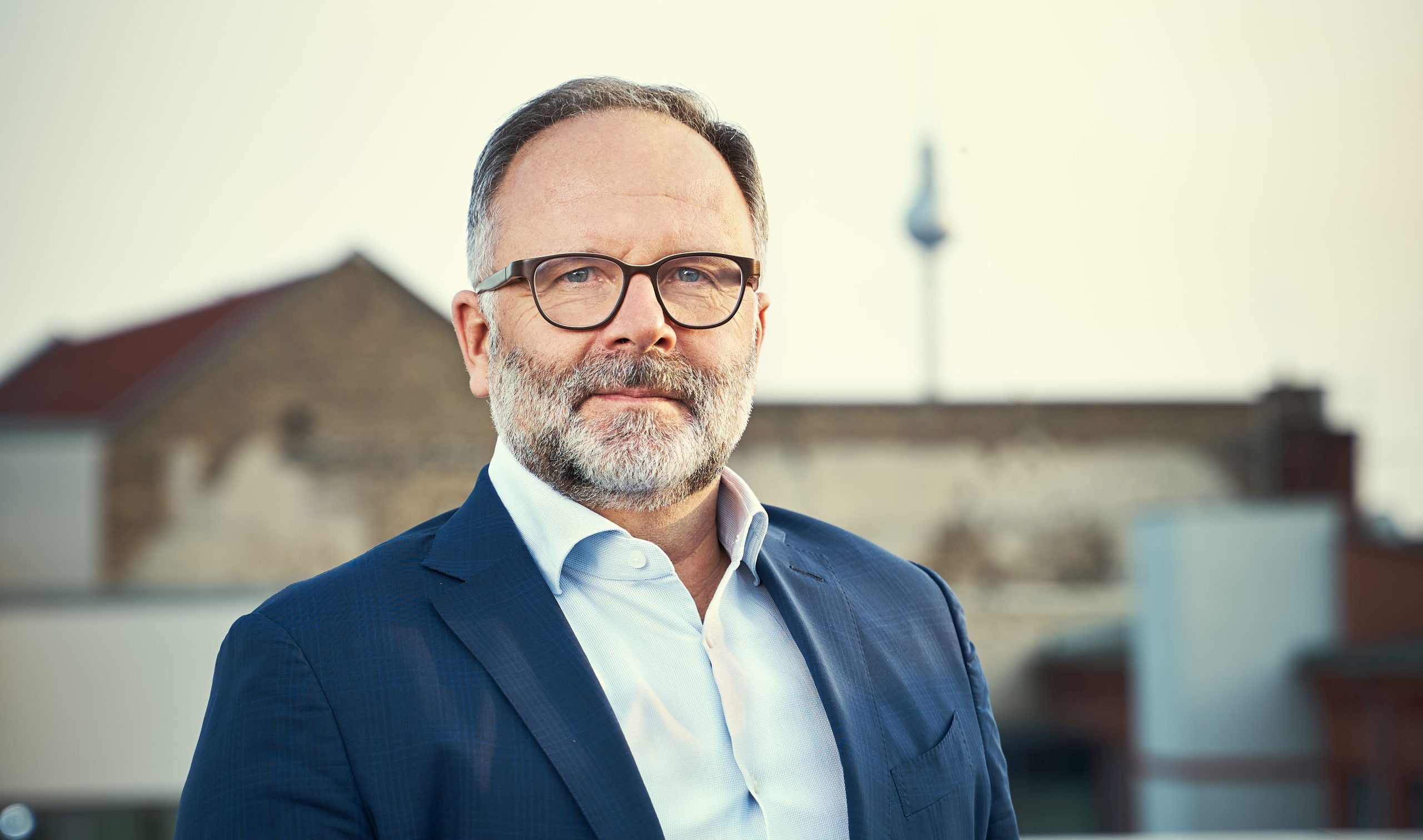
The digital sovereignty of Germany and Europe is gaining new relevance due to current global political events – especially in the digitalization of critical infrastructures (KRITIS). Important and sensitive data is also generated in residential buildings every day. In this interview, Michael Schidlack, Principal Researcher at the Research Association for Electrical Engineering (FE) at ZVEI e. V. and consortium leader in SmartLivingNEXT flagship project, explains how important data sovereignty is for Europe and what role SmartLivingNEXT plays in this.

Mr. Schidlack, the sovereignty of Germany and Europe is gaining new relevance due to current global political developments such as the current uncertainty surrounding the transatlantic data protection agreement. How would you categorize this development in relation to the SmartLivingNEXT research project?
Global political developments, especially the uncertainties surrounding the transatlantic data protection agreement, underline the importance of research projects such as SmartLivingNEXT, which aim to achieve European data sovereignty. The technology programme, funded by the Federal Ministry for Economic Affairs and Climate Protection (German Federal Ministry for Economic Affairs and Climate Action (BMWK)) with 25 million euros, aims to ensure that control over the data remains with the data producers and with trusted European organizations. By providing non-discriminatory and secure access to data, the technology reduces dependence on dominant non-European companies. This creates the conditions for keeping value creation in Germany and generating particularly secure data traffic. To our knowledge, Germany is taking on a special pioneering role in the digitalization of residential buildings through this project. The introduction of SmartLivingNEXT marks a milestone in the development of the smart living ecosystem realized according to European values and also takes the interests of building residents into account to a large extent.
What exactly does the SmartLivingNEXT technology program offer as a solution to these problems?
Our novel conceptual approach allows data to remain in their respective original systems and still be linked on a logical level. As a result, digital service providers and manufacturers of physical components can generate new intelligent applications in the smart living ecosystem by linking data. This also creates an industry solution that meets the requirements of the EU Data Act. This is done by allowing authorized persons or organizers to use the data generated in their systems for predefined purposes.
The concept provides for market participants to be networked on an equal and non-discriminatory basis. The usual model of a dominant platform provider to which all other participants have to submit is no longer applicable. The result is a scalable and low-threshold offer to participate as a provider or consumer of data or services and to benefit from it. Participants retain permanent control over their data.
Are there other advantages apart from the aspect of European sovereignty?
With SmartLivingNEXT, we are creating a kind of national access point to all relevant data from residential buildings. This primarily concerns the areas of energy, home comfort, security solutions, maintenance of building technology and home care. This standardized access point can create significantly more efficient digital services.
Tenants and owners of residential buildings thus receive additional services to improve their everyday lives, their health and safety as well as an increased quality of life and they benefit from cost savings through efficiency gains. Housing providers can access improved building management and maintenance services. Public utilities, local authorities and external service providers such as care staff benefit from increased transparency regarding actual progress and consumption data, which makes their processes more efficient and leads to further cost savings. Acceptance by end users is ensured through compliance with data protection requirements. A not insignificant point is that the work of specialist planners and tradespeople is also made easier, as the issue of interoperability between different systems is solved once and for all by merging the data in Dataspace.
Many companies are reluctant to switch because they fear that European solutions are less efficient. What is the situation with SmartLivingNEXT?
The fear that European solutions could be less efficient is clearly refuted by SmartLivingNEXT and its partners. The research project demonstrates that European technologies are not only competitive, but also forward-looking. SmartLivingNEXT is based on state-of-the-art technologies. It opens up enormous scaling potential for German companies. The prototype application examples already successfully implemented via our satellite projects show that European solutions are not only technically convincing, but are also successful in practice. Another key aspect is the openness of the system: the project consistently relies on the use of open standards and not on proprietary technologies.
Overall, SmartLivingNEXT shows that European solutions are efficient, future-oriented and sustainable. Companies participating in the project not only strengthen their competitiveness, but also benefit from a secure, flexible and innovative data ecosystem.
Many companies argue that such independence is difficult to achieve. What is your response to this?
Of course it is a challenge, but it can be solved. Europe has the know-how, the technologies and well-trained specialists to build digital sovereignty. With SmartLivingNEXT, we are showing that it can actually be done. It offers companies a secure platform to integrate their technologies without losing control of their data. Targeted support and innovative solutions reduce dependence on dominant platforms and create a sustainable, economically viable and, above all, resilient alternative. Companies that switch to such solutions now will benefit in the long term, but should tackle this promptly.
Another point that companies often raise is the issue of interoperability: what is SmartLivingNEXT actually doing to ensure seamless integration and make it easier for companies to get started or switch over?
SmartLivingNEXT relies on open standards and semantics suitable for residential environments as well as SENSE WoT. The ecosystem offers easy-to-use connectors and basic AI services. This enables companies to retain their existing technologies while seamlessly integrating them into the ecosystem. Onboarding into the dataspace via Blueprint and the provision of an open source repository makes it easier to get started and ensures interoperability. This has been confirmed several times: our partners report that connecting to the Dataspace is easy.
This means that manufacturers do not have to make any far-reaching changes to their systems. They can continue to pursue their existing technological approaches and still open up to new services that emerge in this ecosystem. A marketplace for data is being created, as it were, which is superimposed on the proven systems.
Finally, Mr. Schidlack: Do you believe that Europe can sustainably strengthen its digital sovereignty with research projects such as SmartLivingNEXT and what can industry contribute to this?
Definitely yes! Through projects such as SmartLivingNEXT, Europe can strengthen its digital sovereignty in the long term and position itself to be resilient. Through investment, the development of interoperable technologies and the active use of such platforms, industry can help to safeguard European values such as data protection and data sovereignty and drive forward the digital transformation.
Listen to the article (in German):
Editorial office:
Ilka
Klein
Category:
Flagship project
SmartLivingNEXT
Copyright information
Tim Wulf Photography

Central documents for SmartLivingNEXT
The white paper contains the guideline and reference framework for the future technical development of the SmartLivingNEXT Dataspace and the desired governance structure. It was created with the collaboration of teams from German Research Center for Artificial Intelligence (DFKI), the Research Association for Electrical Engineering at ZVEI e.V., Ludwig-Maximilians-Universität München (LMU) and Materna Information & Communications SE. You can have the white paper sent to you as a PDF. Please contact our project office at projektbuero@smartlivingnext.de.
The document is intended as a structuring investor perspective and orientation framework, not as a final business plan, and analyzes the possible roles of potential investors. It was written in collaboration with Michael Schidlack, Research Association for Electrical Engineering at ZVEI e.V., Dr. Rahild Neuburger, Ludwig-Maximilians-Universität München (LMU) and Lars Thomsen, future matters AG. You can have the document sent to you as a PDF. Please contact our project office at projektbuero@smartlivingnext.de.
Das Dokument erläutert im ersten Teil (Governance & Organisation) SmartLivingNEXT als föderiertes Datenökosystem und beschreibt die Rollen, Verantwortlichkeiten und Entscheidungslogiken. Der zweite Teil (technische Architektur & Datenraum) beschreibt, wie diese Governance technisch umgesetzt wird. Es entstand unter Mitwirkung von Michael Schidlack, Forschungsvereinigung Elektrotechnik beim ZVEI e.V., Dr. Rahild Neuburger, Ludwig-Maximilians-Universität München (LMU) und Fanni Vespermann, Materna Information & Communications SE. Sie können sich das Dokument als PDF zusenden lassen. Please contact our project office at projektbuero@smartlivingnext.de.