Sustainable financing model for the building sector
3. December 2025
6 minutes
On November 20, 2025, SmartLivingNEXT presented a decisive step into the future of the digital building world at the Gaia-X Summit in Porto, Portugal: the blueprint for a sustainable financing model that will enable the transition from the research phase to the market phase from August 2026. As part of the so-called Economic Theater, Filip Milojkovic, Team Leader Data Management & AI at Materna Information & Communications SE, gave a high-profile panel of experts a deep insight into the next development steps of the project and explained how SmartLivingNEXT can be scaled after the end of the funding phase.
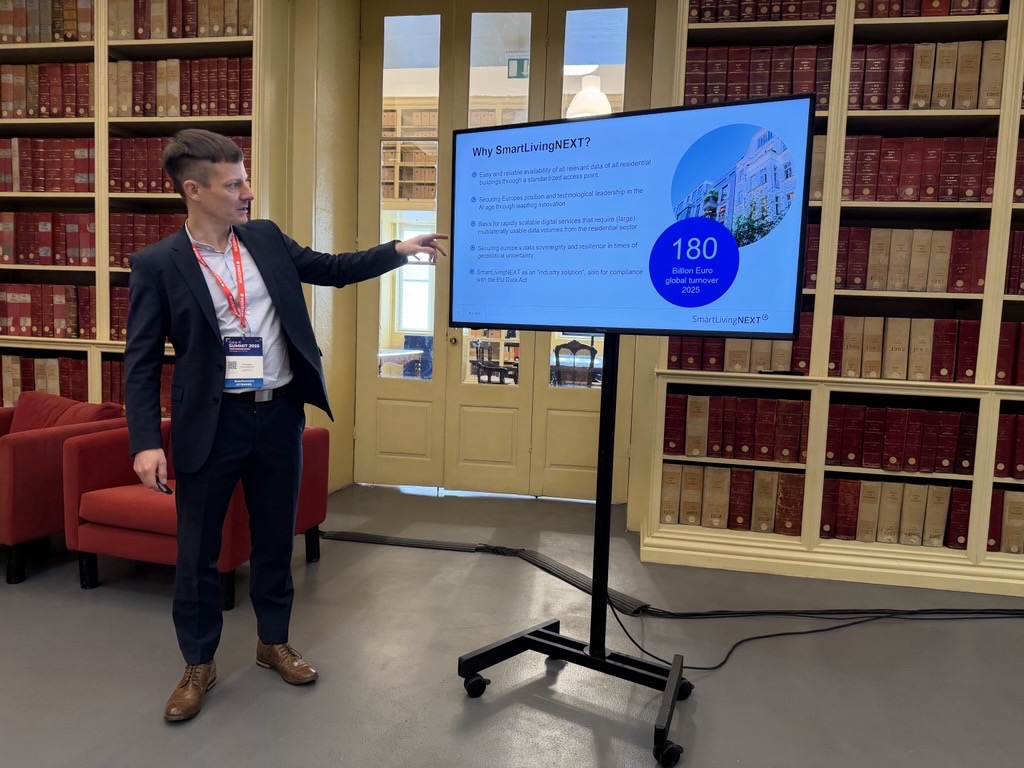
In his role as project manager at Materna and consortium partner of the SmartLivingNEXT flagship project, Milojkovic explained the research project and the associated potential of intelligent smart living services for future living environments. SmartLivingNEXT aims to strengthen Europe with an open and sovereign data ecosystem for buildings, energy and smart services. Milojkovic explained how the transition from isolated solutions to an interoperable, AI-supported reality is being implemented and how this can lead to genuine digital business models for the building and energy industry. The SmartLivingNEXT blueprint not only shows how the technical operation is secured, but also how the project makes the industry more independent in the long term.
Michael Schidlack, Principal Researcher at the Research Association for Electrical Engineering (FE) at ZVEI e. V. and consortium leader of the SmartLivingNEXT flagship project, emphasized in the subsequent discussion: “Europe needs its own, open and sovereign data ecosystem for buildings, energy and smart services. This is exactly what we are building with SmartLivingNEXT – a trustworthy, European data ecosystem that gives companies full control over their data and makes them independent of dominant platform structures. Our financing model is a decisive step towards achieving this goal: It is based on a democratic and sustainable approach that involves all stakeholders on an equal footing and ensures long-term stability.”
The economic foundation for the digital future of living
The financing of SmartLivingNEXT is divided into several phases, with both public funding and contributions from shareholders and technical operators playing a central role. In the research phase (2023 to 2026), the Federal Ministry of Research, Technology and Space (BMFTR) has provided funding of 25 million euros, which covers the development of the blueprint, the development of a governance structure and integration and test environments, among other things. In the operational phase, financing will be provided by shareholder contributions, contractually bound technical operators and possible transitional financing by the state, particularly in the areas of coordination and infrastructure.
The governance and financial model developed by LMU Munich is based on a hybrid approach that combines basic membership fees and usage-based components. Transaction fees are not initially planned, but the introduction of a freemium model should be possible at a later date. Public support is required during the transition phase in order to stabilize operations. Milojkovic: “Our goal is to ensure cost-covering financing, with the aim of breaking even at around 400 participants. During the operating phase, financing will be supplemented by membership fees, user fees and possible certification fees.” Materna has already developed the blueprint. LMU recommends the establishment of a limited liability company in the operating phase. Around 100 participants should come on board in the first three years, with a planned expansion to around 400 participants by the break-even point. This is the first step towards scaling the project across Europe.
A sustainable operating model for more innovation and less dependency
For Michael Schidlack, the development of a transparent and flexible cost structure is a key element: “A sustainable operating model for SmartLivingNEXT can be based on a hybrid approach: tiered membership fees secure the basic structure, usage-based billing ensures fairness and scalability, and a data-based marketplace opens up additional sources of revenue. We place particular emphasis on developing trustworthy licenses and governance models that ensure long-term success.”
The aim is not to make short-term profits, but to strengthen the entire smart living industry in the long term: less dependence on proprietary systems, more freedom to innovate and increased value creation through access to and control over data. “Our concept aims to connect market participants on an equal footing and enable them to act as providers or consumers of data or services. They always retain control over their data,” explained Schidlack.
The road to scale: A European data ecosystem for the future
The SmartLivingNEXT Blueprint already shows concrete steps towards a scalable European data ecosystem. “Today, we are entering the next dimension in Porto,” says Milojkovic. “From a research project to a scalable European ecosystem, from isolated solutions to interoperable, AI-supported reality and from theory to real digital business models for the building and energy industry.”
By developing the cost structure, SmartLivingNEXT is laying the foundations for a sustainable economic basis for the data room. The goal is not a short-term return on investment, but a long-term benefit for the entire smart living industry: more freedom to innovate, less dependence on proprietary systems and more value creation through data. According to LMU, the current state of work shows that a hybrid financing model can achieve this balancing act. However, this requires a shared understanding of responsibility and benefits. Companies that participate in the project not only strengthen their competitiveness, but also benefit from a secure, flexible and innovative data ecosystem.
The 6th edition of the Gaia-X Summit took place on November 20 and 21 in Porto, Portugal, in partnership with the Gaia-X Hub Portugal, led by TICE.PT and Porto Digital. This year’s event was themed “Digital Ecosystems in Action” and featured discussions on AI and data sovereignty. Visible data space initiatives were presented, using Gaia-X to drive innovation across Europe and beyond.
Listen to the article (in German):
Editorial office:
Ilka
Klein
Category:
Flagship project