Clear signal for continuation: SmartLivingNEXT on the way to real operation
19. February 2026
Reading time:
12 minutes
How can a sovereign, interoperable data space enable the scaling of digital business models in the building sector? And what role do artificial intelligence (AI), clear governance structures, financing models and specific use cases play in this? These questions were the focus of the preview of the SmartLivingNEXT data room portal.
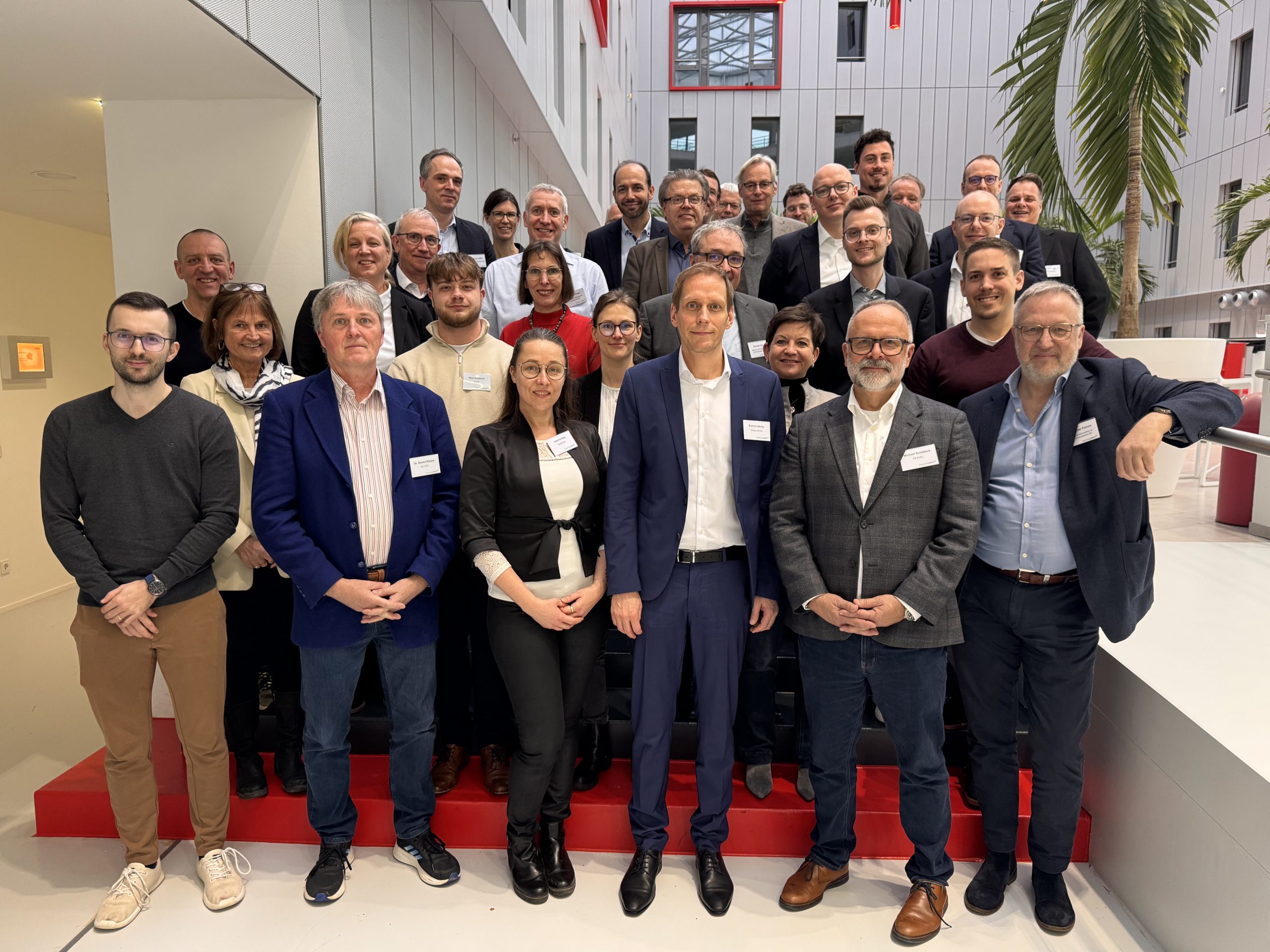
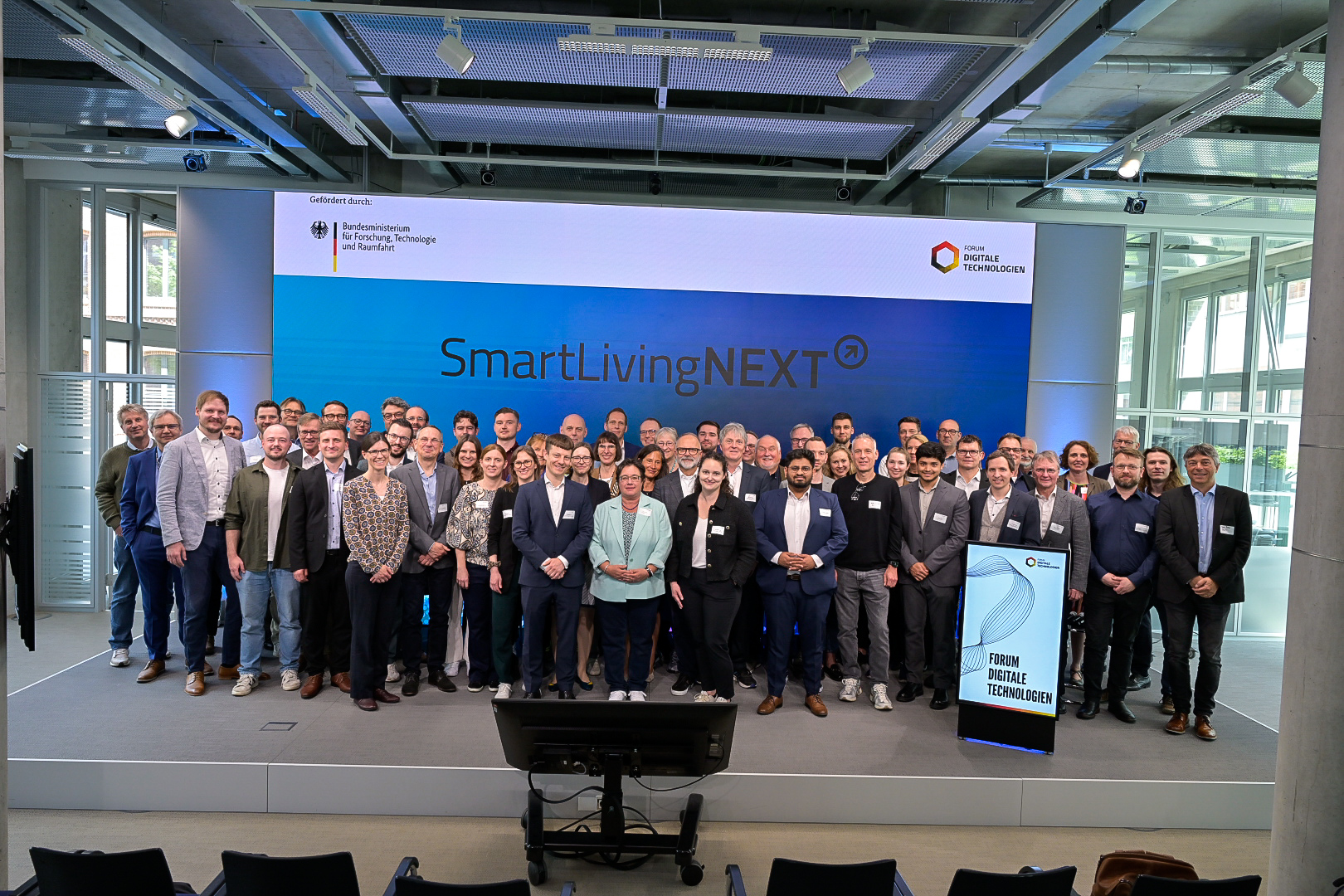
On February 12, 2026, around 40 representatives from industry, the housing sector, associations, the digital economy, architecture, research and start-ups as well as application projects came together at the House of Logistics and Mobility (HOLM) in Frankfurt am Main to discuss the current status of the data ecosystem, its strategic classification and the next steps in real operation. To kick off the event, Michael Schidlack, Principal Researcher at the Research Association for Electrical Engineering (FE) at ZVEI e. V. and consortium leader in the SmartLivingNEXT flagship project, welcomed all participants. In his introduction, he emphasized the special nature of the event for all participants and explained the objective of the research project: to create a European and user-centric data ecosystem for buildings, energy and smart services as a basis for AI, innovation, scaling and digital sovereignty.
Lars Thomsen, founder and Chief Futurist of future matters AG, then took over the strategic classification in larger technological and social developments and showed why cross-sector data ecosystems are a key lever for future viability. In the building sector in particular, there is enormous potential in sharing data securely and evaluating it intelligently, for example to increase efficiency, for new services or resilient business models. Thomsen attached particular importance to the role of artificial intelligence, which is evolving from purely digital applications to physical AI: with smart devices, networked buildings and infrastructures that learn and interact independently. Thomsen placed SmartLivingNEXT in precisely this context: as an answer to the question of how technological excellence, European values and social benefits can be brought together. An open, secure and European data ecosystem is the prerequisite for turning visions into marketable, trustworthy solutions.
Focus on use cases: Where do concrete benefits arise?
In the subsequent use case block, it became clear how practical and scalable the SmartLivingNEXT ecosystem already is today. Tobias Hensel from wowiconsult GmbH used a live demo to show how intelligent data aggregation can create concrete added value for the housing industry. A web-based platform can be used to combine previously isolated building data, evaluate energy data in a standardized way and automatically calculate efficiency indicators. This means that refurbishment options can be simulated based on data and investment decisions can be made on a more informed basis. Hensel: “By connecting to the SmartLivingNEXT data room, data silos are overcome, projects can be scaled more quickly and new target groups can be reached.”
Dr. Hilko Hoffmann from German Research Center for Artificial Intelligence (DFKI) used the Dudopark in Saarbrücken to demonstrate how AI agents will be able to create complex energy forecasts with just a few simple commands in the future. Intelligent background mapping is used to contextually understand and automatically analyze building data. SmartLivingNEXT acts as a digital infrastructure, as quality-assured data is provided interoperably and AI agents can access it in a scalable manner.
Tobias Quickert from Materna Information & Communications SE then presented the Energy Efficiency Data Portal (EEDP) as a business enabler. It brings together energy and building data from public and proprietary sources and uses standardized AI modules to derive specific measures, such as load forecasts, refurbishment indices or CO₂ savings potential. The EEDP reduces technical complexity, facilitates compliance and enables service providers to enter the market more quickly. “Our research project may not result in a finished product, but it does provide proof that a federated, AI-supported energy infrastructure works economically and technically,” concludes Quickert.
Satellite projects in dialog: From a single use case to a scalable ecosystem
The dialog format with the satellite projects ExpliCareNEXT and GAiST offered a special insight into the practical impact of SmartLivingNEXT. Satellite projects develop independent, application-oriented solutions, but consistently think them through in the context of the shared SmartLivingNEXT data space. They thus exemplify the transition from isolated use cases to a scalable, investable ecosystem. In the discussion, moderated by Michael Schidlack, Enrico Löhrke, ExpliCareNEXT, and Nizar Müller, GAiST, explained what drives them personally and why their projects are particularly effective when they interact with a federated data space.
Both projects address specific challenges in the care and nursing context and are already demonstrating measurable benefits in everyday life. GAiST focuses in particular on the intelligent use of building data to support care and operational processes. ExpliCareNEXT, on the other hand, demonstrates how data-based services can create transparency, simplify processes and improve the quality of care and support. However, both project partners believe that the decisive lever lies in the SmartLivingNEXT data room itself. Only through a shared, trustworthy data infrastructure can the developed solutions be scaled beyond individual locations or project constellations. SmartLivingNEXT enables data to be shared confidently, AI-supported applications to be further developed and new stakeholder groups to be integrated, far beyond bilateral collaborations.
This also makes the data room economically relevant: While individual use cases often remain project-specific, SmartLivingNEXT creates the conditions for repeatability, connectivity and investability. For Nizar Müller, this is precisely the difference between a good individual solution and a viable market model. Enrico Löhrke therefore issued a clear invitation to organizations that are still hesitant today: anyone who wants to think long-term about digital business models in the building sector and in the health and care industry should get actively involved in SmartLivingNEXT at an early stage, not just as a user, but as a co-creator of a shared ecosystem.
Preview of the data room portal: transparency and interoperability
Fanni Vespermann and Thomas Feld, both from Materna Information & Communications SE, presented the SmartLivingNEXT data room portal as a central part of the program. The participants were given an insight into the architecture, functionalities and target image of the portal, which serves as a central access point for players in the SmartLivingNEXT ecosystem. The focus was on interoperability, user-friendliness and connectivity with existing European data room initiatives. The data room portal (DRP) gave a concrete impression of how administration in the SmartLivingNEXT ecosystem can be structured and made user-friendly in the future. At its core, the DRP acts as a user interface for administration, both for the user’s own organization (such as companies or associations) and for the data and services offered by this organization. The presentation focused on practical functions such as the onboarding of new participants, the structured setup of data offerings and the administration of policies and contracts. These administrative processes in particular are considered complex and error-prone in federated data rooms. This is where the DRP comes in: It guides organizations through the implemented workflows using clearly structured forms and supports each step with explanatory help texts. The DRP makes administration much easier and minimizes operating errors.
The portal not only reduces technical complexity, but also creates transparency and legal certainty when dealing with data releases and terms of use. Policies and contracts can be created, managed and adapted in a traceable manner, a central building block for trust and governance in the data ecosystem. As part of the SmartLivingNEXT blueprint, the data room portal is available to all participating organizations. It thus forms a connecting administrative level in the ecosystem and ensures that technical infrastructure, governance requirements and practical usability interact systematically.
Organization, governance and profitability
Rahild Neuburger from Ludwig-Maximilians-Universität München (LMU) gave a compact overview of the economic and organizational foundation of SmartLivingNEXT. She explained the financial and governance model developed by her team, which is intended to ensure the long-term viability of the data ecosystem. The financing is structured in several stages: In the research phase (2023-2026), SmartLivingNEXT will receive around 25 million euros in funding from the Federal Ministry of Research, Technology and Space (BMFTR). A hybrid model combining basic membership fees with usage-based components is planned for the subsequent operating phase. Transaction fees are not initially planned, but a freemium model is possible in the future. The aim is to achieve a cost-covering structure with a break-even point of around 400 participating organizations.
In terms of organization, LMU recommends the establishment of an independent operating company (GmbH), which takes on the coordination and further development of the infrastructure as well as governance and compliance issues. Clear role models for data providers, data users, service providers and technical operators as well as transparent licensing and regulations ensure data sovereignty and trust. This is complemented by structured decision-making and participation processes that enable fair, non-proprietary further development of the ecosystem. This makes it clear that SmartLivingNEXT is not aiming for short-term profits, but for a sustainable, scalable data ecosystem as the basis for greater freedom of innovation, less dependence on proprietary systems and a stronger European smart living sector.
Outlook: Next steps in the SmartLivingNEXT ecosystem
In the concluding discussion round, moderated by Michael Schidlack, key findings were summarized and the next steps outlined. The preview of the data room portal marked an important milestone and also heralded the next phase: the further involvement of stakeholders, the consolidation of specific use cases and the gradual transfer to real operations, which will start in August of this year.
When it came to the question of continuation after the end of the project, all participants raised their hands. The common interest in continuing the work and starting real operations was clear. As a result, the SmartLivingNEXT data room has been successfully visualized as a concretely usable infrastructure, the economic added value of real use cases, in particular through the use of AI, has been comprehensibly presented and the transition from the research project to a sustainable real operation has been addressed in a structured manner. The project is therefore at a crucial point: it is less about the “whether” of a data room and more about the “how” of its further design and participation after the end of the research phase. “The data room is no longer being discussed as a vision, but is being demanded as a concrete infrastructure. Now it is important to jointly shape the transition to reliable real operation: with clear roles, governance and willingness to invest,” says Michael Schidlack.
Listen to the article (in German):
Editorial office:
Ilka
Klein
Category:
Flagship project
SmartLivingNEXT

Central documents for SmartLivingNEXT
The white paper contains the guideline and reference framework for the future technical development of the SmartLivingNEXT Dataspace and the desired governance structure. It was created with the collaboration of teams from German Research Center for Artificial Intelligence (DFKI), the Research Association for Electrical Engineering at ZVEI e.V., Ludwig-Maximilians-Universität München (LMU) and Materna Information & Communications SE. You can have the white paper sent to you as a PDF. Please contact our project office at projektbuero@smartlivingnext.de.
The document is intended as a structuring investor perspective and orientation framework, not as a final business plan, and analyzes the possible roles of potential investors. It was written in collaboration with Michael Schidlack, Research Association for Electrical Engineering at ZVEI e.V., Dr. Rahild Neuburger, Ludwig-Maximilians-Universität München (LMU) and Lars Thomsen, future matters AG. You can have the document sent to you as a PDF. Please contact our project office at projektbuero@smartlivingnext.de.
Das Dokument erläutert im ersten Teil (Governance & Organisation) SmartLivingNEXT als föderiertes Datenökosystem und beschreibt die Rollen, Verantwortlichkeiten und Entscheidungslogiken. Der zweite Teil (technische Architektur & Datenraum) beschreibt, wie diese Governance technisch umgesetzt wird. Es entstand unter Mitwirkung von Michael Schidlack, Forschungsvereinigung Elektrotechnik beim ZVEI e.V., Dr. Rahild Neuburger, Ludwig-Maximilians-Universität München (LMU) und Fanni Vespermann, Materna Information & Communications SE. Sie können sich das Dokument als PDF zusenden lassen. Please contact our project office at projektbuero@smartlivingnext.de.