“Data is the new gold!”
6. November 2024
Reading time:
5 minutes
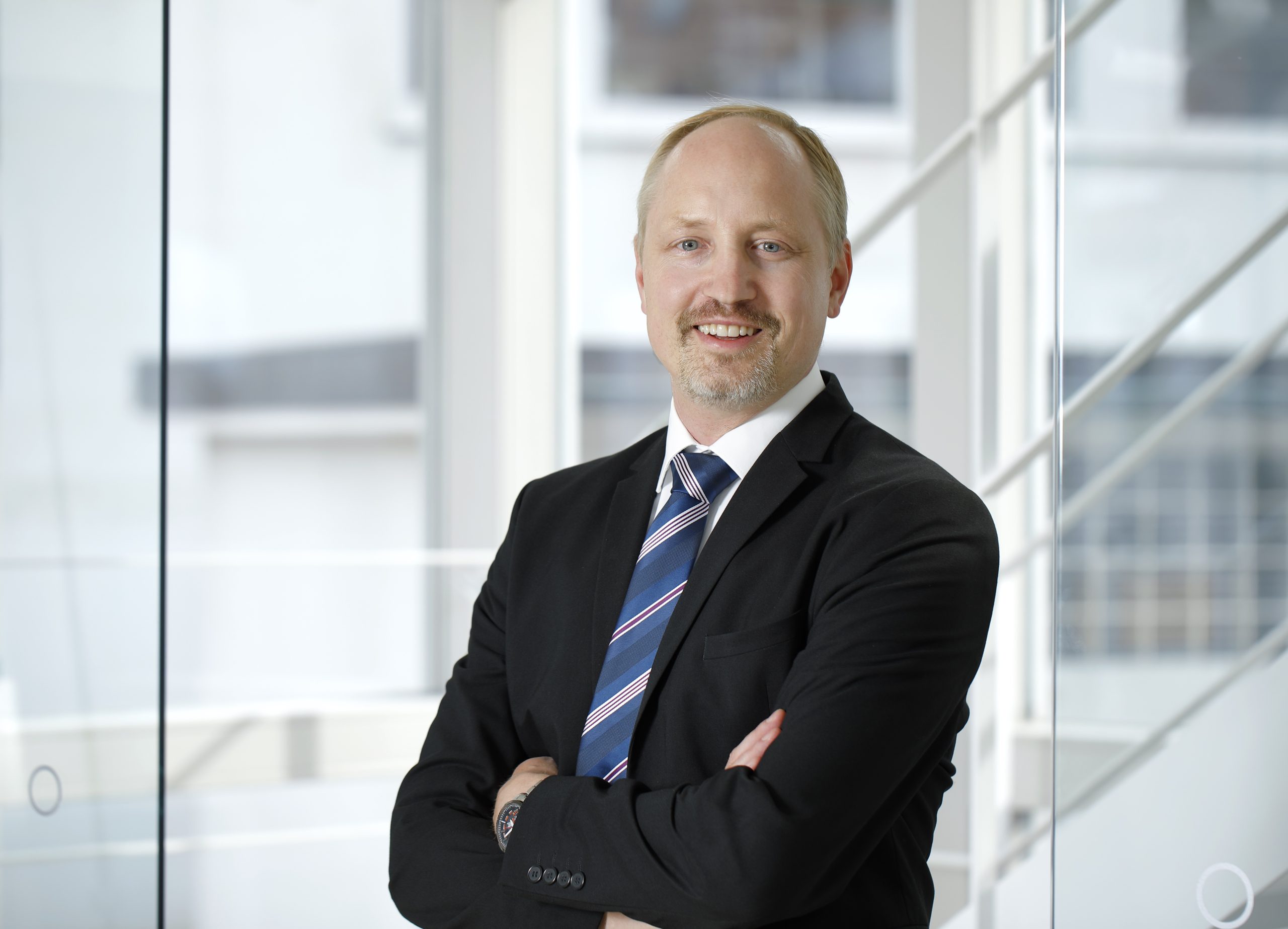
From video intercoms at the entrance to mobile door opening with a smartphone and networked communication systems: this is what Siedle, based in Furtwangen in the Black Forest, stands for. We talk to Christoph Weber, Managing Director Technology, about the opportunities and possibilities in building communication and the motivation behind the company’s involvement in SmartLivingNEXT.
Mr Weber, what impact do megatrends such as globalization and digitalization have on building technology?
They have a considerable impact. Globalization facilitates the exchange of technologies and expertise across national borders. This leads to a faster spread of innovative building concepts, technologies and
materials. Building projects are also increasingly being designed and realized by international planning teams. Companies must therefore adapt their products and services to global requirements and competitive situations.
Digitalization is also changing the way buildings are planned, constructed and operated. Intelligent building technologies enable the networking of trades and therefore a more efficient and transparent use of resources. Digital planning tools such as Building Information Modeling (BIM) promote more precise planning and execution of construction projects and also provide data for optimized building operation.
What importance do you think an open but secure data room will have for smart living data in the future?
An open data space for smart living data will play a role in the future once the business models for its operation and use have been clarified. The fact that data is referred to as the new gold shows the desirability that arises from the analysis of data. The business that is already being done with it today is impressively demonstrated by the stock market values of the so-called hyperscalers, which operate their business models based on the collected data.
It is an absolute must that a data room is also secure. Without compliance with the necessary security levels, further considerations are pointless. Important aspects that an open data room can offer are interoperability, personalization, innovation and sustainability.
As with ForeSight, Siedle is an associated partner in SmartLivingNEXT. What was the main reason for you to rejoin this joint project?
In an economic environment characterized by globalization and digitalization, a single medium-sized company can no longer cover all aspects holistically. If an optimized value chain used to be the only decisive factor for a company’s business model, in future it will also be a value creation network in which everyone contributes their expertise and skills to find the best possible solution for the various use cases – based on standardized interfaces. In the joint project, we see the opportunity for a corresponding exchange with other partners.
Let’s think back to the intelligent building doorman from the ForeSight project. The idea was that there would be intelligent interaction between the access system and other data, for example facial recognition or the presence of residents, with the aim of keyless and situation-dependent access control for relatives, service providers and care staff. This prototype has not yet made it into the real building environment. Do you think this can or should change in the future?
The success of the described use cases for the intelligent building doorman depends on two factors. Firstly, the necessary technical systems must be planned in during the building planning stage, with a view to the subsequent operation of the building. Secondly, the value of these use cases for users is of crucial importance and therefore a positive answer to the question of whether someone is prepared to pay money for this service. Which brings us back to the question of the open data space and the associated clarification of business models.
What other advantages would you be able to discover for yourself after the introduction of SmartLivingNEXT in the market phase?
It is the networking and open exchange with other companies involved in the construction and operation of buildings with innovative technology. For example, user feedback is a very interesting factor that can be incorporated into the further development of products. In addition, the collaboration results in new models for the future, which in turn can provide impetus for our own activities. Ultimately, we want to solve the challenges of the future together and have found a suitable cross-manufacturer platform in SmartLivingNEXT.
Mr. Weber, thank you for the interview!
Listen to the article (in German)
Editorial office:
Ilka
Klein
Category:
Flagship project
SmartLivingNEXT

Central documents for SmartLivingNEXT
The white paper contains the guideline and reference framework for the future technical development of the SmartLivingNEXT Dataspace and the desired governance structure. It was created with the collaboration of teams from German Research Center for Artificial Intelligence (DFKI), the Research Association for Electrical Engineering at ZVEI e.V., Ludwig-Maximilians-Universität München (LMU) and Materna Information & Communications SE. You can have the white paper sent to you as a PDF. Please contact our project office at projektbuero@smartlivingnext.de.
The document is intended as a structuring investor perspective and orientation framework, not as a final business plan, and analyzes the possible roles of potential investors. It was written in collaboration with Michael Schidlack, Research Association for Electrical Engineering at ZVEI e.V., Dr. Rahild Neuburger, Ludwig-Maximilians-Universität München (LMU) and Lars Thomsen, future matters AG. You can have the document sent to you as a PDF. Please contact our project office at projektbuero@smartlivingnext.de.
Das Dokument erläutert im ersten Teil (Governance & Organisation) SmartLivingNEXT als föderiertes Datenökosystem und beschreibt die Rollen, Verantwortlichkeiten und Entscheidungslogiken. Der zweite Teil (technische Architektur & Datenraum) beschreibt, wie diese Governance technisch umgesetzt wird. Es entstand unter Mitwirkung von Michael Schidlack, Forschungsvereinigung Elektrotechnik beim ZVEI e.V., Dr. Rahild Neuburger, Ludwig-Maximilians-Universität München (LMU) und Fanni Vespermann, Materna Information & Communications SE. Sie können sich das Dokument als PDF zusenden lassen. Please contact our project office at projektbuero@smartlivingnext.de.