“For a climate-neutral building stock, the existing data silos must finally be broken up!”
13. August 2025
Reading time:
3 minutes
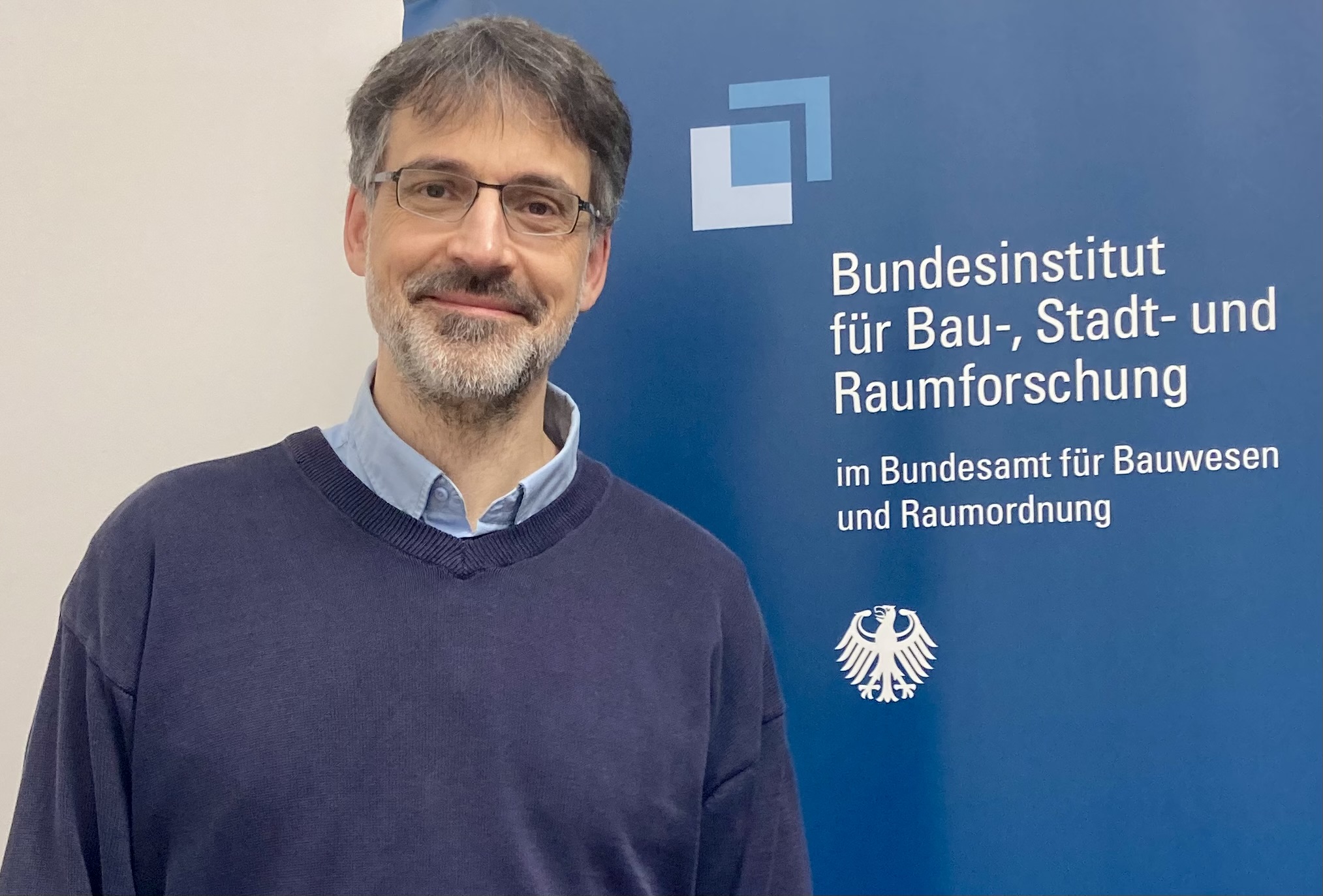
The Federal Institute for Research on Building, Urban Affairs and Spatial Development (BBSR) is the departmental research institute of the Federal Ministry of Housing, Urban Development and Building (BMWSB). We talk to Thomas Tschirner, a member of the “Climate neutrality in building operations” unit in the Housing and Construction Department, about the opportunities and possibilities of a climate-neutral building stock in Germany and the motivation for participating in SmartLivingNEXT.
Germany aims to become climate-neutral by 2045. In your view, what significance does the digitalization of existing buildings have in this context?
Our core problem is that knowledge of the building stock in Germany is still very patchy. In our view, the availability of energy-relevant data should be at the heart of future efforts. Digitalization and the resulting availability of data is a decisive factor in closing precisely these knowledge gaps in order to place measures and incentives for phasing out fossil fuels in the building sector in a targeted manner.
In your opinion, what role could the SmartLivingNEXT data room play in achieving the climate targets?
For us, the crucial thing about the common data room is that the existing data silos are finally being broken down. These make broad data availability difficult. With the SmartLivingNEXT Dataspace, data can be made available for a wide range of energy-related applications and evaluated more easily. And without the data providers losing control. Especially in the area of municipal heating planning, this valid data is urgently needed as a planning basis, for example for the expansion of district heating networks.
What potential does the use of artificial intelligence (AI) have?
AI processes are very promising. However, they can only work if there is sufficient data availability. So if we want to create a good and valid database for AI processes, the shared data space is a perfect instrument for this. I also don’t think that this path can be shortened. There is a great need for data for training, and the SmartLivingNEXT data room can play a central role in meeting this need.
Which smart services do you consider to be particularly interesting here in order to generate added value for you? Please also think about services that do not yet exist in this form, but which could in principle be created through a shared data room.
I myself am very excited about further developments in this area. I can imagine that applications for dynamic load shifting will play an important role. At the moment, however, my focus is still very much on how successful it will be to establish a generally recognized data space with valid data and transfer it to regular operation.
What results or synergy effects do you hope to achieve as an associated partner through the technology program?
It is very exciting and instructive for us to follow the development of the data room, with all its challenges and successes, so closely. We hope to be able to transfer many findings and methods to a future data room for residential and later also for non-residential buildings – the research area of our department.
Listen to the article (in German):
Editorial office:
Ilka
Klein
Category:
Flagship project
SmartLivingNEXT

Central documents for SmartLivingNEXT
The white paper contains the guideline and reference framework for the future technical development of the SmartLivingNEXT Dataspace and the desired governance structure. It was created with the collaboration of teams from German Research Center for Artificial Intelligence (DFKI), the Research Association for Electrical Engineering at ZVEI e.V., Ludwig-Maximilians-Universität München (LMU) and Materna Information & Communications SE. You can have the white paper sent to you as a PDF. Please contact our project office at projektbuero@smartlivingnext.de.
The document is intended as a structuring investor perspective and orientation framework, not as a final business plan, and analyzes the possible roles of potential investors. It was written in collaboration with Michael Schidlack, Research Association for Electrical Engineering at ZVEI e.V., Dr. Rahild Neuburger, Ludwig-Maximilians-Universität München (LMU) and Lars Thomsen, future matters AG. You can have the document sent to you as a PDF. Please contact our project office at projektbuero@smartlivingnext.de.
Das Dokument erläutert im ersten Teil (Governance & Organisation) SmartLivingNEXT als föderiertes Datenökosystem und beschreibt die Rollen, Verantwortlichkeiten und Entscheidungslogiken. Der zweite Teil (technische Architektur & Datenraum) beschreibt, wie diese Governance technisch umgesetzt wird. Es entstand unter Mitwirkung von Michael Schidlack, Forschungsvereinigung Elektrotechnik beim ZVEI e.V., Dr. Rahild Neuburger, Ludwig-Maximilians-Universität München (LMU) und Fanni Vespermann, Materna Information & Communications SE. Sie können sich das Dokument als PDF zusenden lassen. Please contact our project office at projektbuero@smartlivingnext.de.