Governance and financing models with multi-layered requirement concepts: SmartLivingNEXT on course for real operation
16. July 2025
Reading time:
4 minutes
At the end of the second quarter of 2025, SmartLivingNEXT flagship project is at a technically advanced stage. Future financing models and multi-layered requirement concepts for data owners, data consumers and service developers are now being developed. In addition, the development of various governance models to finalize a governance structure for autumn 2025 has continued.

The development of a future governance structure by the consortium partner LMU Munich played a central role in the second quarter. Two specific models were developed for the future organization of the data room. Both variants were considered in terms of tasks, structure, legal framework and possible cooperation with federators. The aim is to find a viable solution that takes into account the diversity of interests, trust and legal requirements in the ecosystem and is also scalable in the long term. At the same time, a financing model is currently being developed that will first record the costs, for example of setting up and technical operation, in data spaces and then approach the benefits. Legal principles and issues have also been analyzed and are now being legally validated.
Uniform rules for the use of data
In this quarter, German Research Center for Artificial Intelligence (DFKI), Materna and Fraunhofer ISST developed machine-readable and standardized rules for secure access to data in the SmartLivingNEXT data room. These important policies for the provision of assets in the data room define who may use which data and under what conditions. In addition, initial catalog entries were developed in close collaboration with the satellite projects and assets such as datasets, documents and services were entered into the catalogs.
The researchers prepared household data from the EBZ Business School ‘s BaltBest system in such a way that it can be used separately as individual assets according to sensor type. This makes it easier for the data provider to control which data types are to be shared. The data consumer can compile the data sets for training models more easily. The corresponding assets have been provided in the blueprint.
Other households were equipped with sensor data on temperature, humidity, door/window contacts and electricity consumption. The aim is to improve heat consumption forecasts and test new use cases for the smart control of household appliances and the optimization of energy consumption with solar power and variable tariffs. AI models will also be tested directly on local appliances. In addition, the blueprint is being further developed and optimized for use by the satellite projects.
Visualize and forecast energy consumption
In the field of artificial intelligence (AI) and semantics, German Research Center for Artificial Intelligence (DFKI) has developed intelligent solutions to simulate energy data in homes. The connection of openEMS-based energy management systems to the synthetic data generator SynTiSeD is currently being prepared and evaluated. The aim is to generate synthetic energy data without having to use real consumption data. At the same time, AI is being used to optimize power consumption or power generation forecasts.
Interactive workshop in Berlin
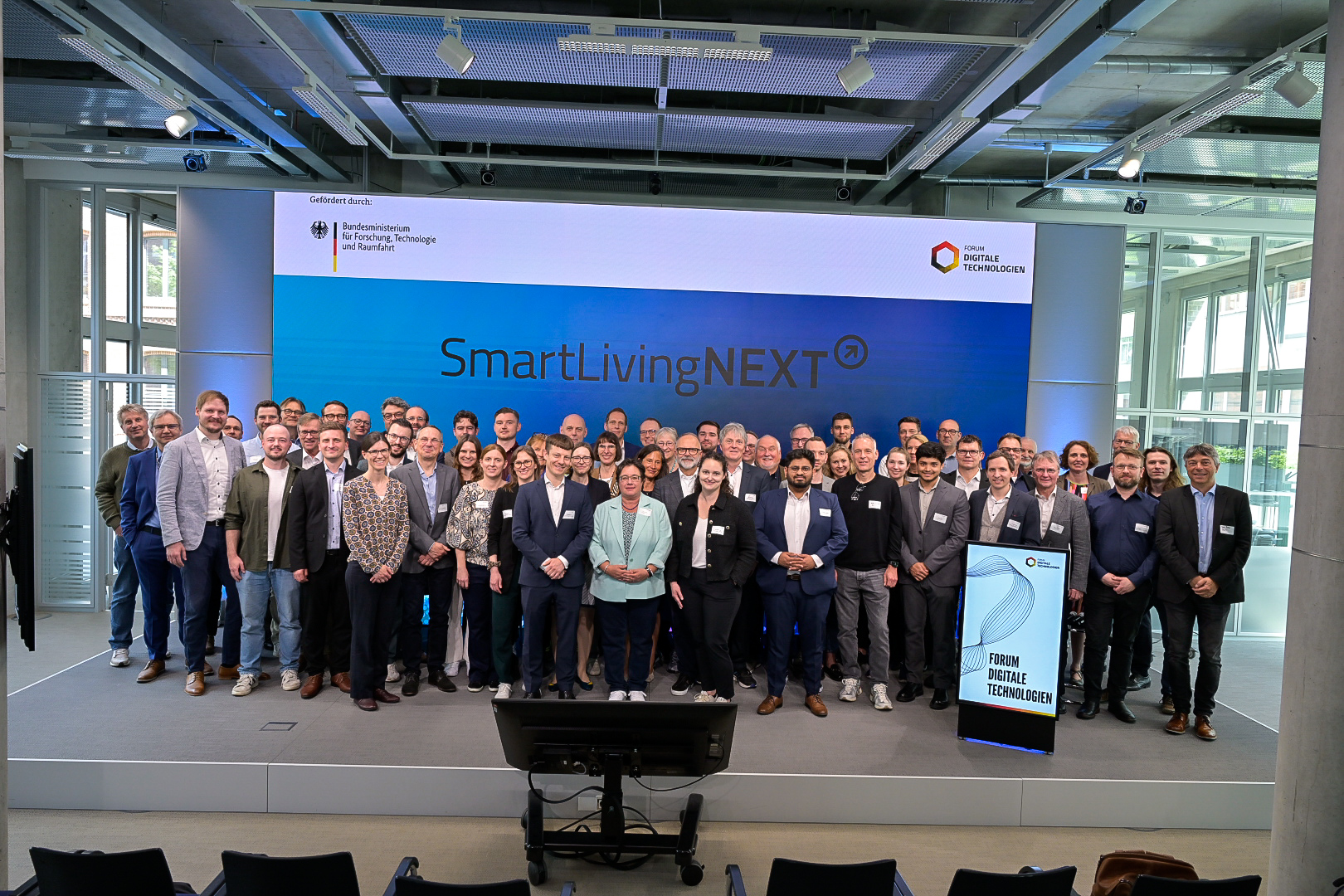
In order to specifically integrate potential partner interests into strategic considerations and concepts, SmartLivingNEXT flagship project organized a workshop on 25 June 2025 at the premises of VDI/VDE Innovation + Technik GmbH in Berlin. Numerous associated partners took the opportunity to take an in-depth look at the future direction of the shared data space and contribute their own perspectives to the design.
Under the motto “From partner to co-creator – perspectives on the SmartLivingNEXT ecosystem”, the workshop offered an intensive exchange on organizational, technical, strategic and business model-related issues. The aim was to develop concrete ideas for active co-design based on the existing concepts for data room governance. The focus was on key questions such as how SMEs and start-ups can benefit from the data room and which data-based services could be real game changers for the market.
Listen to the article (in German):
Editorial office:
Ilka
Klein
Category:
Flagship project
SmartLivingNEXT

Central documents for SmartLivingNEXT
The white paper contains the guideline and reference framework for the future technical development of the SmartLivingNEXT Dataspace and the desired governance structure. It was created with the collaboration of teams from German Research Center for Artificial Intelligence (DFKI), the Research Association for Electrical Engineering at ZVEI e.V., Ludwig-Maximilians-Universität München (LMU) and Materna Information & Communications SE. You can have the white paper sent to you as a PDF. Please contact our project office at projektbuero@smartlivingnext.de.
The document is intended as a structuring investor perspective and orientation framework, not as a final business plan, and analyzes the possible roles of potential investors. It was written in collaboration with Michael Schidlack, Research Association for Electrical Engineering at ZVEI e.V., Dr. Rahild Neuburger, Ludwig-Maximilians-Universität München (LMU) and Lars Thomsen, future matters AG. You can have the document sent to you as a PDF. Please contact our project office at projektbuero@smartlivingnext.de.
Das Dokument erläutert im ersten Teil (Governance & Organisation) SmartLivingNEXT als föderiertes Datenökosystem und beschreibt die Rollen, Verantwortlichkeiten und Entscheidungslogiken. Der zweite Teil (technische Architektur & Datenraum) beschreibt, wie diese Governance technisch umgesetzt wird. Es entstand unter Mitwirkung von Michael Schidlack, Forschungsvereinigung Elektrotechnik beim ZVEI e.V., Dr. Rahild Neuburger, Ludwig-Maximilians-Universität München (LMU) und Fanni Vespermann, Materna Information & Communications SE. Sie können sich das Dokument als PDF zusenden lassen. Please contact our project office at projektbuero@smartlivingnext.de.