Living of the future: SmartLivingNEXT presents universal data ecosystem at the Digital Building Summit
12. November 2025
Reading time:
6 minutes
A shortage of skilled workers, the energy transition and increasing regulation – the housing industry is currently facing enormous challenges. How can construction costs be reduced, energy efficiency increased and smart technologies successfully implemented? SmartLivingNEXT presented the decentralized data ecosystem and the associated potential of intelligent smart living services at this year’s Digital Building Summit.
Under the motto “The future of the housing industry: practical solutions for pressing challenges”, manufacturers, planners and operators of building technology as well as leading experts from the housing industry and municipal institutions came together in the Maschinenraum Berlin on November 6 and 7, 2025 to discuss the latest developments and solutions for the future of construction and the real estate industry.
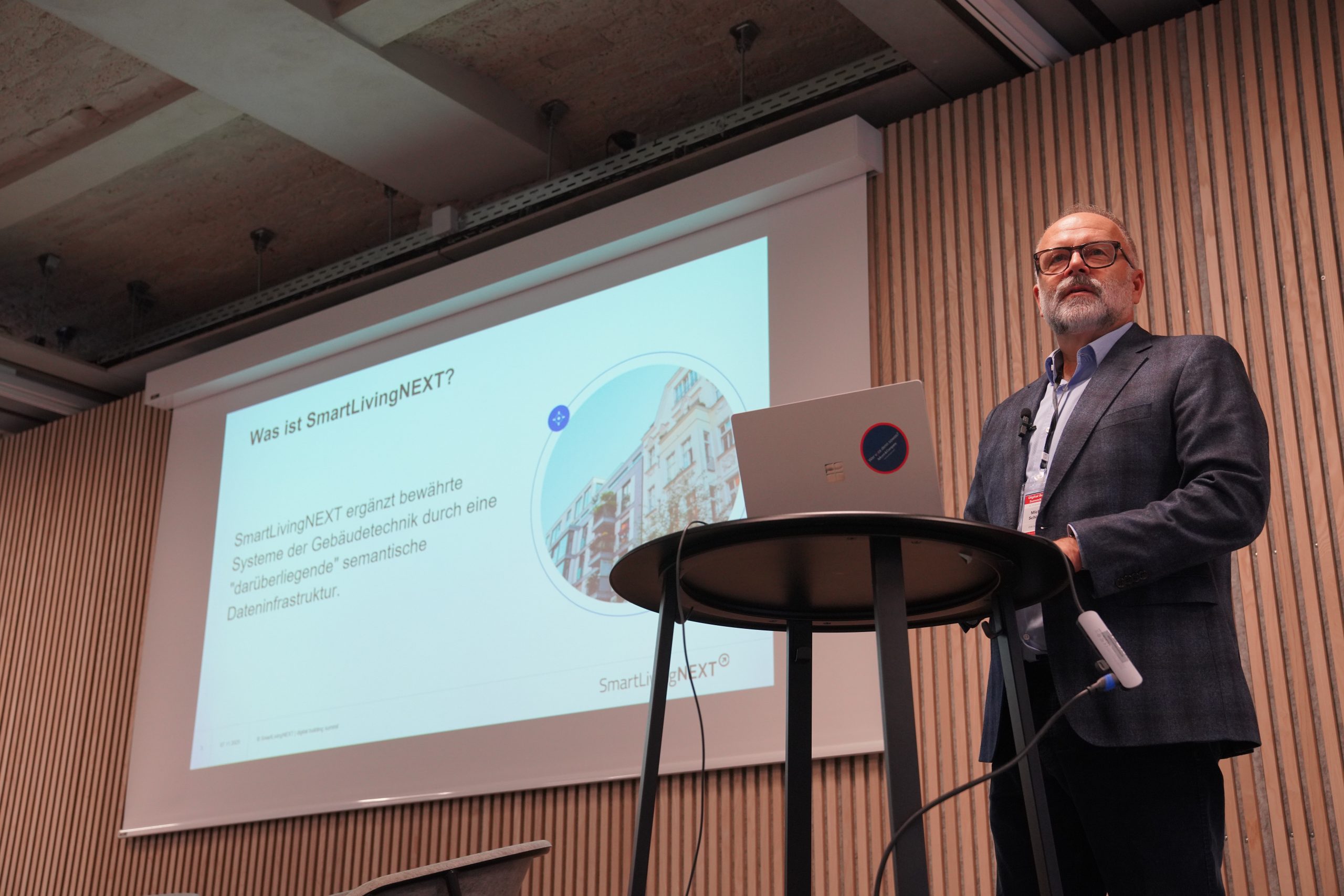
On the second day of the event, Michael Schidlack, Research Association for Electrical Engineering (FE) at ZVEI e. V. and consortium leader of the SmartLivingNEXT flagship project, presented the research project funded by the Federal Ministry for Economic Affairs and Energy (BMWE) with 25 million euros to an interested audience of experts. In his presentation, he gave the participants a practical insight into the future of smart, sustainable and safe buildings. SmartLivingNEXT complements existing building technology systems with an innovative, semantic data infrastructure that makes it possible to link data from different buildings at a local, regional, national and international level. This new data infrastructure creates completely new, cross-domain services. SmartLivingNEXT acts as an upgrade for existing buildings and continues to drive the digital transformation of existing buildings. The aim here is not to reinvent the wheel, but to combine proven technologies and solutions to create an efficient and cost-effective AI-supported ecosystem for residential and living environments. The research project enables simple retrofitting in existing buildings and thus contributes to the optimization of energy monitoring, management processes and AI-supported maintenance of buildings. Scalable, open and affordable solutions are the key to creating future-proof buildings.
Energy efficiency data portal creates digital interfaces between local authorities, energy suppliers and the housing industry
One example of practical implementation within the SmartLivingNEXT dataspace is the energy efficiency data portal for cross-building energy efficiency and heat planning, which is currently being developed by consortium partner Materna. For the first time, the portal would combine real consumption data with data on the building fabric in a data room in order to be able to evaluate measures in the context of heat planning in particular with regard to the savings potential that can actually be expected. This would enable landlords to develop a multi-year, cost- and energy-efficient refurbishment plan for their buildings. They can also use the portal to release data that is helpful for municipal players in heat planning, for example. The SmartLivingNEXT ecosystem thus creates digital interfaces between municipalities, energy suppliers and the housing industry.
“Data rooms are becoming the new supply structure“
Following his presentation, he took part in the “Building of Future” masterclass. Together with Professor Philipp W. Goltermann from Drees & Sommer, Schidlack discussed the concrete implementation of smart buildings (smart living) and cities (smart cities). He emphasized that sustainable living environments can only be created if the data from different systems is linked together in a federated data space, such as the one currently being developed by SmartLivingNEXT. “Data rooms are becoming the new supply structure,” he explained, emphasizing that a digital infrastructure that functions just as naturally as electricity and water is the basis for the development of smart buildings. Such an approach enables greater data transparency and equal rights for all stakeholders, which accelerates the digital transformation in the construction industry. It is crucial to develop open, scalable and user-centered solutions that can be easily integrated into living environments. The future of buildings can only come about through solutions that can be used in any building and are based on proven technologies. SmartLivingNEXT is the basis for future smart cities in which buildings, energy, mobility and infrastructure grow together digitally.
“Most of the living space has already been built. The digital transformation must therefore start with existing buildings, with retrofittable interfaces and modular concepts.” This calls for cost-effective solutions that make existing buildings fit for the digital future. Finally, he emphasized the importance of artificial intelligence (AI) for the efficiency of smart living solutions. AI will not only make the buildings of the future more energy-efficient, but will also ensure sustainable and comfortable use by harmonizing the behaviour of residents and the needs of building technologies. The software-defined house will change the planning and operation of buildings. This shift towards software-based control of building functions will significantly increase the flexibility and scalability of building technologies and create the basis for the smart city of the future.
The Digital Building Summit 2025, organized by wibutler and Advyce & Company, was a complete success for all participants and helped to drive forward the digital transformation in the construction industry. The discussions and contributions clearly showed that the creation of smart buildings depends not only on innovative technologies, but also on close integration and an open exchange between the various players in the industry.
Listen to the article (in German):
Editorial office:
Ilka
Klein
Category:
Flagship project
SmartLivingNEXT

Central documents for SmartLivingNEXT
The white paper contains the guideline and reference framework for the future technical development of the SmartLivingNEXT Dataspace and the desired governance structure. It was created with the collaboration of teams from German Research Center for Artificial Intelligence (DFKI), the Research Association for Electrical Engineering at ZVEI e.V., Ludwig-Maximilians-Universität München (LMU) and Materna Information & Communications SE. You can have the white paper sent to you as a PDF. Please contact our project office at projektbuero@smartlivingnext.de.
The document is intended as a structuring investor perspective and orientation framework, not as a final business plan, and analyzes the possible roles of potential investors. It was written in collaboration with Michael Schidlack, Research Association for Electrical Engineering at ZVEI e.V., Dr. Rahild Neuburger, Ludwig-Maximilians-Universität München (LMU) and Lars Thomsen, future matters AG. You can have the document sent to you as a PDF. Please contact our project office at projektbuero@smartlivingnext.de.
Das Dokument erläutert im ersten Teil (Governance & Organisation) SmartLivingNEXT als föderiertes Datenökosystem und beschreibt die Rollen, Verantwortlichkeiten und Entscheidungslogiken. Der zweite Teil (technische Architektur & Datenraum) beschreibt, wie diese Governance technisch umgesetzt wird. Es entstand unter Mitwirkung von Michael Schidlack, Forschungsvereinigung Elektrotechnik beim ZVEI e.V., Dr. Rahild Neuburger, Ludwig-Maximilians-Universität München (LMU) und Fanni Vespermann, Materna Information & Communications SE. Sie können sich das Dokument als PDF zusenden lassen. Please contact our project office at projektbuero@smartlivingnext.de.