Quo vadis? SmartLivingNEXT at the ZVEI Colloquium Building Automation 2025
15. December 2025
10 minutes
The world of building automation is changing at the intersection of digitalization, sustainability and new technologies. At this year’s ZVEI Building Automation Colloquium, SmartLivingNEXT presented its technology approach for networked, intelligent residential buildings to more than 200 experts from research, industry and practice.
Under the motto “Quo vadis”, the ZVEI Building Automation Colloquium at the House of Logistics and Mobility (HOLM) in Frankfurt am Main on December 3 and 4, 2025 was the central meeting point for industry, the housing sector, planning and research. The event was opened by Nadine Petermann, Managing Director of the Electrical Installation Systems Association at ZVEI e. V., who emphasized artificial intelligence (AI) and the digital twin in both new and existing buildings, which are increasingly becoming key technologies for networked, efficient and adaptive buildings, in front of an interested specialist audience. With trades, planning, system integration, IT, industry and science, the colloquium will show how broadly positioned the field is and how important it is to shape this change together in order to remain competitive in Germany and Europe in the future.
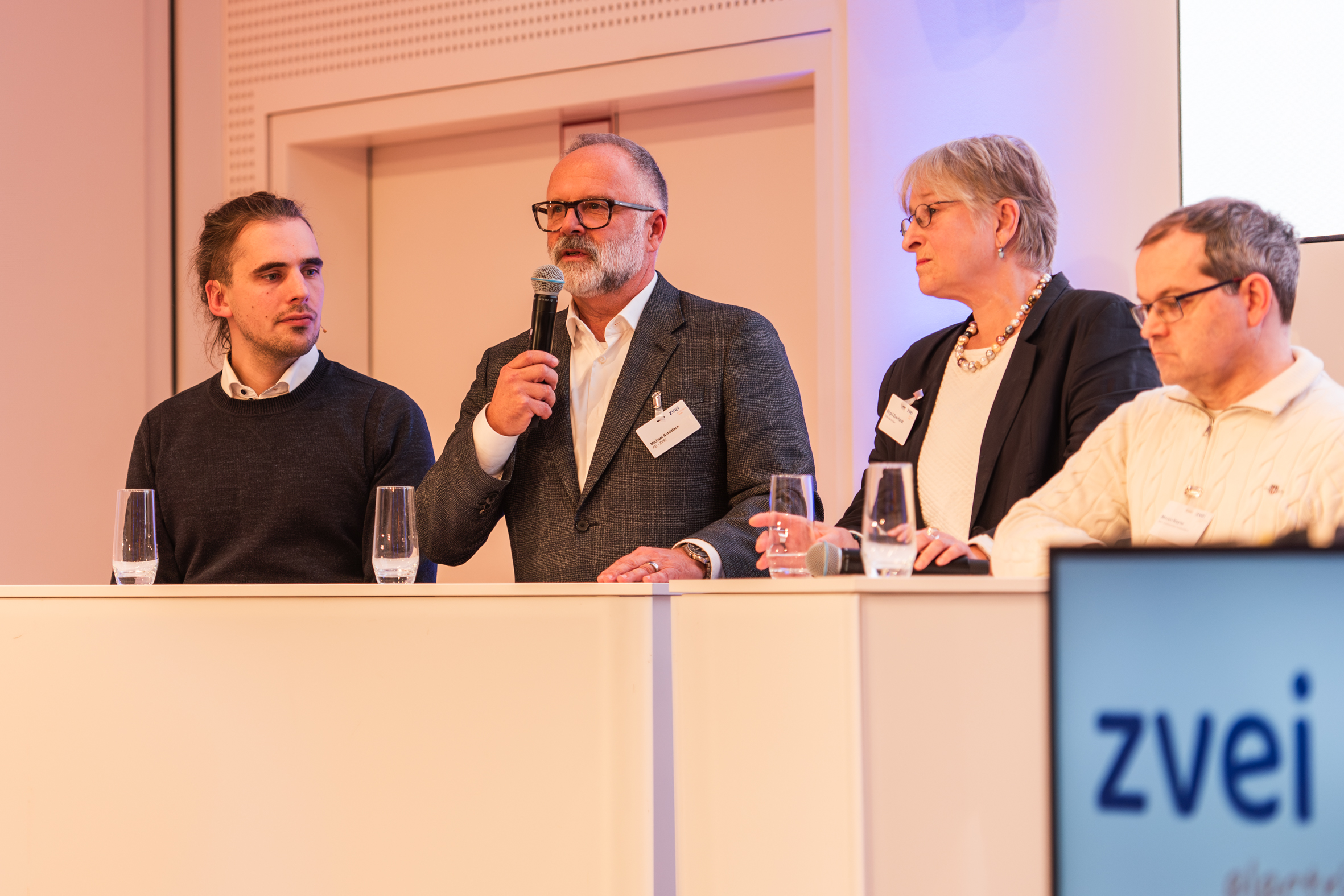
Panel discussion Building automation – Quo vadis?
Where does building automation stand today and where is it heading between energy efficiency, digitalization and sustainability? This key question shaped the panel “Building automation – Quo vadis?” and led to a lively discussion about challenges, priorities and future models, expertly moderated by Dr. Arnaud Hoffmann, Strategic Business Development at Hager. Right from the start, it became clear that the current situation is ambivalent: proven technology on the one hand, limited scalability on the other. Birgid Eberhardt, Head of Research & Development at GSW Gesellschaft für Siedlungs- und Wohnungsbau Baden-Württemberg mbH and consortium partner in SmartLivingNEXT, succinctly summed up the housing industry’s perspective: “Technology must be affordable, robust and understandable for our tenants. If operation or cost-effectiveness are not right, a system is simply not practicable for us.” She thus made it clear that technological innovation can only be successful if it works reliably and transparently in everyday life.

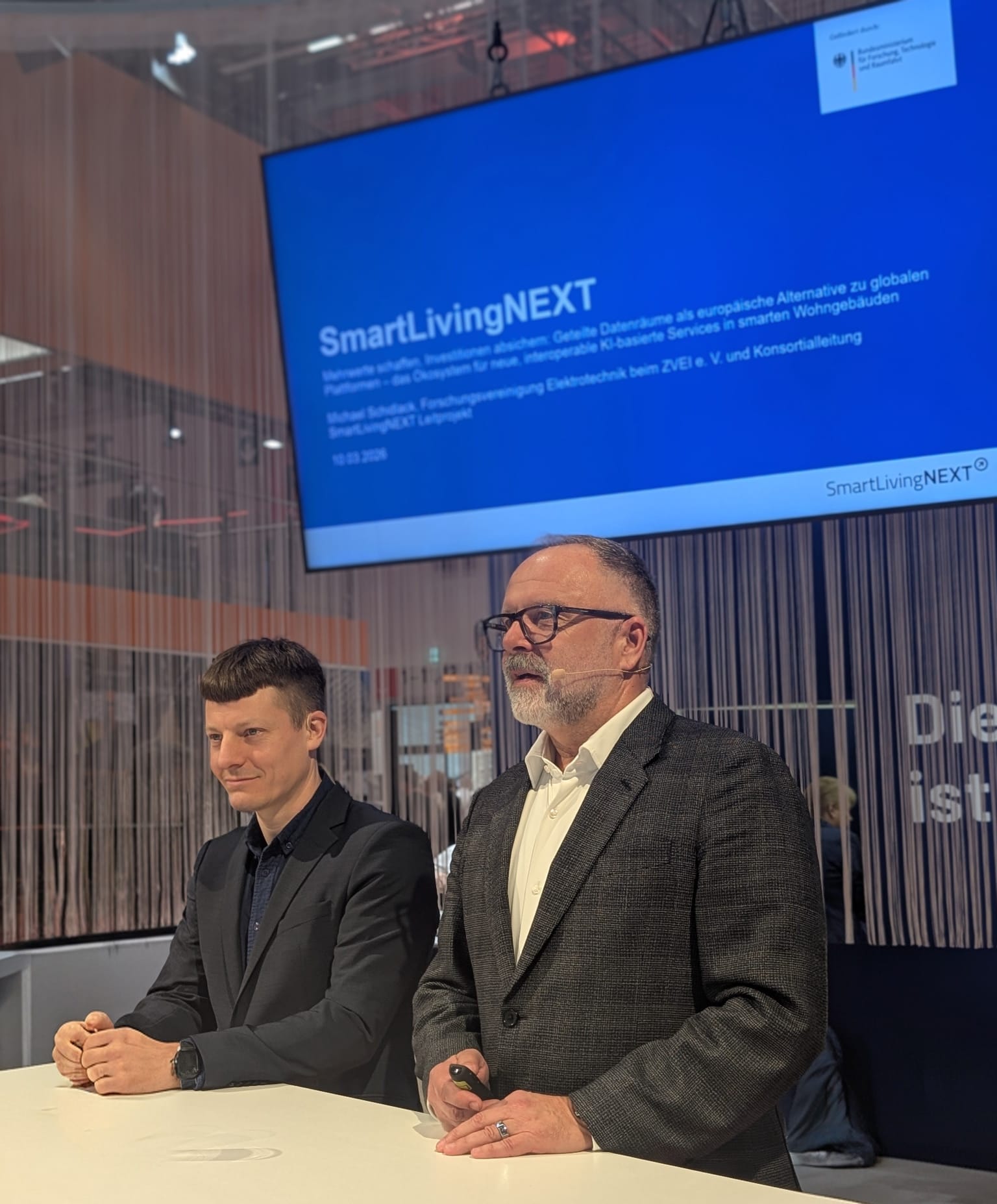
A central focus was on the question of the infrastructure of future data flows. Michael Schidlack, Research Association for Electrical Engineering at ZVEI e. V. and consortium leader in the SmartLivingNEXT flagship project, focused on the structural cause of current problems: “We first need to clarify what a federated data space is. It is not a platform that centralizes data, but a system of controlled permeability. Data stays where it is today.” The decisive advantage: manufacturers, buildings, energy suppliers or property management companies retain sovereignty over their data and can still share it securely, in a structured manner and in compliance with European regulations. Schidlack described the still widespread “threading together” of proprietary systems as outdated: “We need to move away from this. A federated data room enables interoperability without changing systems. A real AI upgrade for existing buildings.”
The discussion showed that openness is no longer an optional feature, but a prerequisite for the future viability of companies and organizations in Europe. Eberhardt once again emphasized the economic perspective: “We need solutions that not only function technically, but also remain sustainable in the long term. Operation, maintenance and acceptance are decisive criteria. In order to meet the requirements of CO₂ reduction and climate neutrality, we as a housing industry need access to different data from numerous sources. SmartLivingNEXT offers an ecosystem for accessing and exchanging data without redundancies as the basis for AI services: with a catalog of available data and services, identity access and contract management, anonymization/pseudonymization and uniform data formats.”
The question of the influence of AI led to a clear realization: without interoperable data, AI remains piecemeal. Schidlack placed the development in a larger context: “The digital twin is becoming the basic structure. Scaling is only possible if buildings are connected with a standardized approach and this is exactly what a federated data space creates.” The outlook became concrete. “We are already testing the federated data room under real conditions. The system will be ready for the market in summer 2026. The decisive factor now is the industry’s willingness to invest in order to set up basic operations. This is not about another platform, but about a common infrastructure that will bring Europe forward technologically,” says Schidlack.
Use of AI in the technically equipped living environment from the perspective of the housing industry
In her presentation, Birgid Eberhardt outlined the potential of artificial intelligence (AI) for the housing industry and highlighted the key role of research projects such as SmartLivingNEXT and SECAI. For GSW, a housing company with over 4,600 units in Baden-Württemberg, Saxony-Anhalt and Berlin, the focus is on the benefits for tenants as well as the optimization of building processes. In contrast to single-family homes or commercial properties, solutions for apartment buildings must be centrally controlled and must not be dependent on private electricity or internet connections, must support tenant changes and at the same time remain compatible with operating cost regulations. Digitalization and AI must therefore deliver measurable results without increasing costs for tenants. One practical example is the AI-supported optimization of heating systems. Data from all components is analyzed, malfunctions are detected at an early stage, optimization suggestions are made and systems are adjusted remotely if necessary – always in combination with the expertise of HVAC tradespeople.
SmartLivingNEXT provides the digital infrastructure for this: a federated data ecosystem that makes standardized, anonymized data accessible and enables AI services such as heating or energy optimization. GSW uses this platform to test real data from existing buildings for AI applications, incorporate user behavior and support climate targets. Eberhardt concludes: “An apartment building has more in common with a cruise ship than with a detached house. AI is increasingly becoming part of smart buildings. SmartLivingNEXT enables efficient, comprehensible and sustainable solutions for the benefit of tenants, tradespeople and the environment.”
The end of stupidity
Lars Thomsen, founder and Chief Futurist of future matters AG and the world’s leading futurologist, provided an unforgettable highlight of the day as the final speaker. His presentation left the audience impressed and thoughtful at the same time. Thomsen made it clear: “We expect the end of stupidity because technologies are finally acquiring the ability to recognize patterns, improve themselves and take responsibility in the interests of people – similar to what we expect from a ‘smart’, i.e. competent and emphatic person.” He painted a picture of the next ten years – 520 weeks in which the world of building automation will change radically. “2025 is the tipping point,” emphasized Thomsen. “We are at a major turning point for several industries: For the first time, energy, mobility, buildings and digital assistance systems can act as a common, learning environment that relieves and supports everyone and thinks along and ahead in the background. What previously existed in separate technical silos is growing together into an organic infrastructure that is intuitive, reliable and self-optimizing.”
The focus is on the megatrends that will shape our lives in the coming years. The penetration of digital AI systems is now being followed by physical AI: with robots, smart devices, buildings and infrastructures that network and learn independently. Pattern recognition will become a key technology, new business models will emerge, but humans will remain the central target group: “Socially useful AI will make our everyday lives better. SmartLivingNEXT provides a clear answer to this. The research project is developing a digital infrastructure that sees AI not as an end in itself, but as a tool for the common good. The goal is a socially beneficial and safe AI that saves energy, supports health and makes living more comfortable and affordable. Sovereign, secure and European.”
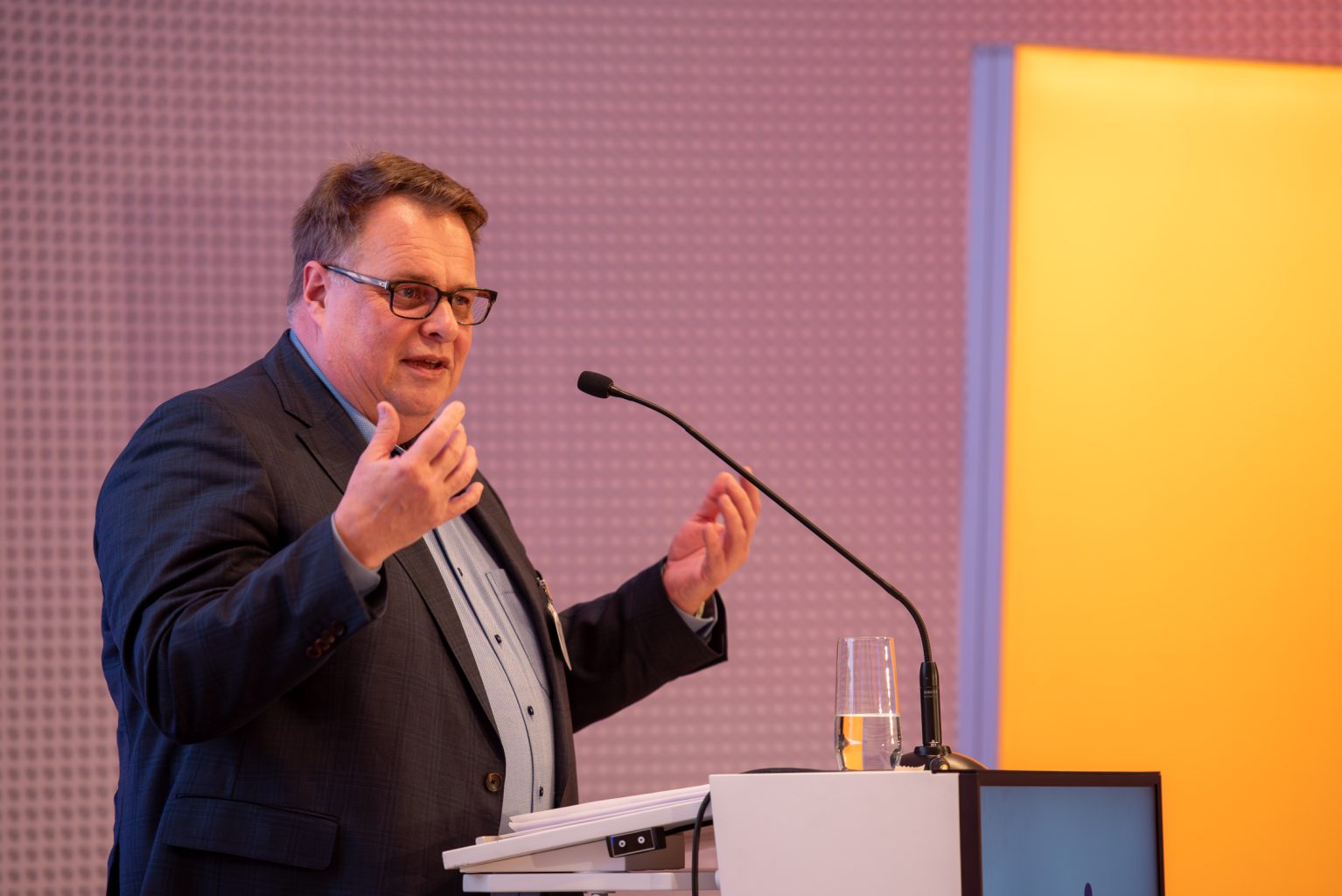
Thomsen made it clear that data rooms are indispensable as the basis for this development. “Data belongs to us as a society,” he explained. “It is like a telephone directory that we can use together to identify patterns and generate new business models.” A central idea of the day: individual smart islands are developing into ecosystems. Every single building becomes part of a networked, intelligent world. “The next 520 weeks will be the most exciting in our industry,” says Thomsen. “We are reshaping the future – the end of stupidity is near, the beginning of smartness can already be felt.”
The ZVEI Building Colloquium 2025 impressively demonstrated how rapidly the world of building automation is currently changing. AI, digitalization and sustainability are already shaping the industry today. This makes networked ecosystems and research projects such as SmartLivingNEXT all the more important for the future of building automation.
Listen to the article (in German):
Editorial office:
Ilka
Klein
Category:
Flagship project
Copyright information
ZVEI/Bender