SCCON 2024: how SmartLivingNEXT can support the digitalization of the public sector
16. October 2024
Reading time:
4 minutes
The Smart Country Convention (SCCON) in Berlin is all about the digitalization of the state and public services. SmartLivingNEXT provides an important building block with the digitalization of residential buildings. Bruno Ristok provided information about the possible applications at the Gaia-X Hub Germany stand.
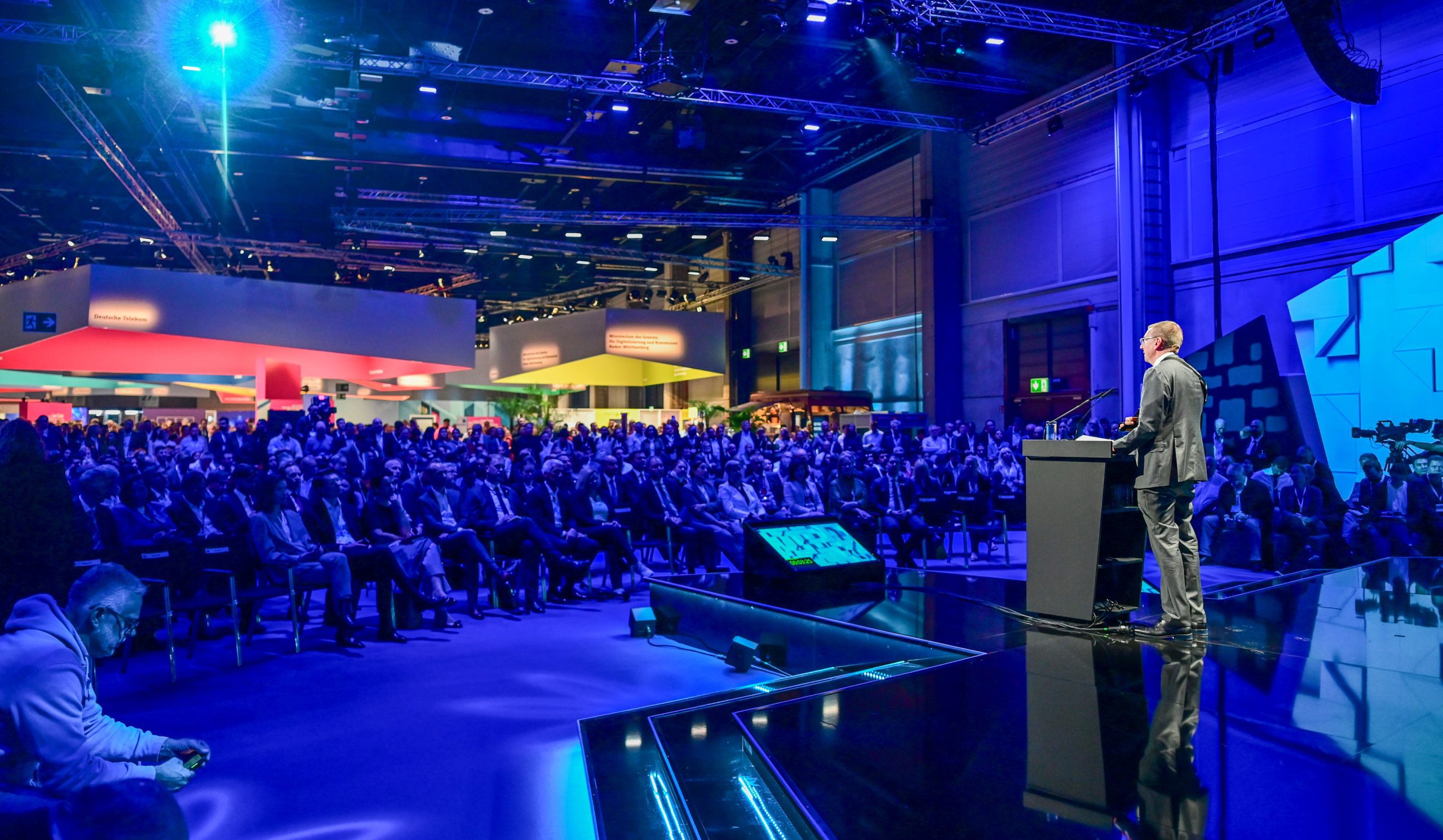
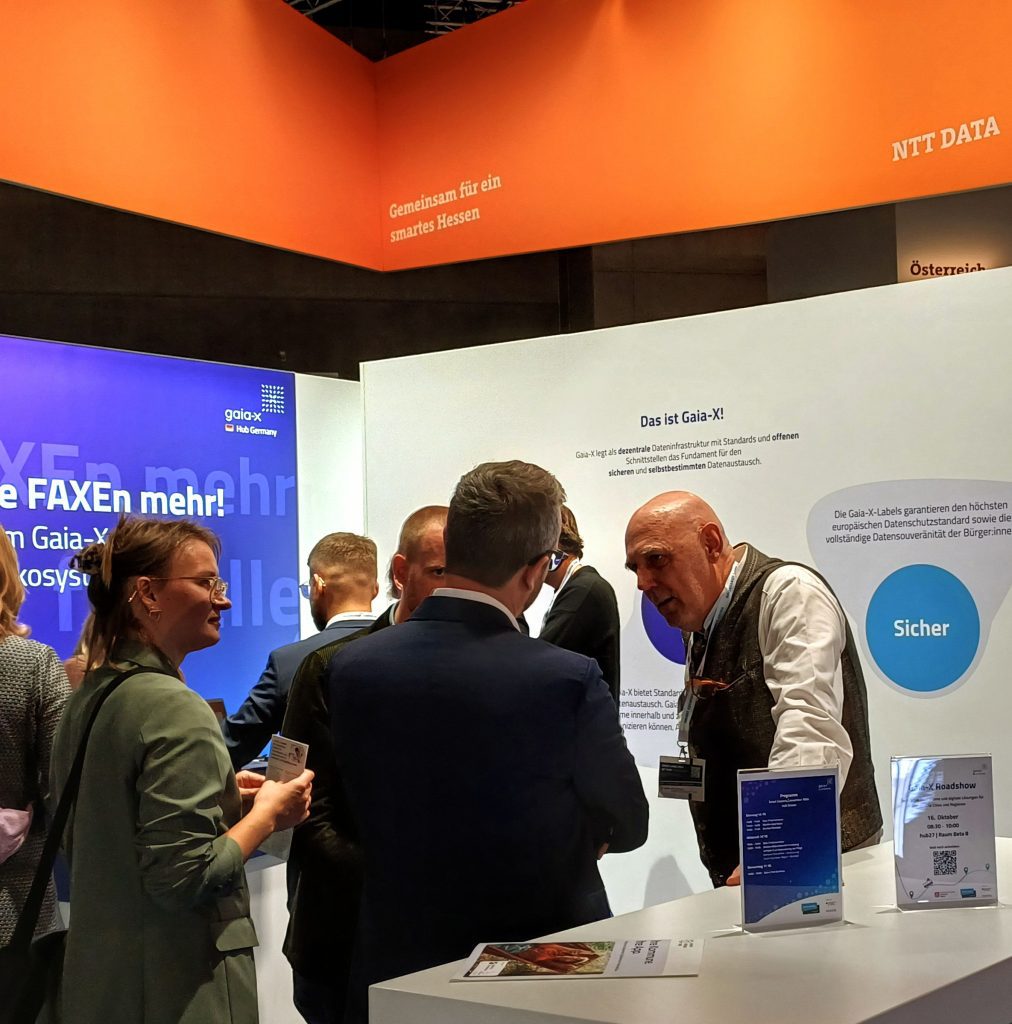
Every year in Berlin, the Smart Country Convention, or SCCON for short, offers a platform for knowledge transfer, networking and the establishment of forward-looking partnerships. With seven stages, 350 partners, 600 speakers and more than 70 workshops, this year’s convention showcased ideas and concepts for the digital future of the public sector in the areas of e-government, smart city and smart region. The SmartLivingNEXT technology program funded by the Federal Ministry for Economic Affairs and Climate Protection (German Federal Ministry for Economic Affairs and Climate Action (BMWK)) was also present on 15 October 2024. At the stand of Gaia-X Hub Germany, Bruno Ristok, consortium partner of SmartLivingNEXT and Managing Director of C&S Computer und Software GmbH as well as sponsor of the health domain of Gaia-X HUB Germany, explained how the digitalization of residential or, for example, administrative buildings can succeed and how the resulting new growth impulses for the smart living market can be realized.
Target image: Gaia-X-compliant smart living ecosystem
“At the moment, buildings are still technologically unique with different system worlds. This makes overarching digitalization difficult. The aim of SmartLivingNEXT is to establish a smart living ecosystem in which the data required for the introduction of innovative services and AI-based applications is much more easily and universally available than at present,” says Bruno Ristok. Gaia-X is a central factor in setting the course for a secure, trustworthy smart living ecosystem. “By providing non-discriminatory and secure access to data, the technology reduces dependence on dominant non-European companies and thus creates the conditions for keeping value creation in Germany. In the coming years, we expect numerous new, innovative applications based on SmartLivingNEXT that will make our living and home environments more sustainable. In future, software companies will be able to create smart applications in the SmartLivingNEXT ecosystem much more easily and, above all, use them across buildings.” This will provide the housing industry with a growing range of digital applications for efficient housing management, while citizens will receive new, intelligent services that will make the homes of the future more energy-efficient, safer and more comfortable.
He also linked the topic of innovative future living environments with the topic of care. Under the title “Living space(s) and healthcare location home”, Ristok explained to an interested audience of experts how “care” and “cure” can be implemented in conjunction with ambient assisted living solutions in the home to support the independence of people in need of care and relieve the burden on the healthcare system. “By combining intelligent sensors, digital assistance systems and barrier-free smart home solutions, a smart household not only offers convenience, but also creates real added value for the well-being and safety of residents,” commented Ristock on the integration of smart technologies for age-appropriate and assisted living. Intelligent alarm and emergency call systems and their connection to care services and hospitals are conceivable here, helping to improve quality of life even in old age.
SCCON 2024 provided a versatile framework for demonstrating the innovation and research potential of SmartLivingNEXT, and not just for its own domain. The congress trade fair was a place of inspiration and exchange, where the vision of a smart and networked future became tangible.
Listen to the article (in German)
Editorial office:
Ilka
Klein
Category:
Flagship project
SmartLivingNEXT
Copyright information
Smart Country Convention – Pressefotos und -videos / Messe Berlin (messe-berlin.de) © Messe Berlin GmbH

Central documents for SmartLivingNEXT
The white paper contains the guideline and reference framework for the future technical development of the SmartLivingNEXT Dataspace and the desired governance structure. It was created with the collaboration of teams from German Research Center for Artificial Intelligence (DFKI), the Research Association for Electrical Engineering at ZVEI e.V., Ludwig-Maximilians-Universität München (LMU) and Materna Information & Communications SE. You can have the white paper sent to you as a PDF. Please contact our project office at projektbuero@smartlivingnext.de.
The document is intended as a structuring investor perspective and orientation framework, not as a final business plan, and analyzes the possible roles of potential investors. It was written in collaboration with Michael Schidlack, Research Association for Electrical Engineering at ZVEI e.V., Dr. Rahild Neuburger, Ludwig-Maximilians-Universität München (LMU) and Lars Thomsen, future matters AG. You can have the document sent to you as a PDF. Please contact our project office at projektbuero@smartlivingnext.de.
Das Dokument erläutert im ersten Teil (Governance & Organisation) SmartLivingNEXT als föderiertes Datenökosystem und beschreibt die Rollen, Verantwortlichkeiten und Entscheidungslogiken. Der zweite Teil (technische Architektur & Datenraum) beschreibt, wie diese Governance technisch umgesetzt wird. Es entstand unter Mitwirkung von Michael Schidlack, Forschungsvereinigung Elektrotechnik beim ZVEI e.V., Dr. Rahild Neuburger, Ludwig-Maximilians-Universität München (LMU) und Fanni Vespermann, Materna Information & Communications SE. Sie können sich das Dokument als PDF zusenden lassen. Please contact our project office at projektbuero@smartlivingnext.de.