SmartLivingNEXT at the Light + Building 2026: Data rooms as the key to the digital building
19. March 2026
10 minutes
At Light + Building 2026, SmartLivingNEXT showed how a federated data space is becoming the key to the digital building. The opportunities that a sovereign, European data ecosystem opens up for new services, business models and AI applications and why the industry is looking right now.
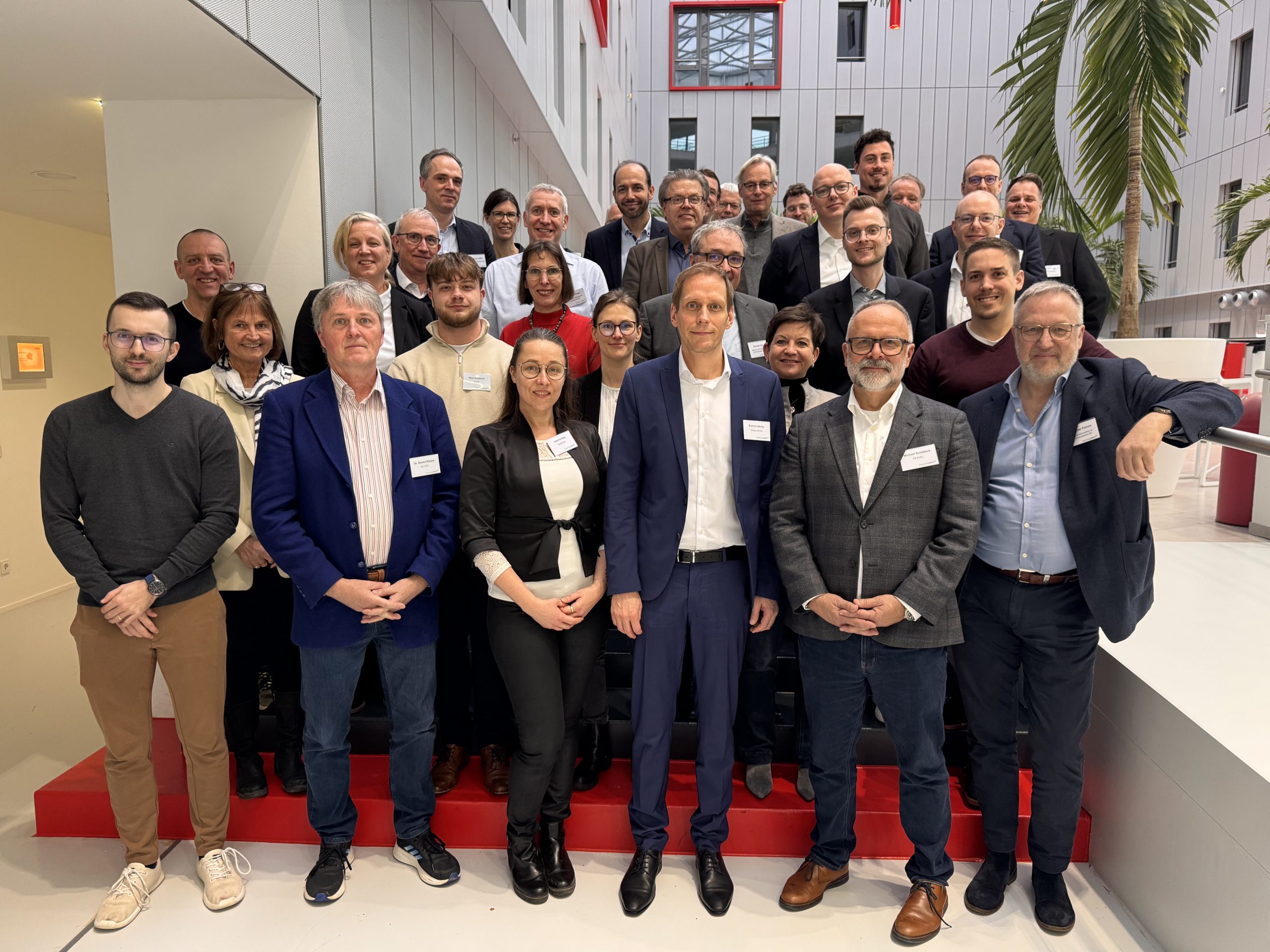
The markets for lighting and building technology are characterized by technological innovation worldwide. Electrification, digitalization and energy efficiency are shaping investment decisions and driving new projects in the building sector. These developments were the focus of Light + Building 2026, which took place in Frankfurt am Main from March 8 to 13. Around 2,000 exhibitors presented solutions for energy-efficient buildings, intelligent networking and modern lighting solutions. For many companies, international business, strategic partnerships and specific project plans were the focus of their trade fair presence.
The intelligent networking of data and systems is a key prerequisite for the transformation of the industry. This is precisely where SmartLivingNEXT comes in. At the joint stand of the German Electrical and Electronic Manufacturers’ Association (ZVEI) in Hall 12.1, the research project, together with partners and satellite projects, presented how an open, European data ecosystem for buildings can enable new services, business models and added value.
Lecture at the ZVEI Technology Forum: Creating added value, securing investments
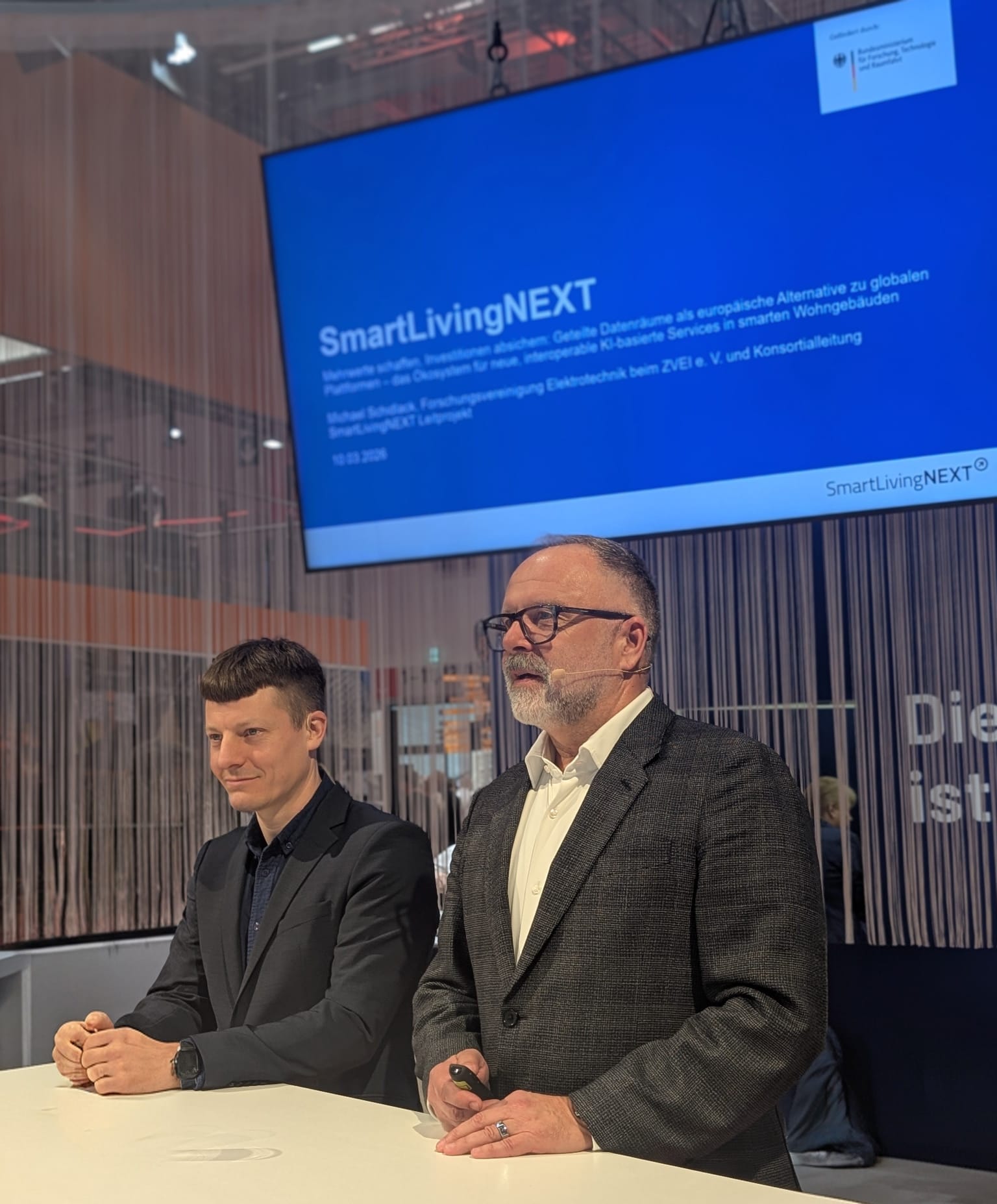
A key highlight of the trade fair was the presentation at the ZVEI Technology Forum entitled “Creating added value, safeguarding investments: shared data rooms as a European alternative to global platforms – the ecosystem for new, interoperable AI-based services in smart residential buildings.”
Here, Michael Schidlack, Principal Researcher at the Research Association for Electrical Engineering (FE) at ZVEI e. V. and consortium leader in the SmartLivingNEXT flagship project, together with Filip Milojkovic, Team Leader Data Management & AI at Materna Information & Communications SE, presented to an interested audience of experts how a sovereign, interoperable data ecosystem for buildings can be created and what opportunities this presents for companies. The focus was on the idea of a federated data space: SmartLivingNEXT supplements existing building technology systems with an overlying semantic data infrastructure. This allows data from different applications to be linked, aggregated and – if necessary – anonymized in a legally compliant manner at local, regional or international level. This works in compliance with the GDPR, even if the data is generated by different natural or legal persons.
The shared use of structured data could also give rise to innovative AI-based applications that make the operation of buildings more efficient, safer and more convenient. A central principle of the SmartLivingNEXT approach is that there would be no dominant platform operator. Instead, data would remain under the control of the respective providers.
Schidlack emphasized that SmartLivingNEXT is deliberately not pursuing a model with a dominant platform operator. Data would remain in the original systems and under the control of those to whom it was assigned or who were authorized to use it. This means that data sovereignty would be maintained. Access and use could be regulated on the basis of consent, for a specific purpose and in a traceable manner. This creates an approach that is not only technologically viable, but also meets the requirements of governance, trust and data protection. This is also an important difference to many platform models. SmartLivingNEXT relies on federation instead of centralization. Existing systems would not be displaced, but rather meaningfully connected with one another. This would make the approach particularly attractive for medium-sized companies, the housing industry, municipal players and other market participants.
“SmartLivingNEXT creates the prerequisite for data to be merged and made usable based on consent and in a rule-based manner, even if it is assigned to different natural or legal persons. This is precisely where the key progress lies: not just technical interoperability, but a data link that can be organized on a governance basis and mapped in compliance with the GDPR. This not only makes the smart building more digital, but also makes it connectable for new forms of secure and trustworthy data exchange,” says Schidlack.
The SmartLivingNEXT data room: sovereign, interoperable, European
In the second part of the presentation, Filip Milojkovic, in his role as project manager at Materna and consortium partner of the SmartLivingNEXT flagship project, explained the research project and the associated potential of intelligent smart living services for future living environments. SmartLivingNEXT aims to strengthen Europe with an open and sovereign data ecosystem for buildings, energy and smart services. Milojkovic explained how the transition from isolated solutions to an interoperable, AI-supported reality is being implemented and how this can lead to genuine digital business models for the building and energy industry. The SmartLivingNEXT blueprint not only shows how the technical operation is secured, but also how the project makes the industry more independent in the long term.
The decisive difference to proprietary platforms lies in the architecture:
- Federated system instead of central platform
- Data sovereignty remains with the data provider
- Common governance rules instead of platform T&Cs
- Added value for service and data providers
Technically, the concept is based on decentralized data storage: each participant would keep their data locally. Other players would only have controlled access, for example for analysis or service development, without data being copied at will. Trust is created via a clearly defined identity and certificate model, roles and contracts as well as machine-readable rules for data usage. As a technical federator, Materna provides a European dataspace infrastructure on Kubernetes. The Dataspace Blueprint provides companies with a low-threshold entry into the data space.
Milojkovic: “With SmartLivingNEXT, we are driving forward the technological maturity of ecosystem services in a targeted manner. Our goal is to complete the transition from specialized individual solutions to a scalable Dataspace-as-a-Service by autumn 2026. This will create a standardized and marketable infrastructure that enables digital services to be integrated seamlessly and interoperably into smart living environments. This step is essential in order to turn research results into real, economically viable applications and to drive forward digitalization in the smart living sector in the long term.”
Satellite projects in dialog: From a single use case to a scalable ecosystem
At the ZVEI trade fair stand, visitors were able to experience how specific applications from the project environment are already being implemented today. Here, three satellite projects presented practical applications that showed how data-based services can be created in the home and building sector. Satellite projects develop independent, application-oriented solutions, but consistently think them through in the context of the shared SmartLivingNEXT data space. They thus exemplify the transition from an isolated use case to a scalable, investable ecosystem.
The BIM-4-Care satellite project demonstrated how digital building models and sensor data can be used to better plan barrier-free and age-appropriate living. This includes 3D measurements of homes, which enable precise digital building documentation, as well as digital tools for planning age-appropriate conversion measures, including transparent cost calculations. BIM-4-CARE is intended to improve the planning of care requirements, conversion measures and the technical implementation and interoperability of system installations.
GaiST focuses in particular on the intelligent use of building data to support care and operational processes. In virtual tours through real living environments, visitors were able to get to know different types of sensors and understand what measured values they provide and what specific benefits they can have for outpatient and inpatient care, for example. The connection to the data room gives tenants, carers, outpatient services and doctors new opportunities to make life within their own four walls even more liveable. By using open source and medical and industrial standards, the project aims to reduce costs and personnel requirements in the healthcare sector.
The COMET satellite project focuses on energy and building data. It demonstrates how residents can share energy consumption data in a self-determined manner in order to generate measurable added value, for example through transparency about potential savings and new energy-related services. COMET collects labeled user data and develops a crowdsourcing app that enables the management of data access rights and the provision of data. For example, users can access personalized information and statistics, such as energy consumption.
The applications illustrated to trade fair visitors how the SmartLivingNEXT data room, as a shared infrastructure, can contribute to the practical development, networking and economic scaling of smart living services. This also makes the data room economically relevant: While individual use cases often remain project-bound, SmartLivingNEXT creates the conditions for repeatability, connectivity and investability.
Outlook
The discussions at Light + Building have shown that open data ecosystems are becoming a key component of the digital transformation in the building sector. With its federated data space, SmartLivingNEXT is creating a basis for interoperable applications, new business models and AI-based services in smart living. Schidlack: “The doors for a sovereign European data ecosystem in the building sector are open. Now is the time to seize these opportunities together!
Listen to the article (in German):
Editorial office:
Ilka
Klein
Category:
BIM-4-CARE