SmartLivingNEXT ecosystem takes shape.
30. September 2024
Reading time:
3 minutes
SmartLivingNEXT is at a very good level of technological development at the end of the third quarter of 2024. An important milestone for the digital ecosystem was reached with the provision of an open source repository. Several data flows from live data sources have been established, which lays the foundation for the cross-manufacturer use of smart living data. In addition, data from the SmartLivingNEXT Dataspace flows into German Research Center for Artificial Intelligence (DFKI)’s machine learning pipeline, which can be used to train AI models.
In the third quarter of 2024, the foundation was laid for the broad use of smart living data that will be generated as the project progresses. Several data sets were entered into the SmartLivingNEXT Dataspace in real time and operational data flows from live data sources were established. Data is now flowing into the SmartLivingNEXT Dataspace from German Research Center for Artificial Intelligence ( DFKI) test apartments, the DudoPark, Future Living Berlin and the BaltBest dataset. As part of the “energy efficiency” use case, the first energy-relevant building data was transferred and integrated into the newly established data space (data exchange hub) of the consortium partner Novus (wowiconsult). The necessary REST APIs for different data groups were set up within the Novus data room to enable the data to be retrieved.
Open source repository available
Thing descriptions (information about data properties) were created for this data in the SmartLivingNEXT flagship project and are managed in the registry. In addition, an open source repository was added to the SmartLivingNEXT Dataspace for satellite projects and future members of the ecosystem. A relevant milestone was reached with the provision of this repository. In addition, fine-tuning work has been carried out to integrate the Eclipse Dataspace Connector (EDC). This can connect external system environments and middleware systems as well as other data spaces that also use the EDC to a SmartLivingNEXT Dataspace. The EDC concept is based on the Gaia-X concepts for sovereign data exchange, which is why it will initially be used and further developed as the standard connector for SmartLivingNEXT. Its use in satellite projects will be supported in an advisory capacity.
The training of AI models can begin
The consortium partners Materna and German Research Center for Artificial Intelligence (DFKI) implemented the first direct data import from SmartLivingNEXT into a German Research Center for Artificial Intelligence (DFKI) machine learning pipeline. This can now be used to train AI models. Conversely, approaches were tested and implemented to make trained models and their parameters available again in the SmartLivingNEXT dataspace. With DudoPark, implementation approaches for AI on Edge in buildings were discussed with a view to data sovereignty and the independence of system solutions and associated business models. These were tested in initial simple prototypes.
SmartLivingNEXT community continues to grow
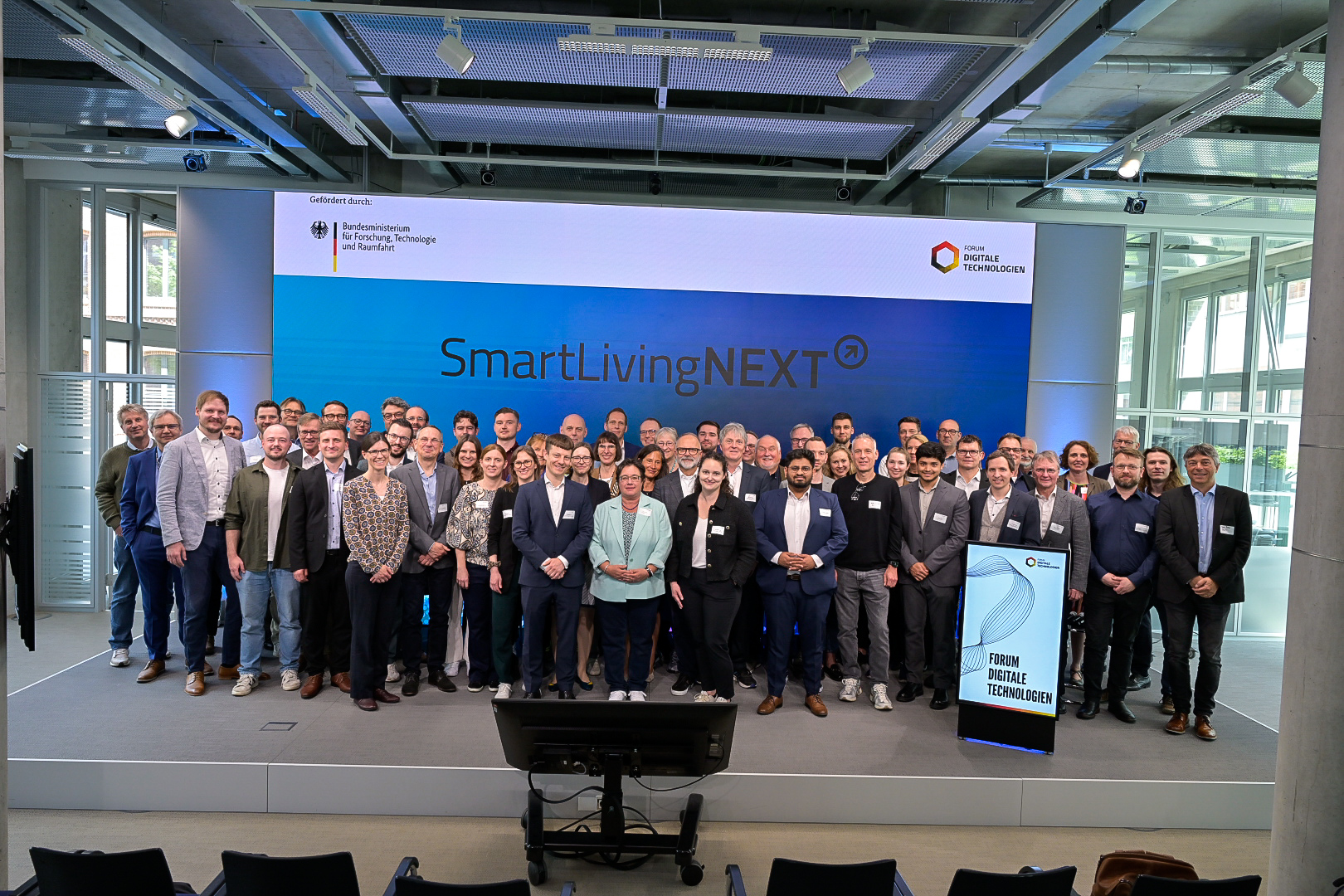
The SmartLivingNEXT community is also making excellent progress, with six new associated partners joining in the third quarter of 2024: the Federal Institute for Research on Building, Urban Affairs and Spatial Development (BBSR), captica GmbH, GROPYUS Technologies GmbH, Lengyel Design, Mako365 and metiundo GmbH. This means that the SmartLivingNEXT flagship project now consists of eight consortium partners and 27 associated partners.
Listen to the article (in German)
Editorial office:
Maximilian
Metzner
Category:
Flagship project
SmartLivingNEXT

Central documents for SmartLivingNEXT
The white paper contains the guideline and reference framework for the future technical development of the SmartLivingNEXT Dataspace and the desired governance structure. It was created with the collaboration of teams from German Research Center for Artificial Intelligence (DFKI), the Research Association for Electrical Engineering at ZVEI e.V., Ludwig-Maximilians-Universität München (LMU) and Materna Information & Communications SE. You can have the white paper sent to you as a PDF. Please contact our project office at projektbuero@smartlivingnext.de.
The document is intended as a structuring investor perspective and orientation framework, not as a final business plan, and analyzes the possible roles of potential investors. It was written in collaboration with Michael Schidlack, Research Association for Electrical Engineering at ZVEI e.V., Dr. Rahild Neuburger, Ludwig-Maximilians-Universität München (LMU) and Lars Thomsen, future matters AG. You can have the document sent to you as a PDF. Please contact our project office at projektbuero@smartlivingnext.de.
Das Dokument erläutert im ersten Teil (Governance & Organisation) SmartLivingNEXT als föderiertes Datenökosystem und beschreibt die Rollen, Verantwortlichkeiten und Entscheidungslogiken. Der zweite Teil (technische Architektur & Datenraum) beschreibt, wie diese Governance technisch umgesetzt wird. Es entstand unter Mitwirkung von Michael Schidlack, Forschungsvereinigung Elektrotechnik beim ZVEI e.V., Dr. Rahild Neuburger, Ludwig-Maximilians-Universität München (LMU) und Fanni Vespermann, Materna Information & Communications SE. Sie können sich das Dokument als PDF zusenden lassen. Please contact our project office at projektbuero@smartlivingnext.de.