“SmartLivingNEXT helps to develop European data integrity and identity and to keep the added value in our own country.”
5. September 2024
Reading time:
5 minutes
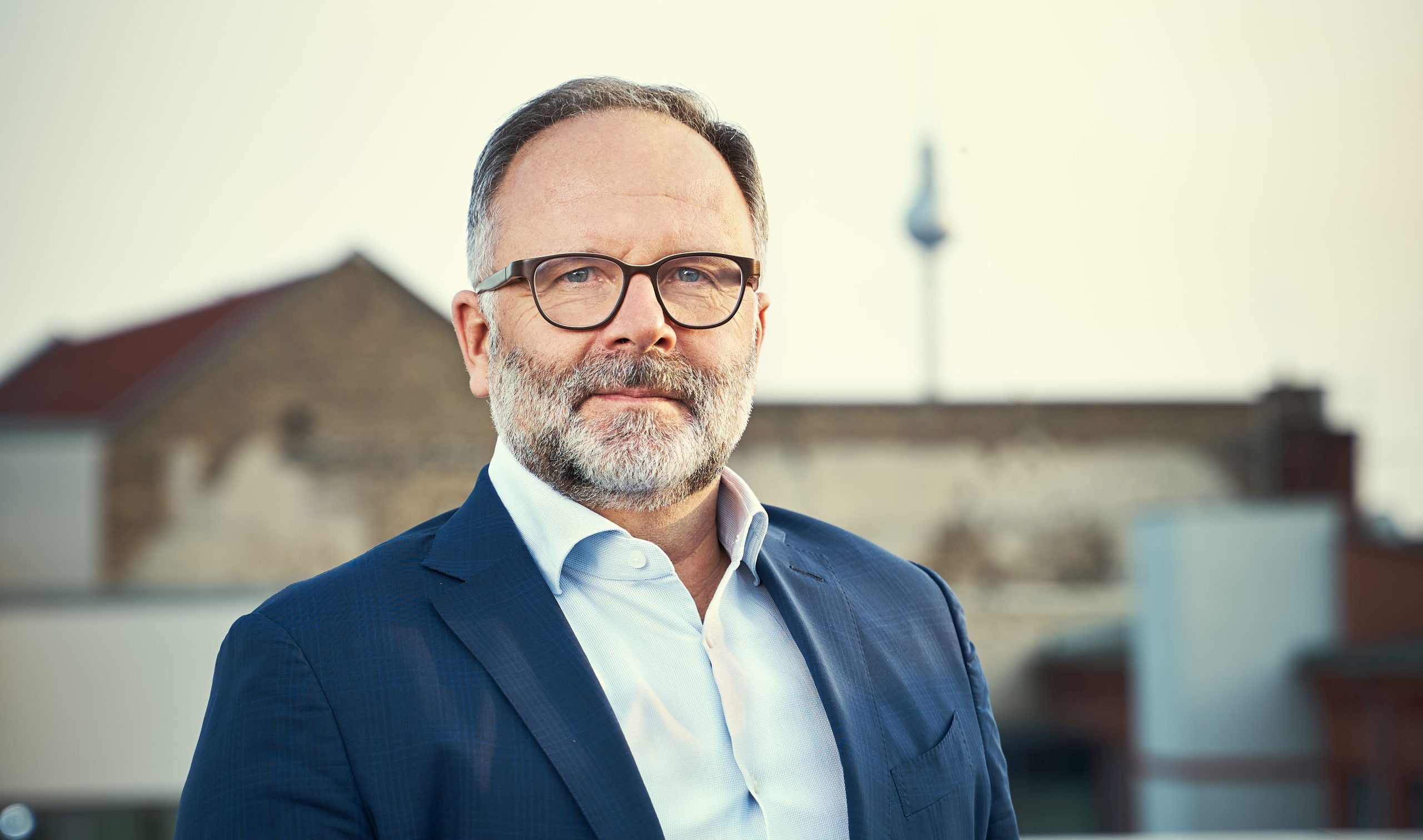
Hamburg-based start-up Goodville develops software and digital infrastructure components for smart, energy-neutral buildings. We talk to Managing Director Christoph Mühlhans about sustainable solutions for buildings, the role of building automation in achieving Germany’s climate targets and the reasons for an associated partnership with SmartLivingNEXT.
Mr Mühlhans, Goodville GmbH is a start-up founded in 2021 that specializes primarily in digital home technology, installation systems, robotics and building automation. Why did you found a company in the green tech sector?
A lot of energy can be saved in the building sector with networked sensors and actuators as well as artificial intelligence (AI).
There are already numerous individual solutions for smart technology, but there is a lack of digital infrastructure to bring them together in a comprehensive, easy-to-control system.
We develop software and digital infrastructure components for smart, heat-neutral buildings to protect the climate and ensure a high quality of living in the future.
Our undivided attention is focused on material and climate-friendly construction while at the same time conserving our precious resources.
The building sector plays a significant role in Germany’s 2030 climate targets, which aim to reduce all greenhouse gases by 65 percent compared to 1990 levels.
What role does building automation play here in increasing energy efficiency and reducing thecarbon footprint?
Building automation must and will make a significant contribution to reducing greenhouse gases in Europe in the future.
For example, smart room sensors and efficient AI in residential buildings can save at least 30 percent energy.
Heat pumps – as long as they provide heating water – also have enormous savings potential.
With a comprehensive digital infrastructure, AI can calculate the efficiency of all systems and machines in the residential building on a daily basis and continuously compare them with earlier stages.
This means that the systems always run in the optimum energy range and any need for servicing is detected as early as possible.
Most energy can be saved in heating and cooling technology in buildings.
Even modern heating systems are currently only controlled via the measured temperatures of the outside air and the return flow.
However, there are many other parameters that need to be taken into account in order to achieve the lowest possible flow temperature and operational hydraulics in order to increase energy efficiency and reduce theCO2 footprint.
Building automation has enormous potential here, which must be increasingly tapped into in the future.
A modern building should not only monitor and control itself, but also be able to learn, conserve resources and plan and execute appropriate actions itself.
What role can intelligent services play here and for which specific applications do you see potential for integration in such buildings?
Algorithms can already do a lot with the data collected in buildings and control living environments in a smart and comfortable way. However, the key to adaptive and predictive building control lies with AI and the experience it has already gained with reliable data. Here it is important to consider the building as a whole. All data from the consumption meters, all incoming and outgoing materials, all services and statuses must be recorded ad hoc, understood by the AI and evaluated in real time.
Imagine that all sockets and appliance connections are part of the system.
Even the smallest consumer is part of the fully recorded electrical and electronic infrastructure.
This will open up many new areas of application for services and pre-calculations in the future that we haven’t even considered yet.
Goodville is an associated partner of SmartLivingNEXT.
What was the deciding factor for you to take part in the research project?
In our search for suitable development partners for responsible AI, we have found an ideal partner in SmartLivingNEXT.
The technology program is developing a reliable, secure, sovereign and national access point for all smart living data.
Above all, we see the high data protection and sustainability requirements as a quality and ultimately competitive advantage for European building automation products and services.
SmartLivingNEXT is an important step in encouraging the industry to work together, to develop its own European data integrity and identity and to keep value creation at home.
Final question, Mr. Mühlhans: What added value do you see in an associated partnership with SmartLivingNEXT?
SmartLivingNEXT already has a wealth of experience with tenant networks and sovereign data infrastructures. The smart living ecosystem inspires us to develop new smart services and test them using the available data space.
Mr. Mühlhans, thank you for the interview!
Listen to the article (in German)
Editorial office:
Ilka
Klein
Category:
Flagship project
SmartLivingNEXT

Central documents for SmartLivingNEXT
The white paper contains the guideline and reference framework for the future technical development of the SmartLivingNEXT Dataspace and the desired governance structure. It was created with the collaboration of teams from German Research Center for Artificial Intelligence (DFKI), the Research Association for Electrical Engineering at ZVEI e.V., Ludwig-Maximilians-Universität München (LMU) and Materna Information & Communications SE. You can have the white paper sent to you as a PDF. Please contact our project office at projektbuero@smartlivingnext.de.
The document is intended as a structuring investor perspective and orientation framework, not as a final business plan, and analyzes the possible roles of potential investors. It was written in collaboration with Michael Schidlack, Research Association for Electrical Engineering at ZVEI e.V., Dr. Rahild Neuburger, Ludwig-Maximilians-Universität München (LMU) and Lars Thomsen, future matters AG. You can have the document sent to you as a PDF. Please contact our project office at projektbuero@smartlivingnext.de.
Das Dokument erläutert im ersten Teil (Governance & Organisation) SmartLivingNEXT als föderiertes Datenökosystem und beschreibt die Rollen, Verantwortlichkeiten und Entscheidungslogiken. Der zweite Teil (technische Architektur & Datenraum) beschreibt, wie diese Governance technisch umgesetzt wird. Es entstand unter Mitwirkung von Michael Schidlack, Forschungsvereinigung Elektrotechnik beim ZVEI e.V., Dr. Rahild Neuburger, Ludwig-Maximilians-Universität München (LMU) und Fanni Vespermann, Materna Information & Communications SE. Sie können sich das Dokument als PDF zusenden lassen. Please contact our project office at projektbuero@smartlivingnext.de.