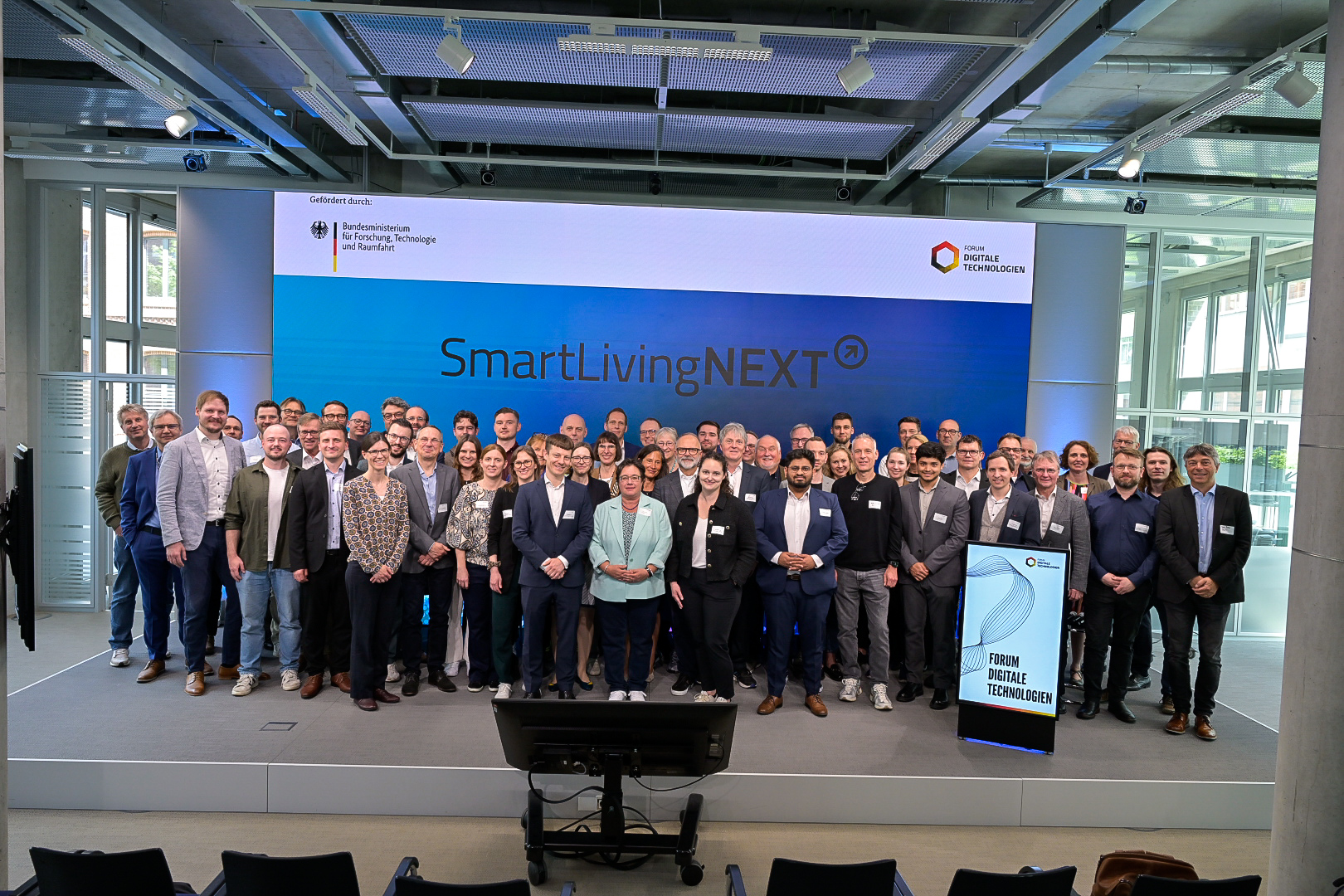
SmartLivingNEXT in conversation with municipal companies in Berlin.
1. December 2023
Reading time:
3 minutes
At Berlin Partner, everything revolves around Berlin’s innovation and economic potential and the networking of innovative sectors and clusters. The Smart City Unit at Berlin Partner manages a network of around 150 companies and organizes topic-specific exchange formats: on 15 November 2023, the SmartLivingNEXT technology program funded by the Federal Ministry of Economics and Climate Protection (BMWK) presented itself to municipal companies.
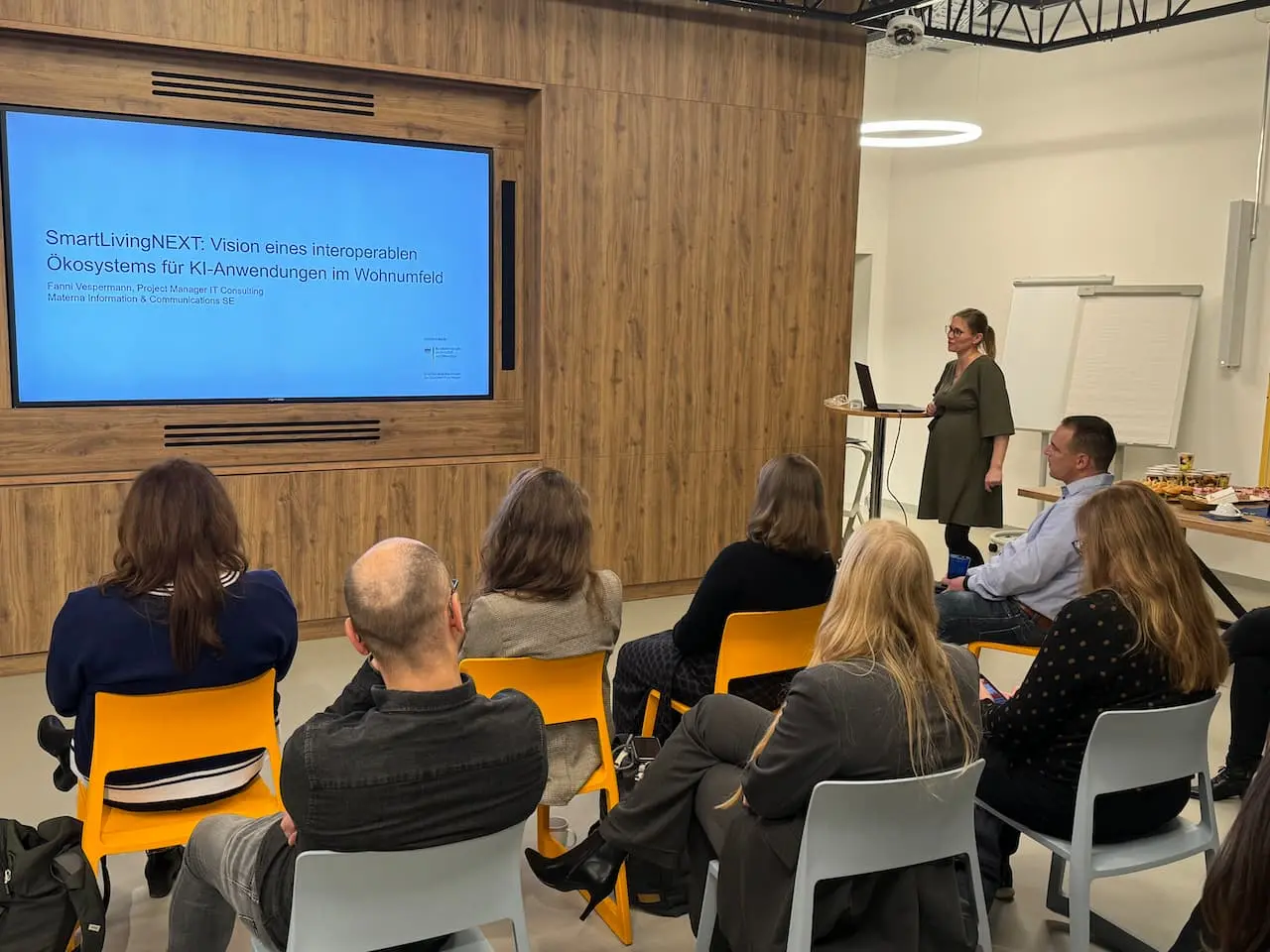
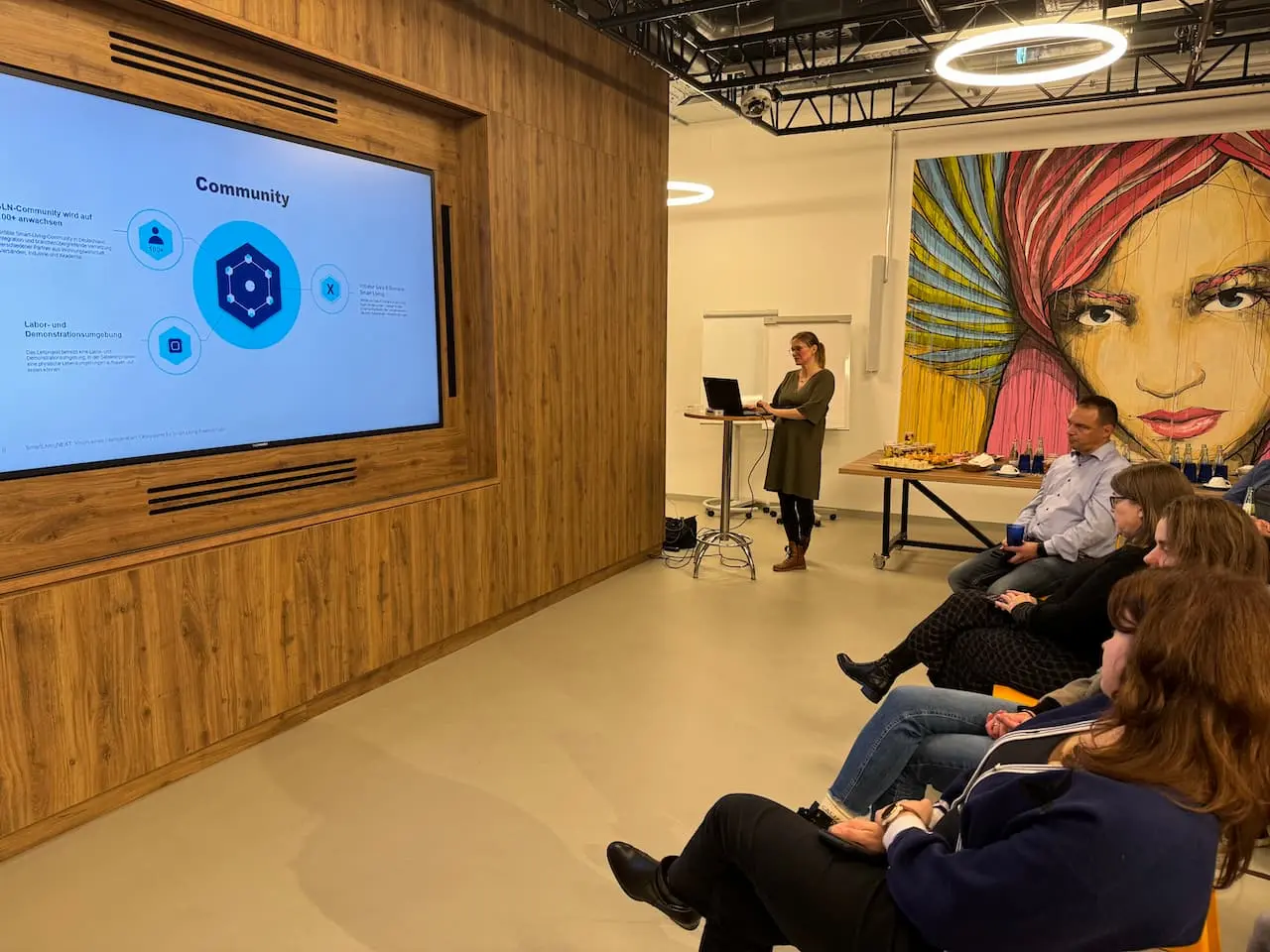
Once a quarter, the Smart City Unit invites digitization officers from around 25 municipal companies in Berlin to the “Municipal Innovation Management” expert group – in November, the focus was on “Artificial Intelligence”. Various questions were on the agenda: How do AI innovations get into the company? What are the current trends and success factors? What experience has already been gained with AI projects in the municipal housing industry? Of particular interest and added value are always concrete application examples from which future collaborations can arise or learning effects can be derived. One such example is the SmartLivingNEXT technology program: Michael Schidlack, consortium leader of the ForesightNEXT lead project, and Fanni Vespermann from Materna (lead project consortium partner) outlined the central idea of a planned ecosystem for AI-based smart living applications at the meeting, providing insights into the research project and exciting counter-questions.
What exactly is a SmartLivingNEXT ecosystem? How can sovereignty and control over the data be maintained? The response from the experts, including those from the housing industry, led to an in-depth discussion about data sovereignty, data security and the importance of a shared data space. To put it succinctly, SmartLivingNEXT offers a universal and secure access point to all relevant data in residential buildings. Each player can retain its own technology and at the same time join the SmartLivingNEXT ecosystem with uniform and transparent standards. The market potential of such a data room is immense.
The smart use of AI and the need for shared data not only form the basis for the smart living domain, but are also of great importance for Berlin on its way to becoming a smart city.
Both Beate Albert, coordinator of the Smart City Unit at Berlin Partner, and Sibylle Kubale, Smart City Innovation Manager, emphasized how important the exchange is for municipal companies in particular. Sustainable services of general interest and innovative municipal infrastructure are the cornerstones of sustainable cities. Municipal companies are therefore important implementation partners. It is essential not only to keep an eye on current technology trends, but also to learn from each other and design joint projects.
With the development of the SmartLivingNEXT ecosystem, the research project aims to make its contribution to this urban task and provide impetus for the future of housing and living in innovation-driven event series.
Article in audio format:
Editorial office:
Tatijana
Milovic
Category:
SmartLivingNEXT

Central documents for SmartLivingNEXT
The white paper contains the guideline and reference framework for the future technical development of the SmartLivingNEXT Dataspace and the desired governance structure. It was created with the collaboration of teams from German Research Center for Artificial Intelligence (DFKI), the Research Association for Electrical Engineering at ZVEI e.V., Ludwig-Maximilians-Universität München (LMU) and Materna Information & Communications SE. You can have the white paper sent to you as a PDF. Please contact our project office at projektbuero@smartlivingnext.de.
The document is intended as a structuring investor perspective and orientation framework, not as a final business plan, and analyzes the possible roles of potential investors. It was written in collaboration with Michael Schidlack, Research Association for Electrical Engineering at ZVEI e.V., Dr. Rahild Neuburger, Ludwig-Maximilians-Universität München (LMU) and Lars Thomsen, future matters AG. You can have the document sent to you as a PDF. Please contact our project office at projektbuero@smartlivingnext.de.
Das Dokument erläutert im ersten Teil (Governance & Organisation) SmartLivingNEXT als föderiertes Datenökosystem und beschreibt die Rollen, Verantwortlichkeiten und Entscheidungslogiken. Der zweite Teil (technische Architektur & Datenraum) beschreibt, wie diese Governance technisch umgesetzt wird. Es entstand unter Mitwirkung von Michael Schidlack, Forschungsvereinigung Elektrotechnik beim ZVEI e.V., Dr. Rahild Neuburger, Ludwig-Maximilians-Universität München (LMU) und Fanni Vespermann, Materna Information & Communications SE. Sie können sich das Dokument als PDF zusenden lassen. Please contact our project office at projektbuero@smartlivingnext.de.