The business value of data: Study explores possibilities for future business models for data ecosystems.
23. July 2025
Reading time:
3 minutes
SmartLivingNEXT, Catena-X and the Mobility Data Space (MDS) are among the first data ecosystems based on the Gaia-X initiative. A study conducted by consortium partner LMU Munich identifies suitable business models for these data ecosystems.
The shared data economy is revolutionizing all areas of society and the economy. The way in which companies generate value from data can take different forms. Two basic business logics can be distinguished here:
- The barter model (Catena-X):
Here, all participants are both data providers and data consumers. Data is mutually exchanged without direct monetary remuneration. Value is created through shared access to relevant data, which can be used for process optimization or decision support, for example. Value is captured indirectly, for example through cost savings or improved customer orientation.
- The marketplace model (SmartLivingNEXT, MDS):
In this model, the roles are clearly separated: data providers make their data available, while data consumers use it for their own purposes. Value creation is based on the fact that relevant data products can be found in a catalog and purchased. Value is captured through direct monetary remuneration or voluntary data donations.
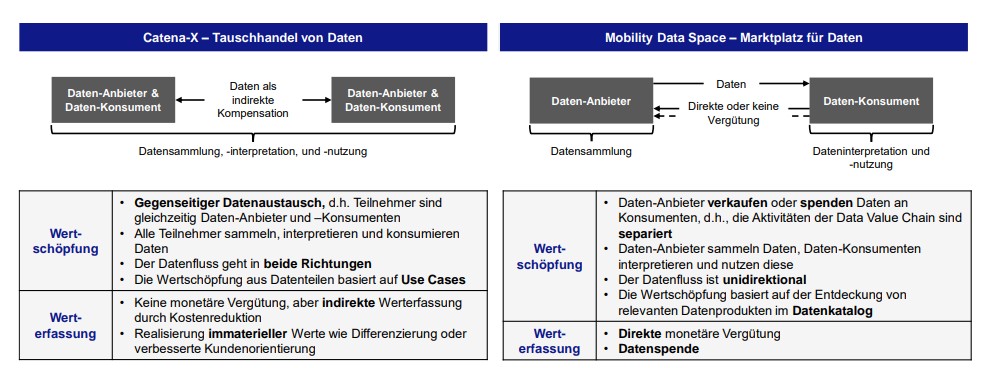
While the barter model impresses with its reciprocity, the marketplace enables data to be monetized directly. Jana Ammann from LMU Munich specifies the challenge: “The central task remains the fair distribution of value and the recording of intangible values such as reputation or innovative ability. The monetization of data can make a significant contribution to value creation in decentralized data ecosystems. Direct monetization in particular makes it possible to clearly quantify the economic benefits, for example through cost savings or a stronger market position for the companies involved. At the same time, indirect forms of value capture such as process optimization or improved customer orientation should not be underestimated. Although these benefits are more difficult to measure, they can also make a decisive contribution to long-term competitiveness.”
The participating consortium partners LMU Munich, Materna and Forschungsvereinigung Elektrotechnik beim ZVEI e.V. are currently working on what the business logics in SmartLivingNEXT will look like in concrete terms. The study’s elaboration of the business model types in Catena-X and the Mobility Data Space provide valuable pointers here. In the long term, SmartLivingNEXT can thus serve as a blueprint for a balanced, sustainable data economy.
Listen to the article (in German):
Editorial office:
Maximilian
Metzner
Category:
SmartLivingNEXT

Central documents for SmartLivingNEXT
The white paper contains the guideline and reference framework for the future technical development of the SmartLivingNEXT Dataspace and the desired governance structure. It was created with the collaboration of teams from German Research Center for Artificial Intelligence (DFKI), the Research Association for Electrical Engineering at ZVEI e.V., Ludwig-Maximilians-Universität München (LMU) and Materna Information & Communications SE. You can have the white paper sent to you as a PDF. Please contact our project office at projektbuero@smartlivingnext.de.
The document is intended as a structuring investor perspective and orientation framework, not as a final business plan, and analyzes the possible roles of potential investors. It was written in collaboration with Michael Schidlack, Research Association for Electrical Engineering at ZVEI e.V., Dr. Rahild Neuburger, Ludwig-Maximilians-Universität München (LMU) and Lars Thomsen, future matters AG. You can have the document sent to you as a PDF. Please contact our project office at projektbuero@smartlivingnext.de.
Das Dokument erläutert im ersten Teil (Governance & Organisation) SmartLivingNEXT als föderiertes Datenökosystem und beschreibt die Rollen, Verantwortlichkeiten und Entscheidungslogiken. Der zweite Teil (technische Architektur & Datenraum) beschreibt, wie diese Governance technisch umgesetzt wird. Es entstand unter Mitwirkung von Michael Schidlack, Forschungsvereinigung Elektrotechnik beim ZVEI e.V., Dr. Rahild Neuburger, Ludwig-Maximilians-Universität München (LMU) und Fanni Vespermann, Materna Information & Communications SE. Sie können sich das Dokument als PDF zusenden lassen. Please contact our project office at projektbuero@smartlivingnext.de.