“We can provide measured values for the interoperable data room without having to get involved in building renovations.”
27. November 2023
Reading time:
4 minutes
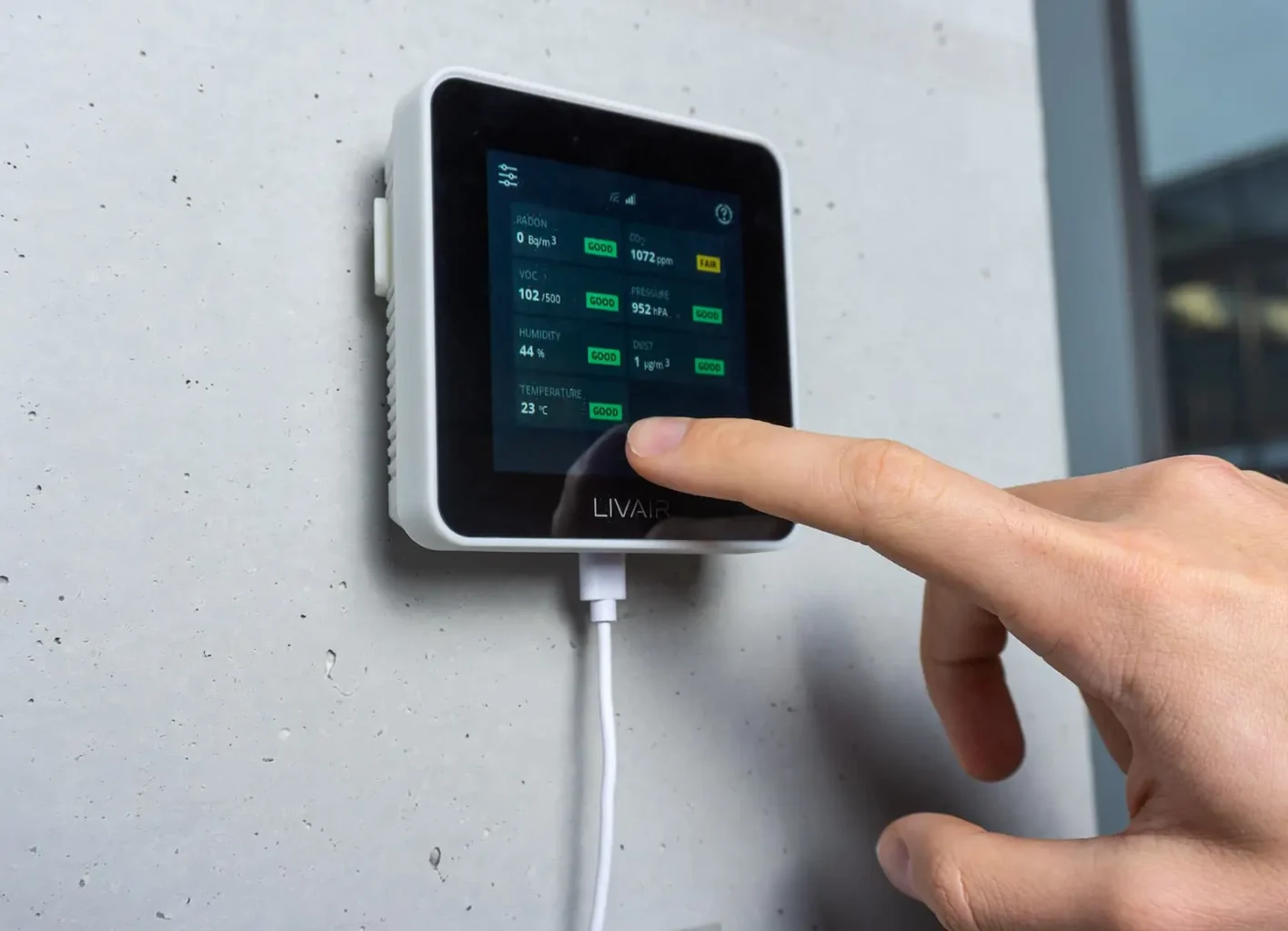
LivAir specializes in the development, manufacture and sale of measurement technology for indoor air measurement. In an interview with Dipl. Ing. Martin Waltl, Managing Director and radon expert, we talk about digitalization in the building sector and the motivation to get involved in SmartLivingNEXT as a start-up.

Mr. Waltl, your company website states that we spend 90 percent of our time indoors every day, breathing air that is five times more polluted than outside. What does good indoor air have to do with smart living?
The future of living and working will be more sustainable and energy-efficient than is currently the case. However, energy-efficient building renovations often require the building envelope to be tightened, which leads to poorer indoor air quality. And air is the most important elixir of life, which we consume in large quantities every day. Only if we measure the parameters in real time can we ensure good air quality for us humans in buildings. This is where LivAir comes in. Our innovative sensor system measures the indoor air. This enables AI-supported ventilation that is adapted to the occupancy behaviour of people and thus optimizes the indoor air.
SmartLivingNEXT is involved in the development of an interoperable, AI-driven and decentralized data room. What similarities between the research project and your company motivated you to become an associated partner?
In many technical applications, common standards ensure an improvement in the respective technology and greater acceptance of the solution on the market. An interoperable data room will therefore ensure more market participants, which will accelerate the speed of transformation. Due to the importance of reducing energy resources in building management, this speed is very relevant for all of us.
Our room air sensors can be retrofitted extremely quickly for building operators and users. We can therefore provide measured values for the interoperable data room very quickly, without having to invest in building renovations and upgrades. At the same time, it enables other software providers to develop their own solutions based on our measurement sensor technology. We therefore see this as a win-win situation for all market participants.
Residential buildings have massive potential for smart home/smart building technologies and for the corresponding intelligent, cross-sector applications or services. What role does AI play at LivAir?
In principle, AI makes it possible to filter out trends from a very large selection of data and respond to individual behavior.
This is particularly interesting in the building sector, as a measuring sensor system always measures the same room air parameters, but the usage behavior of the occupants and users varies completely from room to room and building to building.
Our vision is moving in the direction of an individualized ventilation concept for every interior; in other words, the combination of measuring sensors, automated ventilation and this adapted to the needs of the individual user.
SmartLivingNEXT’s digital services are intended to help reduce energy consumption in buildings, among other things. What role does good indoor air play in reducing CO₂ emissions?
When new buildings are planned and constructed, we are talking about useful lives that are designed for several decades. Real-time sensor technology enables the actual condition of the building to be recorded. This can be compared to a “complete blood count” in humans. Only if you know all the relevant indoor air parameters can you make data-based decisions, e.g. to optimally adapt the heating and ventilation behavior to the usage behavior. This can save an enormous amount of resources and CO₂ emissions over the life cycle of the building.
Mr. Waltl, thank you for the interview.
Article in audio format:
Editorial office:
Tatijana
Milovic
Category:
SmartLivingNEXT

Central documents for SmartLivingNEXT
The white paper contains the guideline and reference framework for the future technical development of the SmartLivingNEXT Dataspace and the desired governance structure. It was created with the collaboration of teams from German Research Center for Artificial Intelligence (DFKI), the Research Association for Electrical Engineering at ZVEI e.V., Ludwig-Maximilians-Universität München (LMU) and Materna Information & Communications SE. You can have the white paper sent to you as a PDF. Please contact our project office at projektbuero@smartlivingnext.de.
The document is intended as a structuring investor perspective and orientation framework, not as a final business plan, and analyzes the possible roles of potential investors. It was written in collaboration with Michael Schidlack, Research Association for Electrical Engineering at ZVEI e.V., Dr. Rahild Neuburger, Ludwig-Maximilians-Universität München (LMU) and Lars Thomsen, future matters AG. You can have the document sent to you as a PDF. Please contact our project office at projektbuero@smartlivingnext.de.
Das Dokument erläutert im ersten Teil (Governance & Organisation) SmartLivingNEXT als föderiertes Datenökosystem und beschreibt die Rollen, Verantwortlichkeiten und Entscheidungslogiken. Der zweite Teil (technische Architektur & Datenraum) beschreibt, wie diese Governance technisch umgesetzt wird. Es entstand unter Mitwirkung von Michael Schidlack, Forschungsvereinigung Elektrotechnik beim ZVEI e.V., Dr. Rahild Neuburger, Ludwig-Maximilians-Universität München (LMU) und Fanni Vespermann, Materna Information & Communications SE. Sie können sich das Dokument als PDF zusenden lassen. Please contact our project office at projektbuero@smartlivingnext.de.