DigiKon Süd: SmartLivingNEXT presents universal data ecosystem for the housing industry
16. April 2025
Reading time:
5 minutes
The housing industry met at DigiKon Süd to discuss megatrends, innovative technologies, new business models and the challenges of digital transformation in the sector. The event took place from March 31 to April 1, 2025 in the BigBox in Kempten. SmartLivingNEXT presented the decentralized data ecosystem and the associated potential of intelligent smart living services for the housing industry.
“Practical digitalization” was the motto of this year’s event for the housing industry in southern Germany. Housing companies came together here to discuss and exchange practical information about their projects. The focus was on artificial intelligence (AI) and sustainable solutions for the climate transition, possible uses of chatbots in the housing industry and successful digitalization projects and cooperation models. Taking part for the first time: SmartLivingNEXT.
Housing industry with immense potential to make data usable
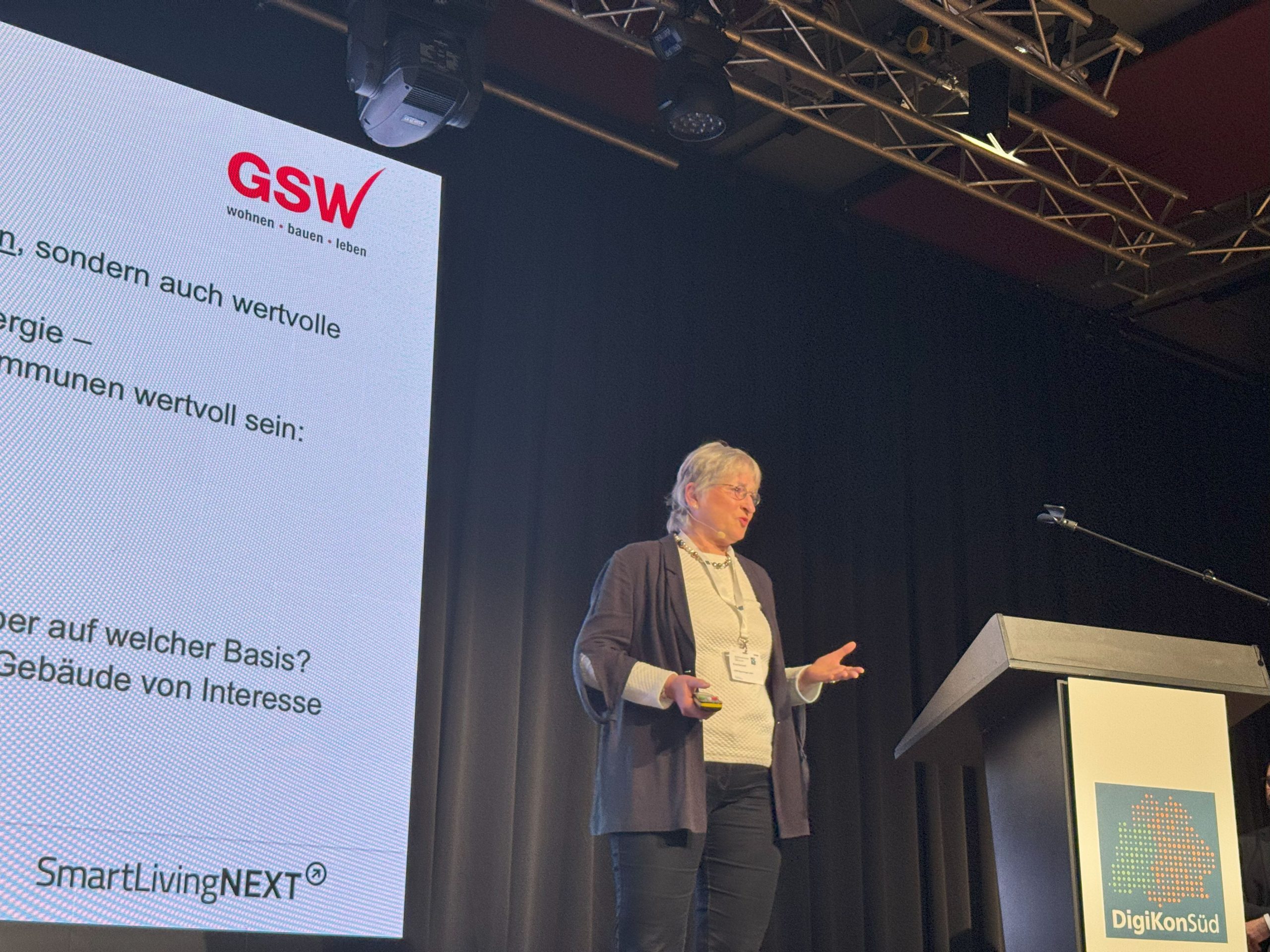
Birgid Eberhardt, Head of Research & Development at GSW Gesellschaft für Siedlungs- und Wohnungsbau Baden-Württemberg mbH and consortium partner in SmartLivingNEXT, presented the research project and the associated innovation potential for the housing industry to an interested audience of experts. Eberhardt made it clear that the housing industry already generates and works with immense amounts of data, but that its systematic use often fails due to its distribution across different systems and their lack of networking. In particular, this leads to redundant, unsynchronized extracts of data that are not up to date. This is where SmartLivingNEXT comes in by creating an AI-supported, universal and sovereign data ecosystem that enables secure data exchange.
Aggregated data from different sources helps housing companies to meet the requirements for greater energy efficiency and climate neutrality
SmartLivingNEXT will create a uniform national and even European access point for data and applications that will help to increase energy efficiency in the home. Above all, it will enable the use of cross-manufacturer and cross-system data and thus the design of new solutions. “As the housing industry, we are not only data consumers, but also valuable data suppliers. Our buildings are major consumers and producers of energy. Information about them can be valuable for energy suppliers and local authorities. The data we collect and aggregate benefits us as a housing company as well as energy suppliers and local authorities when making investment decisions. They can be used to create forecasts for the heating and energy transition and thus support planning processes for everyone involved,” commented Eberhardt.
Best practice: Energy efficiency data portal creates digital interfaces between municipalities, energy suppliers and the housing industry
One example of practical implementation within the SmartLivingNEXT dataspace is the energy efficiency data portal for comprehensive energy efficiency and heat planning, which is currently being developed by consortium partner Materna. For the first time, the portal will allow real consumption data to be merged with data on the building fabric and data from suppliers and local authorities in a data room and evaluated. This will be used for planning by all parties involved, e.g. with regard to energy and heat planning or ensuring grid infrastructure and stability.
The lively dialog that followed was moderated by Hans Maier, Director of the Verband bayerischer Wohnungsunternehmen e. V. (Association of Bavarian Housing Companies). The discussion partners were Birgid Eberhardt and Martin Schneider, Branch Manager for Eastern and Northern Bavaria, Information Management and Digitalized Construction working groups at BAUINDUSTRIE. The latter also emphasized the need for consistent digitalization. There is not too little data, but too much – but above all redundant data in different places. The construction industry urgently needs to go digital in order to reduce costs and solve issues relating to sustainability, climate justice, the circular economy and the shortage of skilled workers. Consistent digitalization of all processes is essential in order to increase productivity.
Eberhardt concludes: “The digitalization of the housing industry is not an end in itself, but a necessary prerequisite for successfully mastering the challenges of the energy transition, climate protection and resource efficiency.”
Overall, the event offered housing companies from Bavaria and Baden-Württemberg a suitable platform to exchange best practices, discuss innovative solutions and gain impetus for the further digital transformation of the industry. DigiKon Süd has been jointly organized by the Association of Bavarian Housing and Real Estate Companies (VdW Bayern) and the Association of Baden-Württemberg Housing and Real Estate Companies (vbw) every year since 2020.
Listen to the article (in German)
Editorial office:
Ilka
Klein
Category:
Flagship project
SmartLivingNEXT

Central documents for SmartLivingNEXT
The white paper contains the guideline and reference framework for the future technical development of the SmartLivingNEXT Dataspace and the desired governance structure. It was created with the collaboration of teams from German Research Center for Artificial Intelligence (DFKI), the Research Association for Electrical Engineering at ZVEI e.V., Ludwig-Maximilians-Universität München (LMU) and Materna Information & Communications SE. You can have the white paper sent to you as a PDF. Please contact our project office at projektbuero@smartlivingnext.de.
The document is intended as a structuring investor perspective and orientation framework, not as a final business plan, and analyzes the possible roles of potential investors. It was written in collaboration with Michael Schidlack, Research Association for Electrical Engineering at ZVEI e.V., Dr. Rahild Neuburger, Ludwig-Maximilians-Universität München (LMU) and Lars Thomsen, future matters AG. You can have the document sent to you as a PDF. Please contact our project office at projektbuero@smartlivingnext.de.
Das Dokument erläutert im ersten Teil (Governance & Organisation) SmartLivingNEXT als föderiertes Datenökosystem und beschreibt die Rollen, Verantwortlichkeiten und Entscheidungslogiken. Der zweite Teil (technische Architektur & Datenraum) beschreibt, wie diese Governance technisch umgesetzt wird. Es entstand unter Mitwirkung von Michael Schidlack, Forschungsvereinigung Elektrotechnik beim ZVEI e.V., Dr. Rahild Neuburger, Ludwig-Maximilians-Universität München (LMU) und Fanni Vespermann, Materna Information & Communications SE. Sie können sich das Dokument als PDF zusenden lassen. Please contact our project office at projektbuero@smartlivingnext.de.