Rethinking buildings: SmartLivingNEXT combines user focus and sustainable business models
15. January 2026
Reading time:
9 minutes
At the end of the fourth quarter of 2025, SmartLivingNEXT will show how user-centered use cases and a sustainable financing model work together. The result is a resilient digital ecosystem for the building world with a clear focus on benefits, practical relevance and future viability.
In the fourth quarter, SmartLivingNEXT made decisive progress towards a user-centered and economically viable digital building ecosystem: The SmartLivingNEXT app is available for the first time as a functional demonstrator for iOS and Android, central energy and building data can be used by local authorities via a new energy efficiency data portal, and a resilient governance and financing model provides the basis for the long-term operation of the data room. Together, these milestones show how digital applications, data rooms and business models can work together to advance the digitalization of buildings in a scalable and practical way.
The SmartLivingNEXT app, which was largely completed, played a central role in the fourth quarter. All central application interfaces that are connected to the backend were designed in the areas of energy, heat, hot water and electricity. All relevant app interfaces have been completed and optimized through user tests. The app is now available as a demonstrator for iOS and Android and has been expanded in terms of functionality, including improved budget billing calculations, an electricity consumption forecast and other analysis functions. At the same time, important milestones were reached with the Energy Efficiency Data Portal (EEDP). Together with the Saarland, a data room demonstrator is being created here that will provide local authorities and government agencies with centralized access to energy-related building data. New analysis functions, a structured metadata catalog and AI-supported evaluations support the derivation of specific measures to increase energy efficiency. In addition, the use of synthetic and real building data for forecasts and a new redispatch concept, which aims to detect grid overloads at an early stage and avoid peak loads, were further developed in the SmartLivingNEXT data room. Testing under real conditions is planned for the further course of the project.
The economic foundation for the digital future of living
Another important milestone in the fourth quarter was the development of a continuation and financing model for the operation of the SmartLivingNEXT data room by LMU Munich. A GmbH structure is recommended for the SLN ecosystem as the controlling entity that integrates technical partners. In the future, models for monetizing data and services should also be made possible. The financing of SmartLivingNEXT is divided into several phases, with both public funding and contributions from shareholders and technical operators playing a central role. In the research phase (2023 to 2026), the Federal Ministry of Research, Technology and Space (BMFTR) has provided funding of 25 million euros, which covers the development of the blueprint, the development of a governance structure and integration and test environments, among other things. In the operating phase, financing will be provided by shareholder contributions, contractually bound technical operators and possible transitional financing by the state, particularly in the areas of coordination and infrastructure.
The governance and financial model developed by LMU is based on a hybrid approach that combines basic membership fees and usage-based components. Transaction fees are not initially planned, but the introduction of a freemium model should be possible at a later date. Public support is required during the transition phase in order to stabilize operations. The aim is to ensure cost-covering financing. In the operating phase, financing is to be supplemented by membership fees, user fees and possible certification fees. Materna has already developed the blueprint. This is the first step towards scaling the project across Europe.
Stable infrastructure and easy access to the data room
In addition, intensive work was carried out in Q4/2025 on a standardized data model that forms the basis for secure, transparent and sovereign data exchange. Consortium partner German Research Center for Artificial Intelligence (DFKI) is responsible for the central technical foundations of the data space, in particular driving forward the description of metadata on data quality, origin, interfaces and access rights. The process for creating and managing data assets was also further developed and standardized on this basis.
At the same time, there was a clear focus on stabilizing and future-proofing the technical infrastructure. The Dataspace Blueprint was continuously developed and optimized to ensure that the data room can be operated reliably and productively even after the end of the project in August 2026. To this end, existing software components were reviewed, modernized and, where necessary, replaced with stable alternatives. In addition, functional connectors were provided, test data sets were integrated and specific use cases were further developed.
Another focus is easy access to the data room for new and existing players. The aim is to make participation as low-threshold and user-friendly as possible. To this end, clear onboarding processes have been defined and a data room portal has been set up that will bundle central functions such as catalogs, services, asset and access management in the future. A user interface that has already been developed is used in previews to clearly convey how the data room works. Special attention is also paid to making data offerings in the SmartLivingNEXT ecosystem easier to find. Federated catalogs were technically merged and supplemented in the future by open standards such as the open source data management system Comprehensive Knowledge Archive Network (CKAN) in order to structure data clearly and make it easier to find. In addition, AI-supported assistants were successfully tested, which significantly simplify the description and setting of data offerings and thus further facilitate the sovereign exchange of data.
Online preview of the SmartLivingNEXT data room portal
In a compact online preview, Materna showed how the data room portal works, how simple the onboarding process is and why it is becoming the central basis for new digital applications and business models. Users were given insights into the SmartLivingNEXT blueprint as the basis for new business models, efficient use and administration of data and services via the data room portal was demonstrated and an interactive presentation of the onboarding process for new participants was presented.
Artificial intelligence (AI) for realistic energy data
In the area of artificial intelligence (AI) and semantics, the SmartLivingNEXT flagship project with the German Research Center for Artificial Intelligence (DFKI) is contributing its AI expertise, particularly in the generation and use of intelligent energy data. In the fourth quarter of 2025, work continued on the targeted use of language models to simulate household behavior. The aim is to generate realistic, synthetic energy data that can be used to train AI and machine learning models without having to rely on real personal data.
To increase the diversity of the data generated, different household types, occupant structures and appliance combinations are included in the simulations. This allows different usage patterns to be better mapped and the quality of the synthetic data to be further increased. The results so far show that the use of language models is very suitable for this and can be further expanded. At the same time, user interaction with the systems has been simplified: in future, it should also be possible to adapt complex logic-based models using natural language. In addition, important foundations were laid for a machine learning development pipeline in the SmartLivingNEXT data room and initial services were integrated. This was rounded off by the further development of an electricity consumption forecast and a user interface that links all modules together as a prototype and clearly illustrates how they work.
SmartLivingNEXT community is growing steadily
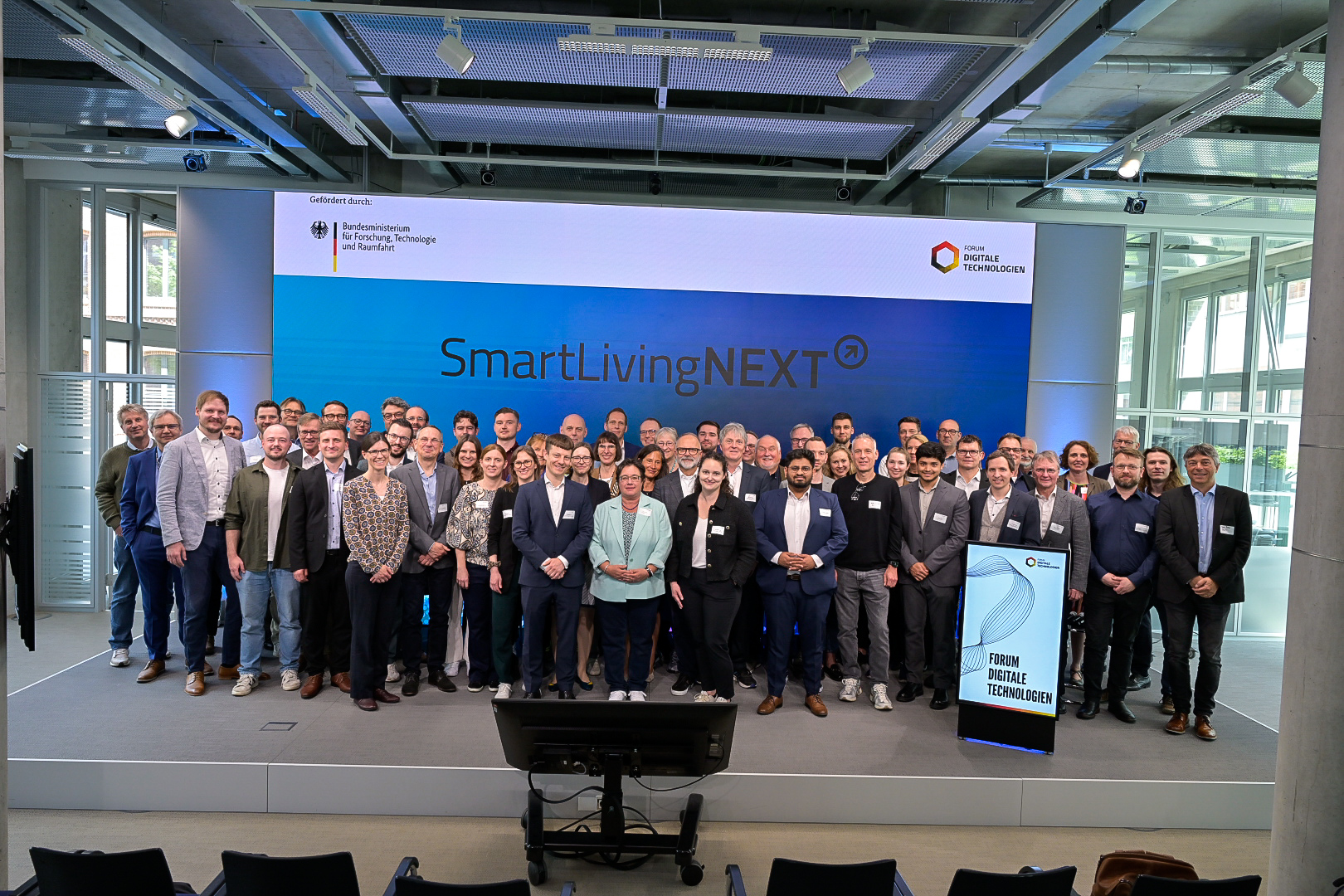
Two new associated partners were added to the SmartLivingNEXT flagship project in the fourth quarter of 2025: HYPERTEGRITY AG and SmartSpace Consulting. This means that the flagship project currently consists of eight consortium partners and 51 associated partners.
Listen to the article (in German):
Editorial office:
Ilka
Klein
Category:
Flagship project
SmartLivingNEXT

Central documents for SmartLivingNEXT
The white paper contains the guideline and reference framework for the future technical development of the SmartLivingNEXT Dataspace and the desired governance structure. It was created with the collaboration of teams from German Research Center for Artificial Intelligence (DFKI), the Research Association for Electrical Engineering at ZVEI e.V., Ludwig-Maximilians-Universität München (LMU) and Materna Information & Communications SE. You can have the white paper sent to you as a PDF. Please contact our project office at projektbuero@smartlivingnext.de.
The document is intended as a structuring investor perspective and orientation framework, not as a final business plan, and analyzes the possible roles of potential investors. It was written in collaboration with Michael Schidlack, Research Association for Electrical Engineering at ZVEI e.V., Dr. Rahild Neuburger, Ludwig-Maximilians-Universität München (LMU) and Lars Thomsen, future matters AG. You can have the document sent to you as a PDF. Please contact our project office at projektbuero@smartlivingnext.de.
Das Dokument erläutert im ersten Teil (Governance & Organisation) SmartLivingNEXT als föderiertes Datenökosystem und beschreibt die Rollen, Verantwortlichkeiten und Entscheidungslogiken. Der zweite Teil (technische Architektur & Datenraum) beschreibt, wie diese Governance technisch umgesetzt wird. Es entstand unter Mitwirkung von Michael Schidlack, Forschungsvereinigung Elektrotechnik beim ZVEI e.V., Dr. Rahild Neuburger, Ludwig-Maximilians-Universität München (LMU) und Fanni Vespermann, Materna Information & Communications SE. Sie können sich das Dokument als PDF zusenden lassen. Please contact our project office at projektbuero@smartlivingnext.de.