
When buildings become intelligent as a system

SmartLivingNEXT creates the federated data infrastructure for AI-based, sustainable living environments.
Buildings and technical building systems are technically mature today. Heating, energy, security, comfort and automation function reliably and have been continuously optimized over the years. These systems are stable, proven and highly efficient locally. At the same time, the framework conditions are changing fundamentally. Dynamic energy markets, increasing regulatory requirements, new mobility needs and the growing use of artificial intelligence mean that buildings can no longer be viewed in isolation. Added value, efficiency and controllability are increasingly being created through the interaction of many buildings, systems and players. The key bottleneck here is not the available technology, but the lack of a structural connection between existing systems. Historically grown architectures are designed for local optimization and reach their limits where scaling, reuse, cross-sector use or AI-supported services are required.
This is precisely where SmartLivingNEXT comes in.
SmartLivingNEXT is an AI-based, federated data ecosystem for the smart living domain. It is not a new building automation system, product or central platform, but a manufacturer-neutral data infrastructure that enables the secure, purpose-specific and interoperable exchange of data across existing systems and buildings. At its heart is a secure access point to relevant data in residential buildings. The underlying semantic dataspace concept leaves data in its original environment and at the same time creates the conditions for making this data usable across systems. This allows proven digital technologies already in use in residential buildings to be integrated, combined and reused – without replacing existing systems.
On this basis, SmartLivingNEXT provides the community with AI-supported basic services for data analysis, forecasting and pattern recognition. The necessary catalogs, tools and connectors are being developed in the ForeSightNEXT flagship project. Six other SmartLivingNEXT projects are conducting parallel research into the implementation of specific use cases, particularly in the areas of energy and assistance, and it is not the individual building that is becoming “smarter”. The system in which buildings interact with each other becomes intelligent. SmartLivingNEXT thus creates the basis for scalable services, new business models and cost-effective real operation of intelligent buildings in a network.
SmartLivingNEXT is a call for funding applications carried out by the Federal Ministry of Research, Technology and Space (BMFTR) on the basis of the “Development of Digital Technologies” funding program. Funding of around 25 million euros is available in the overall program.

Central documents for SmartLivingNEXT
Das Whitepaper enthält die Leitlinie und den Referenzrahmen für die künftige technische Entwicklung des SmartLivingNEXT Dataspaces und der angestrebten Governance-Struktur. Es entstand unter Mitwirkung der Teams von DFKI, der Forschungsvereinigung Elektrotechnik beim ZVEI e.V., Ludwig-Maximilians-Universität München (LMU) und Materna Information & Communications SE. Sie können sich das Whitepaper als PDF zusenden lassen. Kontaktieren Sie dazu unser Projektbüro unter SmartLivingNEXT@iit-berlin.de.
Das Dokument versteht sich als strukturierende Investorenperspektive und Orientierungsrahmen, nicht als finaler Businessplan und analysiert die möglichen Rollen potenzieller Investoren. Es entstand unter Mitwirkung von Michael Schidlack, Forschungsvereinigung Elektrotechnik beim ZVEI e.V., Dr. Rahild Neuburger, Ludwig-Maximilians-Universität München (LMU) und Lars Thomsen, future matters AG. Sie können sich das Dokument als PDF zusenden lassen. Kontaktieren Sie dazu unser Projektbüro unter SmartLivingNEXT@iit-berlin.de.
Das Dokument erläutert im ersten Teil (Governance & Organisation) SmartLivingNEXT als föderiertes Datenökosystem und beschreibt die Rollen, Verantwortlichkeiten und Entscheidungslogiken. Der zweite Teil (technische Architektur & Datenraum) beschreibt, wie diese Governance technisch umgesetzt wird. Es entstand unter Mitwirkung von Michael Schidlack, Forschungsvereinigung Elektrotechnik beim ZVEI e.V., Dr. Rahild Neuburger, Ludwig-Maximilians-Universität München (LMU) und Fanni Vespermann, Materna Information & Communications SE. Sie können sich das Dokument als PDF zusenden lassen. Kontaktieren Sie dazu unser Projektbüro unter SmartLivingNEXT@iit-berlin.de.
SmartLivingNEXT – The first universal and AI-based ecosystem for all digital smart living services according to European values.
You are currently viewing a placeholder content from YouTube. To access the actual content, click the button below. Please note that doing so will share data with third-party providers.
More InformationSmart living on course for growth
97
Millions of European households will use smart living applications by 2025.
180
Mrd. Euro wird der weltweite Umsatz durch Smart Living bis 2025 betragen.
Figures based on data from the German Federal Ministry for Economic Affairs and Climate Action (BMWK)
Current posts
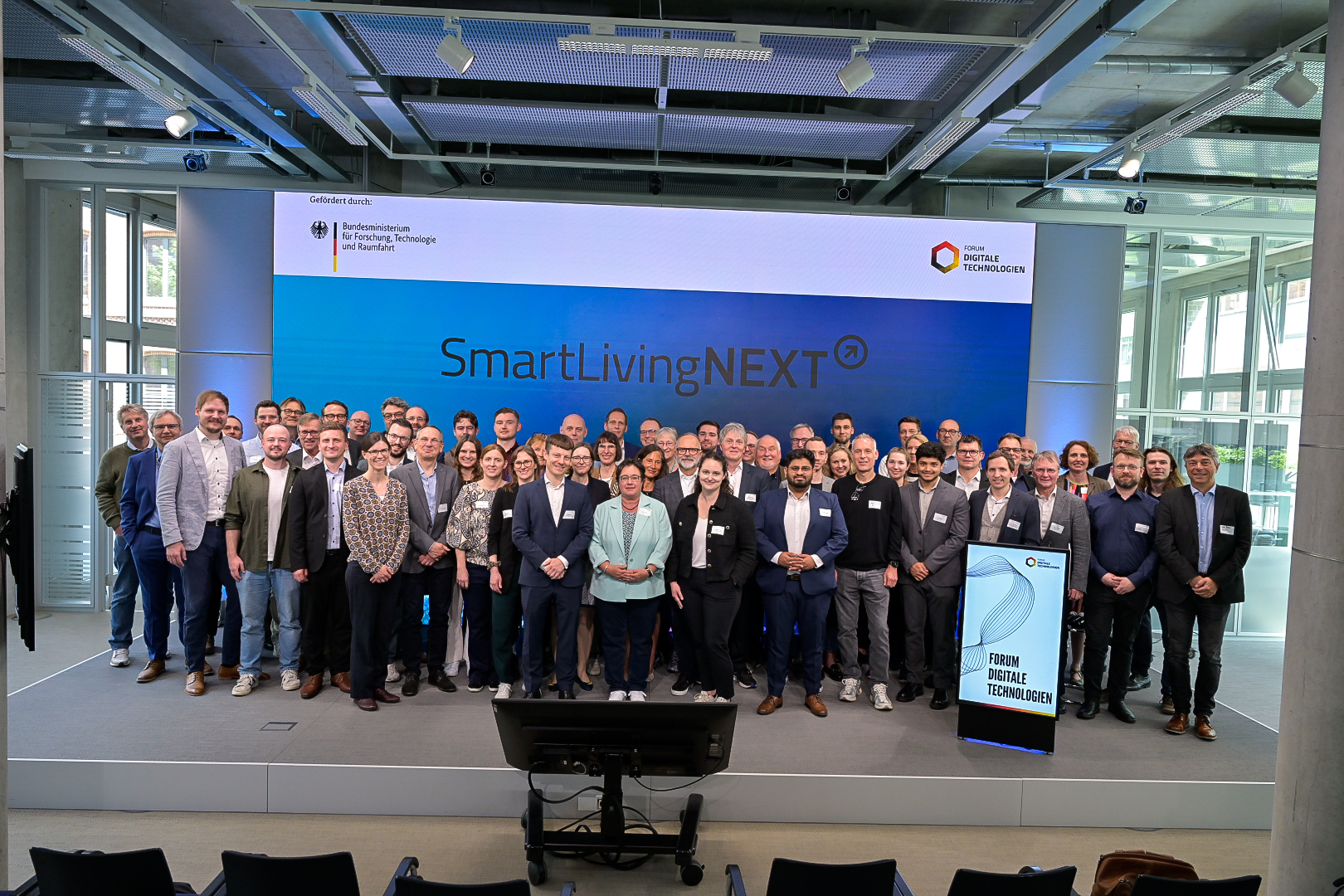



Latest press releases
Upcoming events
Industry news
Latest publications
Become a partner of SmartLivingNEXT
Associated partners accompany SmartLivingNEXT throughout its entire duration and actively support the objectives of the call for funding applications. Numerous companies and institutions have already expressed their interest in participating as associated project partners.