To kick off the event, Michael Schidlack—Principal Researcher at the Electrical Engineering Research Association (FE) within ZVEI e.V. and consortium lead for the SmartLivingNEXT flagship project—welcomed the guests and contextualized the technology program’s significance within the digital transformation of the building sector. “With SmartLivingNEXT, we have demonstrated that interoperable data spaces can work in the building sector—in a way that is legally secure, scalable, and cross-vendor. Now, the crucial phase begins: the transition from research project to real-world operation,” Schidlack explained.
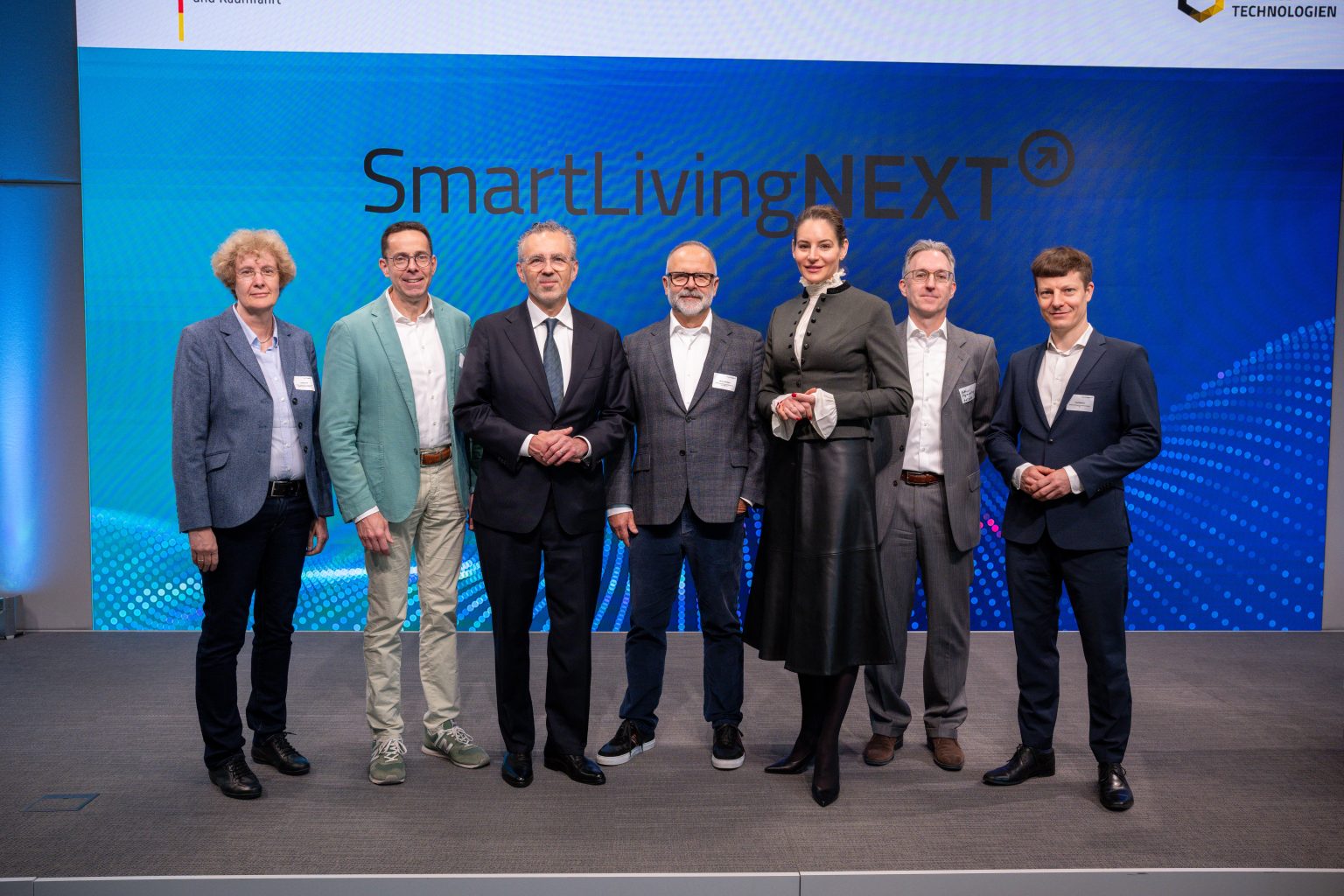
Discussing the launch of real-world operations at the SmartLivingNEXT conference held at the Forum for Digital Technologies in Berlin were (from left): Ute Bernhardt, Head of the Artificial Intelligence Division at the Federal Ministry for Research, Technology and Space (BMFTR); Wolfgang Weber, Chairman of the ZVEI Executive Board; Thomas Jarzombek, Parliamentary State Secretary to the Federal Minister for Digital Affairs and State Modernization; Michael Schidlack, Principal Researcher at the ZVEI Electrical Engineering Research Association and Project Lead for the SmartLivingNEXT flagship project; Dr. Alexandra-Gwyn Paetz, Head of the Technological Sovereignty & Innovation Department at the Federal Ministry for Research, Technology and Space (BMFTR); Matthias Szymansky, Head of the Analytics & AI Competence Center at Materna Information & Communications SE; and Filip Milojkovic, Team Lead for Data Management & AI at Materna Information & Communications SE.
Dr. Alexandra-Gwyn Paetz, Head of the Technological Sovereignty & Innovation Division at the Federal Ministry for Research, Technology and Space (BMFTR), emphasized the strategic importance of the technology program funded by the BMFTR in her opening remarks: “SmartLivingNEXT demonstrates how artificial intelligence (AI) can be deployed safely and reliably in the building sector, in compliance with national and European regulations. This creates new opportunities—particularly for small and medium-sized enterprises—to develop and scale AI-based solutions on a shared, interoperable foundation. For users, the approach is practical, innovative, and offers direct added value. In doing so, we are strengthening innovation capacity and technological sovereignty in Germany and Europe,” Paetz explained. She also highlighted the importance of trustworthy technologies: “Innovation requires trust. Trust in the technology, trust in security. Trust in the reliability of collaboration and in the long-term perspective.”
Thomas Jarzombek, Parliamentary State Secretary at the Federal Ministry for Digital Affairs and State Modernization, highlighted the potential of sovereign data spaces for companies and for Germany as a business location. “SmartLivingNEXT demonstrates that data sovereignty, interoperability, and practical applicability can go hand in hand. The task now is to move from proven feasibility to an orderly transition into live operation and the creation of a European data ecosystem. Beyond the direct benefits for companies—specifically cost savings and opportunities for novel, innovative business models—sovereign, federated data spaces can make a significant contribution to building resilience and digital sovereignty. Both are becoming increasingly important in light of geopolitical developments. It is crucial that companies are able—and, above all, willing—to seize the opportunities offered by these developed structures,” said Jarzombek. At the same time, he described SmartLivingNEXT as a potential platform for a future smart living ecosystem: “SmartLivingNEXT can do for smart living what the App Store did for the iPhone: act as a platform and marketplace that connects individual applications into an integrated ecosystem.”
Future Impulse: The Intelligent Building as a Learning System
In the subsequent “Future Impulse” session, Lars Thomsen—founder and Chief Futurist at future matters AG and a leading global futurist—outlined potential developments in the smart living market over the coming years. The focus was on buildings capable of learning, AI-driven assistance systems, decentralized energy systems, and connected neighborhoods. “The home of the future will not merely be energy-efficient; it will operate in a way that is adaptive, connected, and capable of learning,” Thomsen explained. European companies need to realize that the years ahead will not follow a linear path; instead, there will be numerous trend breaks and disruptions in technologies and business models—alongside immense opportunities for those who grasp these changes faster than others. Energy, mobility, buildings, and services will converge into a single market defined by data spaces, AI, and edge intelligence. Companies that begin evolving into these new, interconnected ecosystems now will set the standards that others will have to follow.
The key lies in learning quickly, experimenting boldly, and consistently broadening one’s horizons toward interconnectedness. The future belongs to organizations that view themselves as part of a learning system. Success will not come to those who wait for markets to consolidate, but rather to those who develop contextual adaptability early on and understand how buildings, energy, mobility, data, and services converge. The most important decision, therefore, is not to hesitate, but to shape the future. Those who fail to actively help define the context today risk losing their relevance tomorrow in a market increasingly defined by interoperability rather than individual products.
From Vision to Autonomous Building
In his presentation “SmartLivingNEXT – From Initial Vision to the Real World,” Michael Schidlack demonstrated how SmartLivingNEXT has evolved from a technological vision into a functioning ecosystem since 2023. His presentation centered on the target concept of the autonomous building. In the future, buildings should be capable of self-optimization, early detection of maintenance needs, intelligent management of energy flows, and the automated preparation of reports. At the same time, they should aggregate and anonymize data, support neighborhoods and energy grids, and provide digital services for residents. “The intelligent building of the future is no longer an isolated technical system; it is becoming an active component of an interconnected data and service ecosystem,” Schidlack explained.
He explained why this infrastructure is necessary: existing systems need to be integrated, consent-based and legally secure data usage enabled, and a data foundation established for AI-based services. In doing so, SmartLivingNEXT deliberately avoids a centralized platform in favor of federated data exchange, allowing data from various rights holders to remain usable under their own control.
A key outcome of the technology program is said to be the so-called three-level model:
- Level 1 describes the intelligent building featuring sensor technology and building automation.
- Level 2 represents digital building operations and cross-building services.
- Level 3 views buildings as part of larger infrastructures, such as neighborhoods or energy systems.
For Schidlack, this was precisely where the decisive breakthrough lay: “The focus is not on the individual use case, but on the structured interconnection of the various levels. Only when data becomes usable across these levels do genuine scaling effects and new business models emerge. SmartLivingNEXT is the necessary response to the growing complexity of smart buildings.” At the same time, he succinctly captured the perspective on new data-driven value creation: “SmartLivingNEXT demonstrates how building data can give rise to new services, new markets, and a platform that intelligently links energy, housing, health, and care.”
Technological foundations for the transition to live operation
In his capacity as Team Leader for Data Management & AI at Materna and as Project Manager for the flagship project SmartLivingNEXT, Filip Milojkovic outlined the technological foundations and future potential of the data ecosystem. The discussion focused on how housing, energy supply, and healthcare services can be interconnected in the future in a secure, interoperable, and sovereign manner. The goal of SmartLivingNEXT is to strengthen digital sovereignty in Germany and Europe and to establish a foundation for sovereign AI services for residents, housing companies, municipalities, energy providers, and other market participants.
Milojkovic highlighted that SmartLivingNEXT addresses a key challenge in the smart living market: vast amounts of relevant data are already being generated by smart meters, IoT sensors, smart home systems, and digital assistance solutions, yet this data often remains trapped in isolated, standalone systems. The SmartLivingNEXT data space aims to overcome these data silos without centrally aggregating data or replacing existing specialized systems; instead, the infrastructure enables secure, purpose-bound, and interoperable data exchange between existing systems.
The decisive difference compared to proprietary platform approaches lies in the architecture:
- Federated system instead of central platform
- Data sovereignty remains with the data provider.
- Common governance rules instead of platform-specific terms and conditions
- Value creation remains with service and data providers.
Technically, the concept is based on decentralized data storage: data remains within its original environment but can be used interoperably via shared semantic concepts. Other parties are granted only controlled, purpose-specific access—for instance, for analytics, energy, or assistance services. Trust is established through clearly defined identity and certificate models, role and contract mechanisms, and machine-readable rules governing data usage.
In doing so, Milojkovic emphasized that the true added value of the data space stems from the intelligent linking of diverse data sources: “Practical benefits arise when data from different sectors is meaningfully combined. The energy sector requires real-time and consumption data for more efficient control. The care sector needs contextual data to identify needs at an earlier stage. The housing industry often sits at the intersection of these areas but has no desire to become a software developer, energy supplier, or care provider itself. This is precisely where the data space clearly delineates roles while still enabling collaboration.”
As a technical federator, Materna provides a European data space infrastructure based on Kubernetes. The SmartLivingNEXT data space blueprint is designed to enable companies to easily join the data space and integrate their own use cases in the future. At the final conference, Materna presented initial technological components and demonstrators for the transition from research to real-world operation—including an energy efficiency data portal and the SmartLivingNEXT app. While the portal assists municipalities and federal states with AI-supported reporting obligations, the app provides transparency regarding energy consumption and costs, and supports tenant electricity and energy-saving models in multi-family buildings.
“SmartLivingNEXT is not a new centralized platform that aggregates all data,” explained Milojkovic. “The data space creates an infrastructure that allows existing systems to exchange their data securely, for specific purposes, and in an interoperable manner.” The goal now is to drive the transition from specialized, standalone solutions to a scalable “Dataspace-as-a-Service,” thereby creating a standardized and market-ready infrastructure for digital smart living services.
Professor Dr. Christian Schlicht—an expert in data and artificial intelligence (AI) within the construction, real estate, and facility management sectors, and Managing Director of The Real Insight GmbH—assessed the potential of agentic AI systems for the real estate industry. “The real estate sector is facing a fundamental transformation: data spaces are becoming the infrastructure for digital value creation,” Schlicht explained. SmartLivingNEXT demonstrates that a vendor-neutral, AI-enabled data ecosystem for residential buildings is both technically and regulatorily viable. The focus now shifts to scaling the developed technologies and governance structures for the market, establishing open standards, and building sustainable digital services. “The next phase is the market. European providers can play a leading role in this—provided the right infrastructure decisions are made now.”
Market-ready services from the SmartLivingNEXT ecosystem
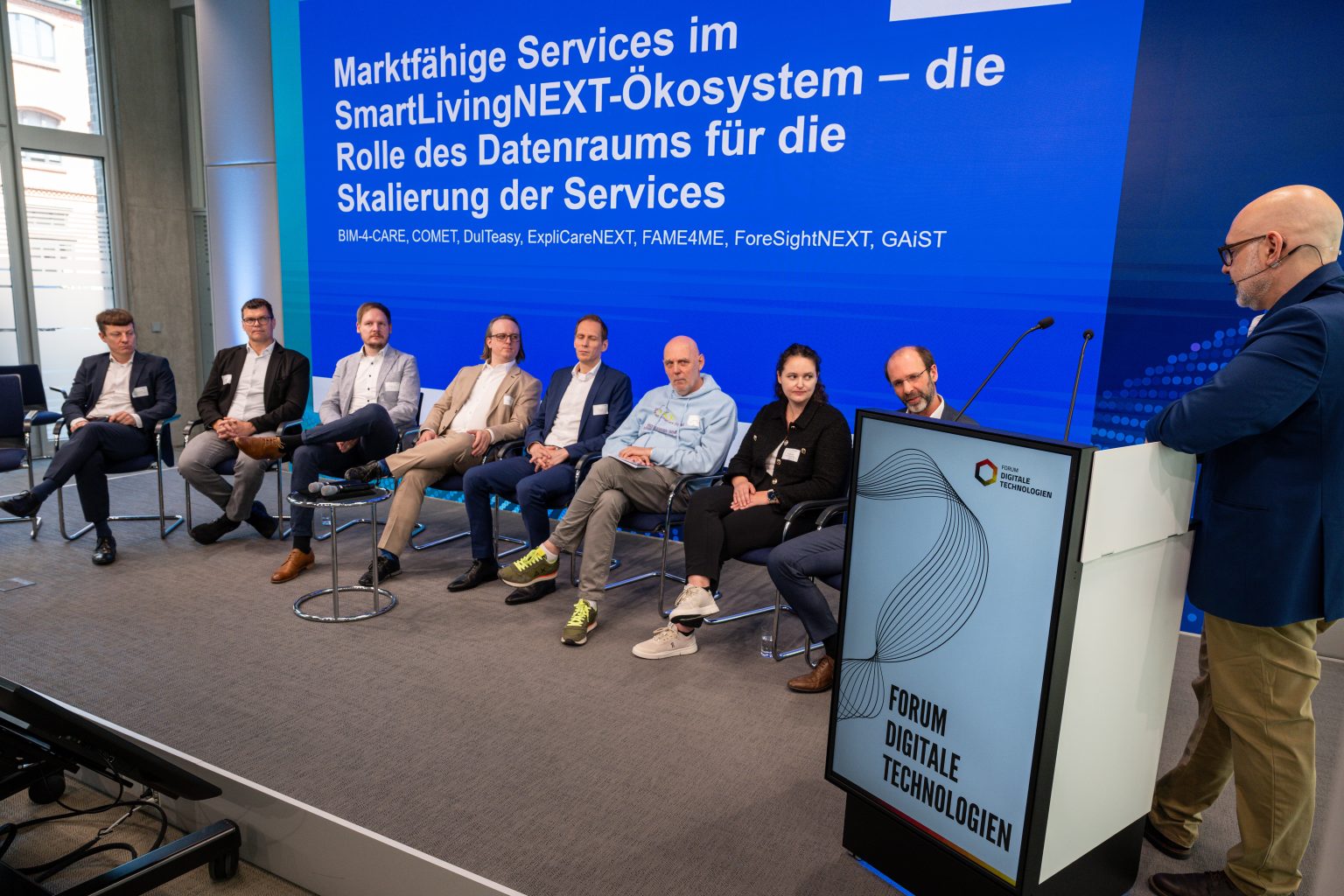
Later in the conference, the satellite projects BIM-4-CARE, COMET, DuITeasy, ExpliCareNEXT, FAME4ME, GAiST, and the flagship project ForrsightNEXT presented their results in a joint panel discussion themed “Market-ready services in the SmartLivingNEXT ecosystem – the role of the data space in scaling services.” Using concrete applications, they explained how data-driven services can emerge from a shared data space. The topics ranged from home adaptations for care needs, digital assistance tools, and preventive risk detection to energy data portals and dynamic electricity pricing. Furthermore, AI agents, XR applications, and new data-driven services for energy, housing, health, and care were showcased.
From Prototype to Operation: Governance, Acceptance, and Business Models
Professor Dr. Johann Kranz (LMU Munich) provided further significant impetus with his presentation, “From Prototype to Operation: Key Levers and Challenges for Acceptance, Governance, and Business Models.” Kranz emphasized that technological feasibility alone is insufficient for successfully bringing digital ecosystems to market. Crucial factors include trust, clear governance structures, and economically viable value propositions for all stakeholders. “The transition from research project to market is determined not merely by technology, but by acceptance, responsibilities, and sustainable business models,” Kranz explained.
Data sovereignty plays a pivotal role, particularly in the smart living sector. Users need to be able to understand how their data is used and the specific benefits digital services offer in their daily lives. “People share data when transparency, control, and tangible added value come together,” Kranz added. He also emphasized the importance of federated structures for future digital ecosystems: “Federated data spaces create the foundation for combining innovation, competition, and data sovereignty.”
Industry Panel: The Market Takes Center Stage
A highlight of the event was the industry panel titled “How to Successfully Enter the Market?” moderated by Bastian Elsner, Managing Director of Elsner Elektrotechnik GmbH. With precise questions, a clear structure, and a strong focus on practical application, he guided the discussion on market mechanisms, governance, and the future operational structure of SmartLivingNEXT. He successfully brought together diverse perspectives from the industrial, housing, skilled trades, and association sectors, highlighting the key challenges involved in transitioning to actual market operation. Together with representatives from these sectors, the panel discussed how to achieve a successful transition from research project to market reality. It became particularly clear that SmartLivingNEXT is neither a new protocol nor a central data repository, but rather a federated, rule-based data infrastructure that connects existing systems while keeping data at its source. “Michael Schidlack sums it up this way: SmartLivingNEXT builds the road, while applications and services do the driving. Once you grasp that, you view the entire discussion in a different light,” said Elsner.
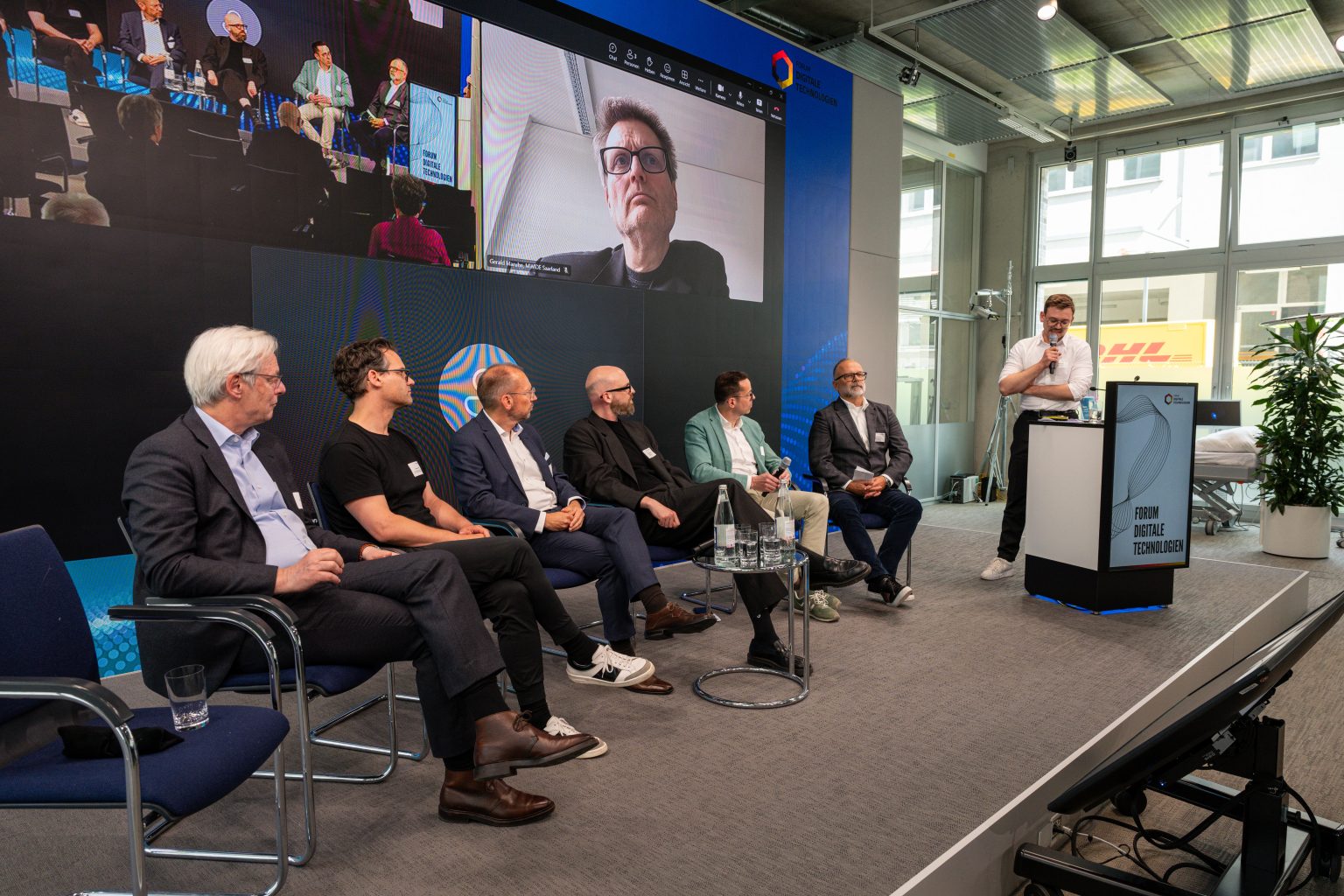
Furthermore, it became clear that the fundamental market shift lies not merely in technical interoperability, but above all in subsequent operations, business models, and governance structures. Anyone who categorizes SmartLivingNEXT solely as a technical issue misses the true driver of change. Panelists also emphasized the importance of interoperable data spaces for the next stage of building digitalization.
Wolfgang Weber contextualized the SmartLivingNEXT approach within the industry: “SmartLivingNEXT represents a relevant structural approach for the next stage of building digitalization. Technical interoperability remains important, but it is not enough. The key lies in the legally secure, consent-based, and economically viable linking of distributed data.” Mike Lange of Smart Home Initiative Deutschland e.V. highlighted the importance of interoperable solutions: “The market is no longer waiting for standalone products, but for integrated services that offer genuine added value.” Sven Schmittbüttner of the Krebs Group also assessed these developments from a practical perspective: “Buildings are increasingly evolving into intelligent service platforms. The crucial step now is to rapidly translate innovations into everyday operations.”
Demonstrator Exhibition: Hands-on SmartLivingNEXT
In the afternoon, the demonstrator exhibition took center stage. Under the motto “Experience – Try Out – Exchange,” visitors tested the developed applications right on site. Using a total of seven demonstrators, the project partners showed how concrete services can emerge from a shared data space. Presentations included AI-powered step-by-step support for care staff, digital assistance tools for assisted living, preventive risk detection, and energy portals with live consumption visualization, as well as AI copilots and XR applications for the buildings and energy systems of tomorrow.
BIM-4-CARE developed an AI-based building model for redesigning home living environments to better suit care needs. COMET demonstrated how secure and sovereign data sharing could function within a data space between households and providers of smart living, energy, and care services. DuITeasy developed assistance services—ranging from emergency detection to heat protection—for assisted living arrangements and neighborhoods. The ExpliCareNEXT project created an AI-based, step-by-step support system for untrained caregivers in home care settings. FAME4ME made energy data immediately actionable through live consumption visualizations and dynamic electricity pricing. The flagship project ForeSightNEXT established the structural and organizational foundations for the entire SmartLivingNEXT ecosystem. GAiST demonstrated preventive risk detection using vital sign and home automation data to support independent living in old age.
Live operations can begin!
In his concluding remarks, Michael Schidlack offered a positive assessment: “Today, SmartLivingNEXT demonstrated what has been achieved through collaboration: a sovereign, legally secure data ecosystem for smart living that integrates technical interoperability, governance, and concrete applications. The next step is crucial: the transition to real-world operation. This is about more than just a project; it concerns the future viability of Germany as a business location and Europe’s technological sovereignty. Important milestones toward this goal were reached today,” said Schidlack. The successful conclusion of the conference made one thing clear: the foundations for an open European smart living ecosystem are in place. Now, the process of scaling up for the market begins.