About SmartLivingNEXT

The Reason Why
The digitalization of living spaces has made enormous progress in recent years. Energy efficiency, safety, comfort and assistance can already be significantly improved today through digital applications. The technical basis for this exists – in new buildings as well as in existing ones. However, the key bottleneck is not a lack of technology, but a lack of connection.
Existing buildings and systems have grown historically, are locally optimized and are usually self-contained. Large amounts of data are generated, but remain trapped in proprietary structures. This means that smart living applications reach their limits where scaling, reuse, cross-sector use or AI-supported services are required. Intelligence remains selective – instead of having a systemic effect.
This is exactly where SmartLivingNEXT comes in.
The aim is to create the structural conditions to ensure that digital smart living services are not only technically feasible, but also economical, secure and widely implementable – in both new and existing buildings. The key to this is universal access to relevant data, regardless of the building technology installed, without the need for additional hardware and while fully preserving data sovereignty.
SmartLivingNEXT is developing a reliable, secure and sovereign access point for smart living data: the SmartLivingNEXT Dataspace. This forms a federated data infrastructure in which data is not collected centrally but remains in its original systems. Access, use and purpose limitation are under the control of the data providers at all times. The underlying concept follows the European Gaia-X approach and enables the interoperable exchange of data across buildings, systems and actors. This does not make individual buildings more intelligent – it makes the overall system in which they interact intelligent.
A key development goal of SmartLivingNEXT is not to replace existing technologies, but to connect them structurally. Each party providing data retains its systems and decides for itself which data is made available in the ecosystem in whole or in part. SmartLivingNEXT also provides a toolbox that simplifies the handling of the dataspace. This includes standardized semantics for smart living data (SENSE WoT), AI-based basic services and open source applications.
The SmartLivingNEXT research program consists of the ForeSightNEXT flagship project, in which the core technology is being developed and tested using our own applications. It is supplemented by six associated research projects that implement exemplary use cases based on the SmartLivingNEXT Dataspace. The result is a broad portfolio of applications that addresses real requirements right from the start. The focus is particularly on use cases in the areas of energy efficiency, assistance, maintenance and home security. These will be raised to a new level by no longer being able to be developed and operated in isolation, but on the basis of a universally usable data infrastructure.
SmartLivingNEXT is expected to be completed in fall 2026. Until then, the technical, organizational and market-oriented framework will be comprehensively researched and documented. The results will create the basis for broad deployment on the market – and for an open smart living ecosystem in which many players can participate.
SmartLivingNEXT project office
Want to learn more? Contact our project office at
E-mail: projektbuero@smartlivingnext.de
Phone: +49 (0)151 14 34 14 17
Der SmartLivingNEXT Dataspace
The SmartLivingNEXT Dataspace is an open, AI-supported data space for the smart living market and its players. Secure, trustworthy and user-friendly smart living services are provided on the Gaia-X-compliant data platform. The SmartLiving Dataspace is made available as a modular blueprint. Interested parties can use their own instance of the Blueprint within the infrastructure also offered in the project or operate the Blueprint or parts of it in their own infrastructure and adapt it as required. The value creation potential remains with the service providers and manufacturers.
The center of SmartLivingNEXT is an open data platform for the smart living market. It is the basis for testing AI methods and intelligent services based on them. We work with open source applications.
The dataspace contains standardized, semantic data models that are accessible to all participants via interfaces. SmartLivingNEXT projects can bundle their needs for smart living sensor data and merge and share available data sources from different sources across projects via the SENSE WoT standard in accordance with the GDPR and the EU Data Act.
We mirror the real existing environment in the form of a virtual copy. This ensures technical stability and reliability.
The flagship project and the dataspace follow the role model developed in the Gaia-X community and implement it for the smart living ecosystem. In doing so, we are setting the course for a secure, trustworthy cloud infrastructure and following the basic principles of Gaia-X.
The SmartLivingNEXT Toolbox
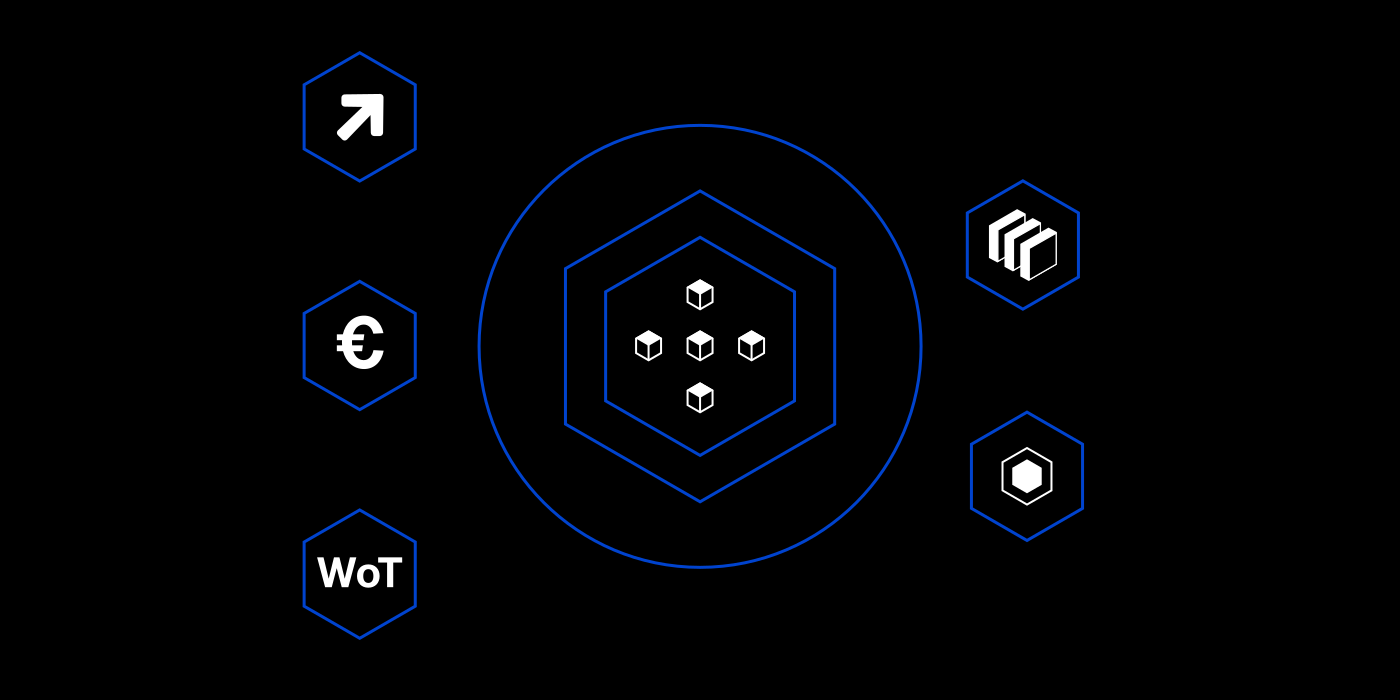
The SmartLivingNEXT Toolbox contains tools and technological foundations for semantic interoperability, data quality and the development of AI methods for data preparation and analysis. Intelligent services based on this can run across all manufacturers in all digitalized buildings. This also enables new business models, for example in the areas of energy management, building automation or management as well as health and care. The SmartLivingNEXT Toolbox provides basic services for the implementation of standardized data pipelines, e.g. for data acquisition, activity recognition, mapping and classification, semantic search and machine learning.
These include services for the implementation of standardized data pipelines, e.g. for data acquisition, activity recognition, mapping and classification, semantic search and machine learning as a basis for the application of AI-based solutions.
The project is based on existing ecosystems, e.g. from the Gaia-X environment, and examines suitable business models, roles and specific applications in a smart living ecosystem. The aim is to develop a viable and scalable business model for platform operators and providers of smart living services.
ML pipelines offer a scalable workflow of data preprocessing, training, evaluation and deployment. ML models are provided, described and versioned in a model registry.
Use of connector plugins for the most widely used system solutions (legacy) in the smart home and smart building sector, for example plugin for the open source system “Home Assistant”.
In the SENSE research project, the WoT (Web of Things) standard was further developed in SENSE WoT in order to map the information required in the context of a building (e.g. locations). SENSE WoT enables the interoperability of commercially available devices and systems from different manufacturers.
The SmartLivingNEXT Community
A digital ecosystem can secure the competitive advantage for European industry in the smart living sector. This is why the integration and cross-sector networking of various partners from the housing sector, associations, industry and science is a key feature of SmartLivingNEXT. Together, the numerous players involved in building a platform regardless of the manufacturer are strengthening Germany as a business location. The SmartLivingNEXT community is the largest national network for research in the field of smart living and is constantly expanding with new partners. Market and acceptance barriers to AI-based applications are being eliminated in SmartLivingNEXT through coordinated cross-industry collaboration. SmartLivingNEXT projects can, for example, test newly emerging use cases in the flagship project’s demonstration environment and present them to a larger audience.
Manufacturers and organizations from the housing sector, industry, research and their associations are participating in SmartLivingNEXT as consortium and associated partners over the three-year project period.
The demonstration of a sustainable living environment can take place on different levels through the interaction of virtual reality (virtual sensors and locations) and physical reality (actual sensors and locations). In virtual reality, complex living environments can be visualized by combining location-based building and sensor data across buildings and analysing it in virtual data rooms.
In the flagship project, data guidelines for the collection, storage, processing and destruction of data will be developed and offered to the SmartLivingNEXT projects. The flagship project forms an organizational steering committee with the projects as well as a technical steering committee for joint coordination. Workshop series on various topics are organized.
Focus groups
Focus groups ensure that participants in the data ecosystem have the opportunity to actively shape the content of their work. They represent the content-related and technical cooperation format for the operational work of the flagship project and SmartLivingNEXT projects. They cover the cross-cutting topics of “Dataspace / Dataspace Governance”, “Semantics and AI”, “Market conformity and data economy”, “Project coordination/testing environments”, “User perspectives” and “Communication”.
The aim of the focus group is to align the SmartLivingNEXT platform with the needs of satellite and community projects and to create technological governance for the platform. To this end, requirements for the platform and application life cycle management are collected collaboratively. The focus group examines implementation concepts and discusses change requirements. Participants are expected to be willing to familiarize themselves technologically with the various components of the SmartLivingNEXT data room and the technological standards, in particular the Gaia-X services. The results of the focus group have a significant influence on the further development of connectors and plugins.
Management
Andreas Schulz-Dieterich, Materna SE
Deputy: Thomas Feld, Materna SE
Organization
Planned meetings: 4 x per year, 2 to 3 hours, online.
The semantics and AI focus group serves to clarify the need for semantic technologies and AI. It is worked out whether semantics are openly accessible and established for the domains. Based on this, we work out which tasks are to be solved with AI, which data is available in which quality and what the typical AI methods are. The focus group evaluates the requirements and available data and derives requirements for AI services and semantic descriptions. Results are semantic descriptions, evaluation of data for AI methods, method and effort estimates for AI services, assessment of basic AI services.
Management
Hilko Hoffmann, DFKI
Substitute: Ingo Zinnikus, German Research Center for Artificial Intelligence (DFKI)
Organization
Planned meetings: 4 x per year, 2 hours, online
The focus group deals with the topics of user behavior and acceptance in the smart living ecosystem, the realization of successful business models and the design of governance structures and mechanisms that are sustainable in the long term. The aim is to discuss specific issues and objectives together and to evaluate implementation options. Workshops on the above-mentioned topics are planned, in which the interests of the stakeholders involved are identified, experiences are shared and joint discussions – also with experts from practice and science – take place. In the workshops, participants are encouraged to contribute their current challenges and objectives. The results are then documented in writing so that they are available to the project network and can be incorporated into the final papers.
Management
Dr. Rahild Neuburger, LMU
Substitute: Dr. Anne Ixmeier, LMU
Organization
Planned meetings: 4 x per year, 2 hours, online
The project coordination focus group supports the satellites with administrative issues and general organization. Training is planned on the use of the support and collaboration tool provided and on the provision of documents and documentation. A further aspect is the clarification of the need for the contractual basis in the area of (mutual) data use and provision and the planning and participation in joint events with an external impact and, if necessary, trade fair appearances, in each case as a distinction from or supplement to tasks in the context of accompanying research. In addition, requirements for the operation of joint or technology program-spanning demonstrators and laboratories are discussed and any related planning is coordinated. The aim is to establish an orderly project process with clearly defined roles between satellite partners, flagship project and accompanying research, which can also participate as a guest. The meetings are recorded and then made available to the entire technology program to support its activities. The target group is primarily those responsible for the consortium management of the satellite projects, who are required to implement the findings in their own funding program, as well as those responsible for the accompanying research.
Management
FE-ZVEI, Michael Schidlack (project management flagship project) and Dr. Birgit Fröhler (project office management).
Organization
3-4 times a year for approx. 90 minutes with decreasing frequency towards the end of the project. Meeting format: Online, but also as a face-to-face meeting by special invitation if required. External experts may be admitted on request for specific topics.
In this focus group, the emphasis is on the needs and requirements of users who help to develop applications through their tests and feedback during the project and who should use them later. The aim is to raise awareness of the different perspectives of professionally motivated users, intrinsically motivated private users and users who are not necessarily motivated.
Aspects during the project term include appreciative communication with testers, their motivation and support, but also the development and communication of an exit strategy. Topics such as ethics, trustworthiness, non-discrimination, accessibility and legal framework conditions are relevant in all phases.
We invite the project partners from the satellite projects to jointly discuss and evaluate their potential applications with regard to the points mentioned above.
Management
Birgid Eberhardt, GSW Sigmaringen mbH
Organization
Planned meetings: 4 x per year, between 1 and 3 hours, online.
The communication focus group is an interaction and working format for the public relations work of the SmartLivingNEXT projects and the accompanying research. The aim is to increase awareness of the technology programme among the smart living community, the leading media and politicians, as well as to transfer knowledge of the research results obtained in the projects to companies, research institutes, associations and organizations. Based on an already defined communication strategy, measures are developed, in particular for social media, the SmartLivingNEXT newsroom and participation in public events. Participants are encouraged to submit structured proposals relating to their own project. The results are recorded in an editorial plan.
Management
Maximilian Metzner, FE-ZVEI
Organization
Planned meetings: 2 x per year, 2 to 3 hours, online.