More sustainable use of resources through AI in smart homes
8. October 2024
Reading time:
2 minutes
Comet at Computer Science Festival 2024
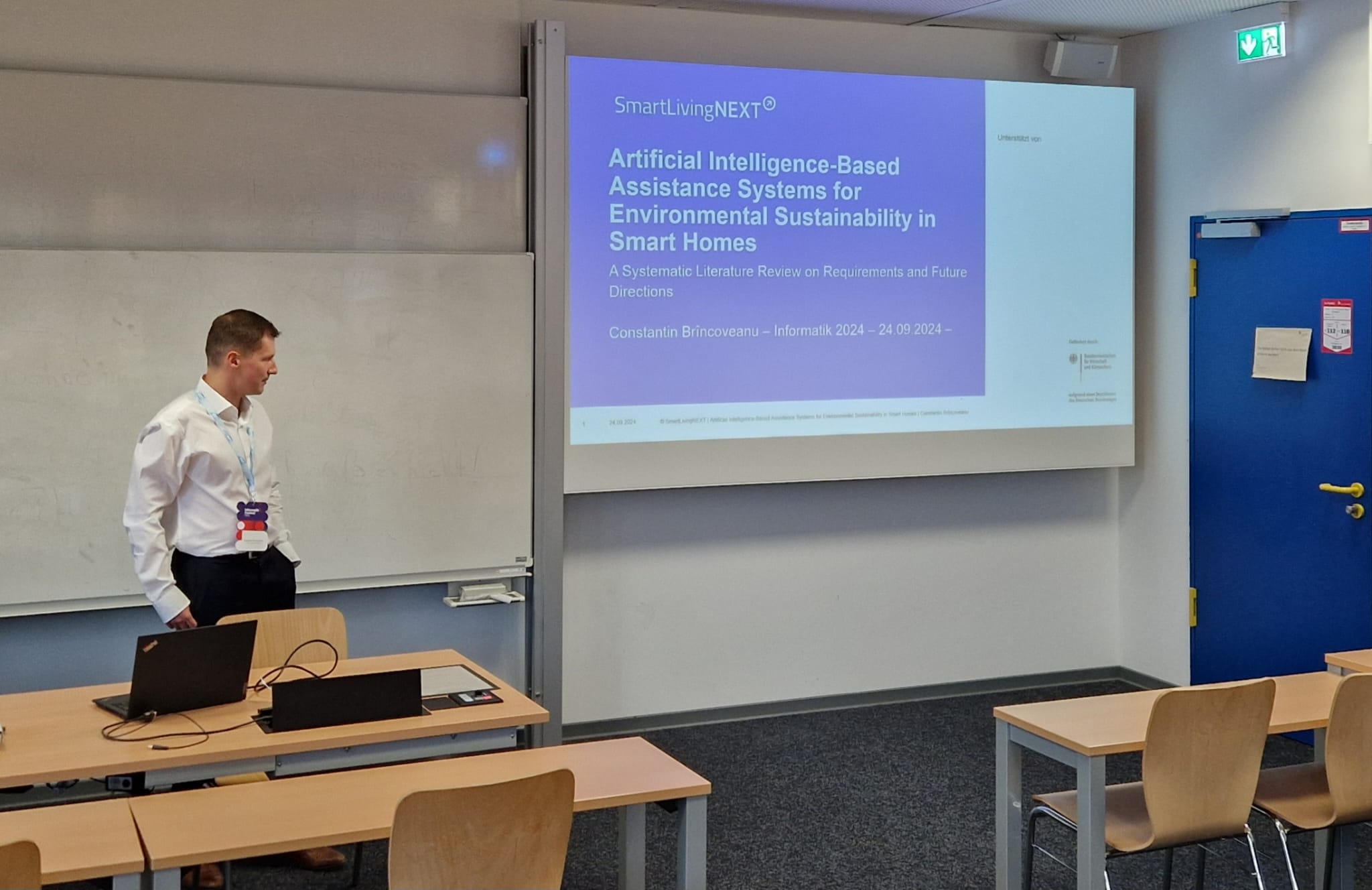
In September, the COMET team from Goethe University Frankfurt and German Research Center for Artificial Intelligence (DFKI) successfully presented their research at the Computer Science Festival 2024, which took place this year at RheinMain University of Applied Sciences in Wiesbaden. Constantin Brîncoveanu presented the paper “Artificial Intelligence-Based Assistance Systems for Environmental Sustainability in Smart Homes”, which was developed as part of SmartLivingNEXT.
The paper examines how AI-based systems in private households can contribute to a more sustainable use of resources. Based on the analysis of 60 scientific papers, key patterns were identified, including predictive analytics, real-time monitoring, data protection, personalized user interactions and strategies to increase energy efficiency. These technologies offer potential for a more sustainable use of resources in smart homes and promote user acceptance through targeted adaptations.
The well-received presentation led to an exciting discussion about the application of these samples in industry. The feedback gained provides valuable impetus for further research into sustainable assistance systems for smart homes.
You can download the paper “Artificial Intelligence-Based Assistance Systems for Environmental Sustainability in Smart Homes” here download.
Listen to the article (in German)
Editorial office:
Anita
Walcher
Category:
COMET
SmartLivingNEXT

Central documents for SmartLivingNEXT
The white paper contains the guideline and reference framework for the future technical development of the SmartLivingNEXT Dataspace and the desired governance structure. It was created with the collaboration of teams from German Research Center for Artificial Intelligence (DFKI), the Research Association for Electrical Engineering at ZVEI e.V., Ludwig-Maximilians-Universität München (LMU) and Materna Information & Communications SE. You can have the white paper sent to you as a PDF. Please contact our project office at projektbuero@smartlivingnext.de.
The document is intended as a structuring investor perspective and orientation framework, not as a final business plan, and analyzes the possible roles of potential investors. It was written in collaboration with Michael Schidlack, Research Association for Electrical Engineering at ZVEI e.V., Dr. Rahild Neuburger, Ludwig-Maximilians-Universität München (LMU) and Lars Thomsen, future matters AG. You can have the document sent to you as a PDF. Please contact our project office at projektbuero@smartlivingnext.de.
Das Dokument erläutert im ersten Teil (Governance & Organisation) SmartLivingNEXT als föderiertes Datenökosystem und beschreibt die Rollen, Verantwortlichkeiten und Entscheidungslogiken. Der zweite Teil (technische Architektur & Datenraum) beschreibt, wie diese Governance technisch umgesetzt wird. Es entstand unter Mitwirkung von Michael Schidlack, Forschungsvereinigung Elektrotechnik beim ZVEI e.V., Dr. Rahild Neuburger, Ludwig-Maximilians-Universität München (LMU) und Fanni Vespermann, Materna Information & Communications SE. Sie können sich das Dokument als PDF zusenden lassen. Please contact our project office at projektbuero@smartlivingnext.de.